
OOBThaiAmulets
Por Sala Tan
Por Sala Tan
Couldn't load pickup availability
PST07
Lersi Samadhi
Por Sala Tan
2 Inches
Mainstream Artifact
Individual Craftsmanship
Each traditionally cast piece naturally carries variations in its surface, patina, casting marks and form. These characteristics are part of its individual craftsmanship and should not be expected to appear perfectly uniform.
Personal Experiences Shared by Luksits
Por Sala Tan was known to travel and maintain contact with other masters and fellow practitioners. These meetings were not simply social visits. They provided opportunities to exchange experiences, discuss spiritual practices and share knowledge of different Wicha.
Sacred materials and objects were also sometimes exchanged out of mutual respect. Por Sala Tan would give suitable materials or objects from his own practice, while other practitioners would likewise present him with pieces connected with their traditions.
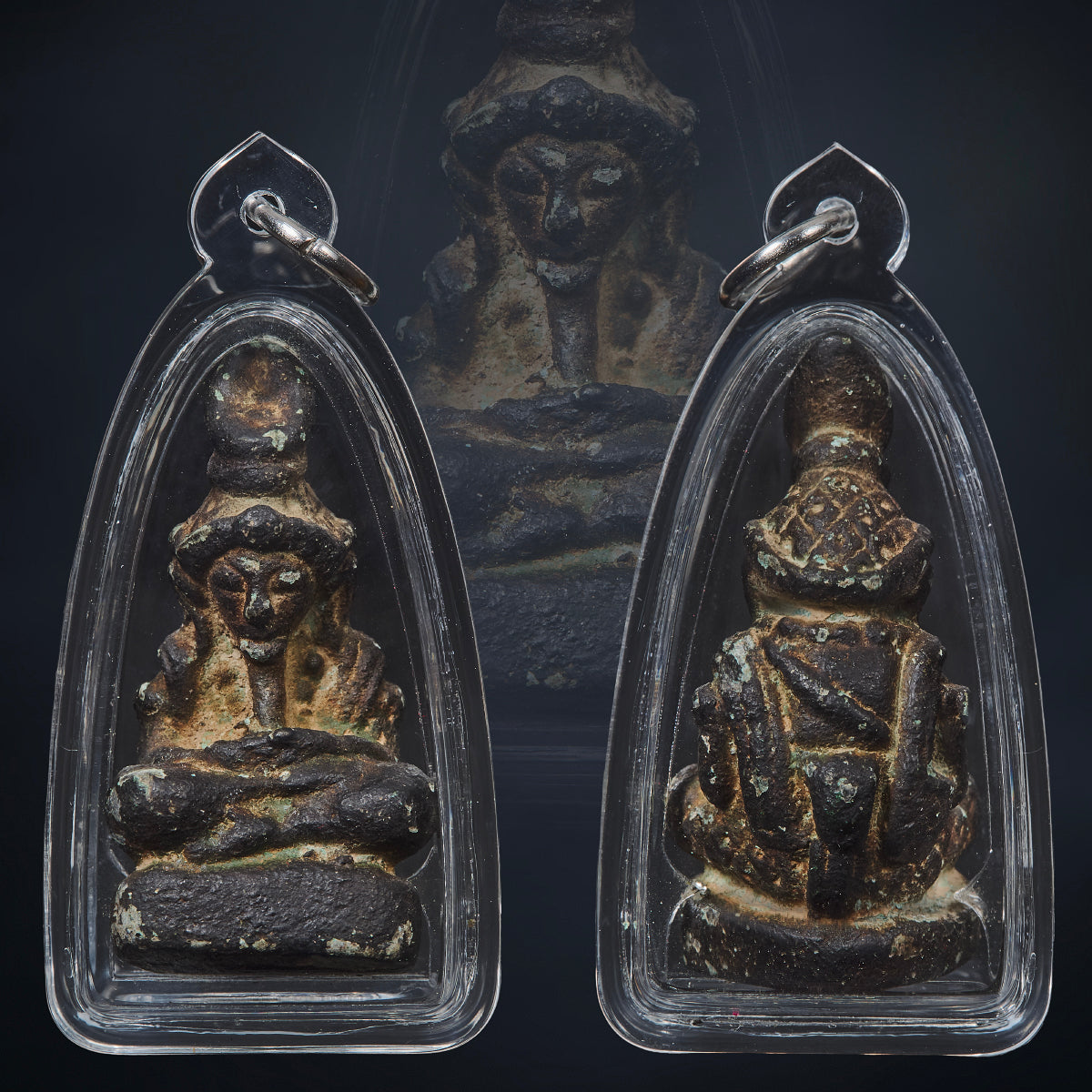
This Lersi Samadhi Roop Lor was one such gift.
For luksits, objects of this nature carry an additional meaning beyond their physical form. They recall the relationships between practitioners and the older tradition in which knowledge, materials and sacred objects could pass personally from one practitioner to another.
Summary
Lersi Samadhi represents the hermit-sage in a state of deep meditative concentration.
The word Lersi, related to the Sanskrit Rishi, refers to the ancient hermit or sage. Within Thai sacred traditions, Lersi are associated with meditation, knowledge, healing, herbs, traditional sciences and various branches of Wicha.
Samadhi refers to collectedness and deep concentration — a state in which the mind becomes increasingly still and focused.
Together, the image of Lersi in Samadhi represents something particularly important: power arising through stillness rather than force.
For practitioners and devotees, the image can therefore serve as a reminder to remain composed, observant and mentally steady before making important decisions.
Historical Background
Lersi occupy a distinctive position within Thai spiritual culture. Their origins connect with the much older Indian concept of the Rishi — ascetics and sages who withdrew from ordinary worldly life in pursuit of knowledge and spiritual cultivation.
Over centuries, the Lersi became incorporated into Thai religious and esoteric traditions.
They are particularly associated with teachers and the transmission of knowledge. For this reason, Lersi imagery frequently appears within Wai Kru traditions, where respect is offered to teachers, lineage holders and those responsible for preserving particular branches of knowledge.
Different forms of Lersi may represent different qualities or Wicha. The meditating form places particular emphasis upon Samadhi, wisdom and disciplined cultivation of the mind.
Origins of the Materials
Unlike many Por Sala Tan pieces that were personally constructed from combinations of sacred materials, this Roop Lor began as an existing sacred object.
It came to Por Sala Tan through his relationship with another practitioner.
Such exchanges were part of a wider culture among practitioners who travelled, visited one another and shared materials. An unusual relic, casting, sacred powder, herb or ritual object might be given to another practitioner who was considered capable of understanding or continuing its spiritual purpose.
The provenance of this piece is therefore closely connected with friendship between practitioners and the exchange of Wicha.
Ritual
The seated posture represents Samadhi — sustained concentration and inner stillness.
Within traditional understanding, advanced meditation is regarded as an important foundation for many forms of spiritual practice. Before knowledge can be properly applied, the practitioner must first learn to control distraction, emotion and intention.
Traditional accounts sometimes attribute extraordinary attainments, known as Abhinna, to highly accomplished meditators. These may include forms of heightened perception or other unusual abilities. Such descriptions belong to Buddhist and regional religious traditions and should be understood within that spiritual context rather than as scientifically established abilities.
For the devotee, the more immediate lesson of the Lersi Samadhi is simpler:
Still the mind before acting.
Blessings and Effects
Within Thai folk and practitioner traditions, Lersi Samadhi is associated with several qualities:
- Wisdom and mindfulness — supporting clear thought and careful judgement.
- Samadhi — encouraging concentration, patience and emotional steadiness.
- Baramee — cultivating dignity, presence and the respect of others.
- Protection — traditionally associated with guarding against harmful influences, obstacles and negative spiritual conditions.
- Metta Maha Niyom — connected with goodwill, harmonious relationships and favourable interactions.
- Knowledge and Wicha — particularly meaningful to those studying traditional practices or working under a teacher and lineage.
Modern Application
The symbolism of Lersi Samadhi remains surprisingly practical in modern life.
For someone working in business or a demanding profession, the emphasis is not simply upon attracting opportunities. It is also about possessing sufficient calm to recognise which opportunities should actually be pursued.
For those managing people, negotiating contracts or facing difficult situations, the Lersi's meditative posture can serve as a reminder not to react immediately under pressure.
For practitioners, it carries another meaning: knowledge without discipline is incomplete.
The Lersi therefore represents the continual cultivation of wisdom, concentration and respect for one's teachers.
Physical Details
An old hand-cast Lersi Roop Lor depicting the hermit-sage seated in Samadhi, produced through a traditional mould-and-pour casting technique. The aged metal displays a naturally darkened patina with areas of oxidation and surface variation, while the casting retains a distinctly handmade character. The figure wears the characteristic Lersi headdress and sits upon a raised base in meditation. The reverse retains traditional details and markings from the original casting. The piece is now preserved within a clear protective casing.
Recommended Pairing
Lersi Samadhi may be paired with sacred objects associated with Metta Maha Niyom, Baramee, wisdom, protection or professional advancement.
It can also sit naturally alongside another Lersi image representing a more active Wicha. In such a pairing, Lersi Samadhi symbolically provides the quieter foundation — concentration and wisdom — while the accompanying piece represents the particular quality being cultivated.
Personal Notes
What makes this piece meaningful is not elaborate construction or the number of sacred materials contained within it.
It is the story of how it reached Por Sala Tan.
Por Sala Tan's journeys brought him into contact with many practitioners. They met, exchanged knowledge, discussed experiences and occasionally entrusted one another with objects from their own traditions.
This Lersi Roop Lor was one of those gifts.
For me, that gives the piece a particularly appropriate connection with Lersi Samadhi. The Lersi represents the pursuit and preservation of knowledge, while the history of the object itself reflects how traditional knowledge was often transmitted — from teacher to practitioner, and from one practitioner to another, through respect, trust and shared Wicha.
-
Free Shipping for Singapore| $15 Worldwide | $60 USA For Items Below $350