
OOBThaiAmulets
Por Sala Tan
Por Sala Tan
Temple-sourced certified artifacts since 2005. Questions before you buy? WhatsApp us at +65 9155 7000.
Couldn't load pickup availability
PST07
Si Peng Maha Saneh
Por Sala Tan
1 Inch
Mainstream Artifact
Individual Craftsmanship
The containers were carved individually from selected natural branches and filled by hand, variations in wood grain, shape, internal arrangement and the quantity and appearance of the Si Peng are natural to each artifact.
Personal Experiences Shared by Luksits
Among Por Sala Tan's luksits, Si Peng was regarded as a practical form of Metta and Saneh wicha because it could be used when a person specifically needed to meet, speak with or gain the goodwill of others.
Followers traditionally applied a small amount before situations in which personal interaction mattered — meeting customers, discussing business, negotiating, asking someone for assistance or entering an important social setting.
One of its commonly described purposes was speech.
Luksits regarded the Si Peng as supporting Metta around one's words: helping a person to be listened to, received more warmly and communicate with greater ease. For those working in sales or customer-facing businesses, this naturally extended to conversations with customers and prospective clients.
Others did not regularly apply the Si Peng at all. They simply carried the complete Mai Rak container with them as a Metta artifact, keeping the Phra Ngan, Yin Tong, takrut and old Si Peng preparation together.
Summary
Por Sala Tan's Si Peng Maha Saneh combines sacred wood, forest herbs, old Si Peng, Phra Ngan, Yin Tong and takrut wicha within one compact artifact.
Its construction begins with Mai Rak, specifically a selected upward-pointing branch traditionally associated with growth and the auspicious meaning of rak — love and fondness.
The hollowed wooden container is then filled with Por Sala Tan's old Si Peng preparation.
This Si Peng was not described as something mixed once for a single batch. It came from an older continuing concoction that Por Sala Tan had been preparing, mixing and developing over time, incorporating Maha Saneh herbs gathered from deep forest areas.
Small Phra Ngan and Yin Tong figures were subsequently placed into the preparation, together with a takrut directed towards increasing likeness, charm and favourable reception.
The result could be used in two ways: the Si Peng itself could be applied when required, or the entire container could simply be carried as a personal Metta Maha Saneh artifact.
Historical Background
Si Peng belongs to an old family of ritual powders, pastes and preparations used within Thai and regional wicha concerned with Metta Maha Niyom and Maha Saneh.
Such preparations are closely associated with social interaction. Their traditional purpose is not limited to romantic attraction. Metta can encompass being treated kindly, gaining goodwill, being remembered positively and encountering greater receptiveness when dealing with other people.
Maha Saneh places greater emphasis upon personal attraction and presence.
For Por Sala Tan, these ideas were frequently expressed through combinations of natural materials, sacred herbs, oils, powders, takruts and symbolic figures rather than through one ingredient alone.
This particular preparation reflects that approach particularly clearly.
The Mai Rak container establishes the Metta symbolism, while the old Si Peng provides the principal herbal preparation. Phra Ngan and Yin Tong add further Saneh symbolism, and the takrut directs the completed artifact towards increased personal favour and charm.
Origins of the Materials
The Si Peng was prepared from sacred Maha Saneh herbs collected from deep within forest areas and incorporated into Por Sala Tan's older mixture.
The container itself came from Mai Rak, with luksits specifically tasked to search for the appropriate tree and obtain wood from its highest upward-pointing branch.
This selection was deliberate.
Mai Rak carries an immediate linguistic association with rak — love, affection and fondness — and is traditionally connected with Metta Maha Niyom and charm work.
Inside the hollowed wood was placed Por Sala Tan's old Si Peng concoction. A miniature Phra Ngan, Yin Tong and a dedicated charm takrut were subsequently embedded into the preparation.
Each component therefore contributes towards the same central purpose rather than being included merely for decoration.
Ritual
Preparation began before the Si Peng was placed inside.
Luksits first had to locate the appropriate Mai Rak tree. Rather than taking wood indiscriminately, they were instructed to select the branch growing highest and pointing upwards.
The chosen branch was brought back and worked by hand into a small hollow container.
Por Sala Tan then gradually filled the cavity with his old Si Peng Maha Saneh preparation, made from selected sacred herbs and material accumulated through his continuing practice.
The Phra Ngan and Yin Tong were inserted directly into this mixture.
A takrut specifically prepared for increasing likeness and charm was added alongside them before the container was completed.
The construction consequently creates several layers of the same wicha:
Mai Rak for affection and Metta.
Si Peng for Maha Saneh.
Phra Ngan and Yin Tong for attraction.
Takrut for increased likeness and favourable reception.
Blessings and Effects
Within Por Sala Tan's practice, this Si Peng is traditionally associated with:
- Metta Maha Niyom — goodwill and being favourably received.
- Maha Saneh — attraction and personal charm.
- Jeraja — smoother speech and communication.
- Increased likeness — encouraging others to feel comfortable and receptive.
- Customer relations — traditionally useful for sales and service work.
- Negotiation — supporting favourable conversations and agreements.
- Social presence — being noticed, remembered and approached positively.
- Relationship harmony — encouraging warmth and affection between people.
The emphasis of this particular preparation is therefore strongly upon human interaction, speech and favourable personal presence.
Modern Application
The Si Peng was traditionally intended to be used when needed rather than excessively applied.
A small amount could be used before an important meeting, sales discussion, negotiation or other situation where the wearer wished to strengthen Metta and favourable communication.
Its association with speech makes it particularly suitable within the tradition for people whose work depends heavily upon communication — salespeople, business owners, agents, negotiators and customer-facing professionals.
However, physical application is not necessary for every keeper.
The complete wooden container can simply be carried on the person as a Metta artifact. In this form, the Mai Rak wood, Si Peng, Phra Ngan, Yin Tong and takrut remain together as one complete sacred object.
Physical Details
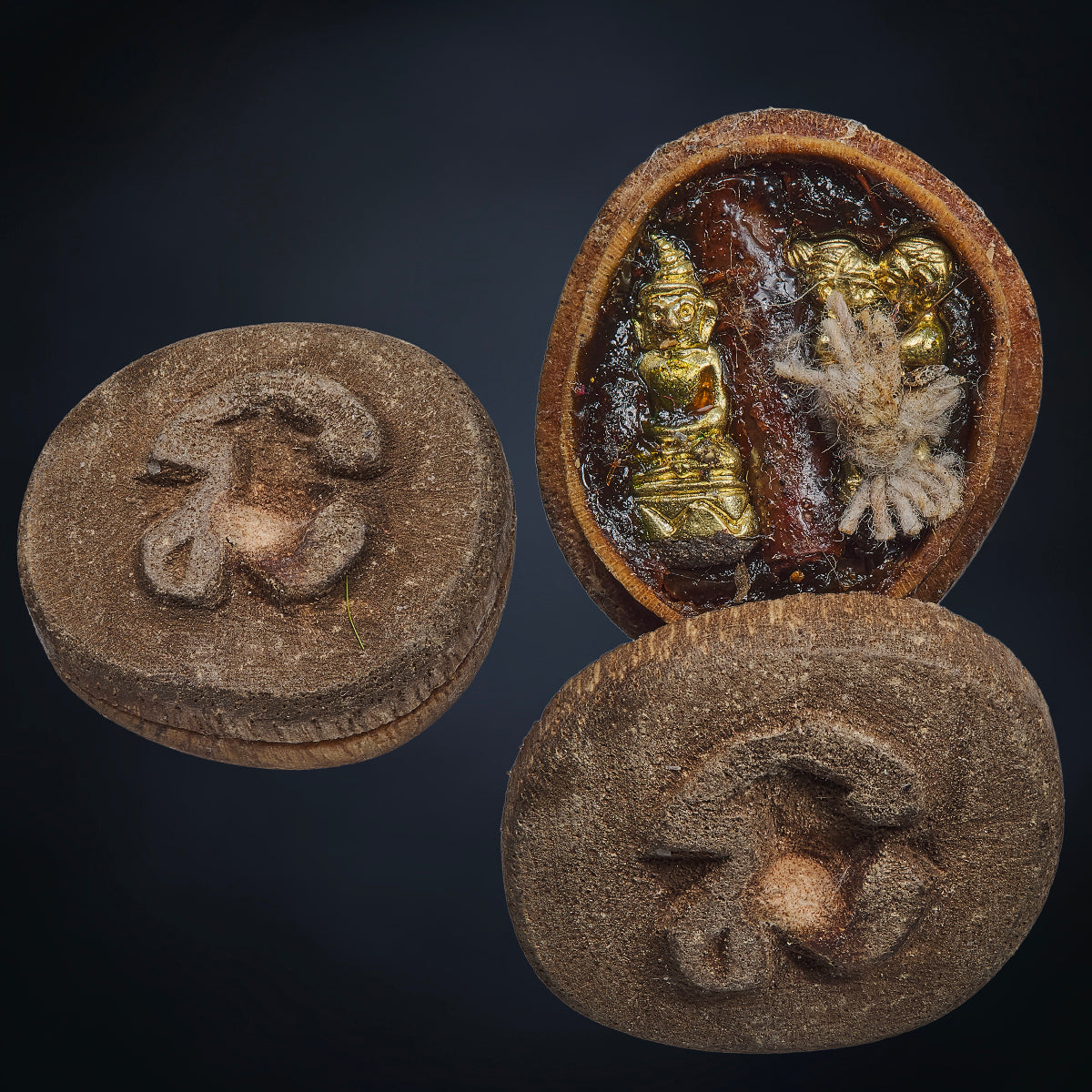
The artifact is formed from a small section of Mai Rak wood, hollowed to create a natural round container with a fitted wooden cover. The exterior retains the grain, texture and earthy character of the original branch rather than being heavily finished.
Inside is Por Sala Tan's dark, aged Si Peng Maha Saneh preparation. Embedded directly within it are a small golden Phra Ngan and Yin Tong, together with the charm takrut and other prepared material. Sacred thread remains visible within the mixture.
The underside and cover retain the handmade character of the original Mai Rak wood, making each container naturally different in its proportions, grain and surface.
Recommended Pairing
The Si Peng Maha Saneh is already a concentrated Metta and Saneh artifact, so it does not require complicated pairing.
For business use, it can be kept together with a Riak Sap or Maha Lap artifact, combining favourable personal interaction with wealth and incoming opportunities.
For someone whose livelihood depends heavily upon speaking and persuasion, a Jeraja or Metta Maha Niyom takrut provides a natural complement.
It can also simply be carried alone. The combination of Mai Rak, old Si Peng, Phra Ngan, Yin Tong and the charm takrut already gives the piece a complete purpose.
Personal Notes
What I find particularly interesting about this Si Peng is that even the container was part of the wicha.
Por Sala Tan did not simply prepare the Si Peng and place it into any available box.
His luksits were tasked to find a Mai Rak tree and specifically select its highest upward-pointing branch. They then had to carve the small containers themselves before Por Sala Tan gradually filled them with his old Si Peng concoction.
That old mixture is also important. It was something he had been mixing, maintaining and developing over time, using Maha Saneh herbs gathered from deep within the forest.
Only after the Si Peng had been placed inside were the Phra Ngan, Yin Tong and charm takrut added to strengthen the preparation further.
For me, this makes it a very characteristic Por Sala Tan artifact. What appears externally to be a simple piece of carved wood actually brings together sacred natural material, old herbal preparation, handwork and several branches of Metta Maha Saneh wicha within one small container.
-
SG: Free | Worldwide except USA: $20 Registered | USA: $25 Registered / $100 Courier (SGD)