
OOBThaiAmulets
Por Sala Tan
Por Sala Tan
Couldn't load pickup availability
PST07
Yant Maha Baramee
Por Sala Tan
4.5cm
Barang Artifact
Individual Craftsmanship
Each artifact was individually prepared by hand. Natural differences in the relic, soil, inscriptions, lead covering and Sai Sin therefore give every surviving piece its own appearance and character.
Personal Experiences Shared by Luksits
Luksits who have carried artifacts prepared from these particular grave materials have spoken mainly about changes involving business, customers and interpersonal dealings.
Shopkeepers have described business becoming noticeably more active, with customers coming more regularly and transactions proceeding more smoothly than before.
Salespeople and those whose work requires regular negotiation have shared another recurring observation: people seemed more approachable and understanding. Customers were sometimes more willing to listen, discussions became less confrontational, and agreements could be easier to move forward.
Others associated the artifact with meeting helpful people at the right moment or receiving cooperation from individuals who were previously difficult to approach.
Within Por Sala Tan's practice, such experiences are traditionally connected with Baramee, Metta Maha Niyom, Maha Saneh and wealth-drawing wicha. They are personal accounts rather than guaranteed outcomes.
Summary
This artifact was created from materials originating from an unmarked coffin accidentally uncovered in agricultural land.
A villager was ploughing his field in preparation for planting when the buried coffin was discovered. With no surviving grave marker and no clear identification of the deceased, the villager contacted Por Sala Tan rather than disturbing the burial further.
Por Sala Tan was asked to conduct the appropriate funeral rites and cremation for the deceased.
According to the account preserved with these pieces, Por Sala Tan communicated with the spirit associated with the coffin and requested permission to retain a small amount of the relic and burial materials. These would subsequently be transformed into sacred artifacts, with merit from their use and associated religious practice dedicated back to the deceased.
For this particular piece, Por Sala Tan chose the Yant Maha Baramee as its principal yantra.
Historical Background
Maha Baramee can be understood in the context of barami—a concept associated with accumulated virtue, spiritual stature and the personal authority that arises from cultivated merit.
Within Thai sacred and occult traditions, the idea extends beyond simple dominance over others. Baramee carries the sense of a person possessing sufficient moral or spiritual presence that others naturally recognise, respect or support them.
When incorporated into yantra practice, Yant Maha Baramee is consequently associated with qualities such as personal authority, respect, favourable recognition, leadership and assistance from others.
Por Sala Tan's version combines this Baramee principle with wealth wicha and spirit-associated grave materials, giving the artifact a broader emphasis on livelihood, opportunity and human relations.
Origins of the Materials
The materials began with the accidental discovery of an old burial.
While ploughing agricultural land in preparation for planting, a villager uncovered an unmarked coffin beneath the field. The burial appeared to have been forgotten over time, with the surrounding land eventually returning to agricultural use.
Rather than simply removing the remains, the villager sought Por Sala Tan's assistance.
Por Sala Tan attended the site and performed the appropriate rites for the deceased. According to the account accompanying the artifact, communication with the spirit took place before any material was retained.
Permission was requested to keep a small quantity of the relic and earth lying beneath the coffin. These materials could then be used in sacred works, while merit generated through prayers, offerings and good deeds could continue to be dedicated to the deceased.
This is important to the provenance of the piece. The earth incorporated into it was not ordinary cemetery soil collected generally from the grounds; it was specifically soil recovered from beneath the coffin.
Ritual
After the deceased had received the necessary funeral and cremation rites, Por Sala Tan prepared the retained materials for sacred use.
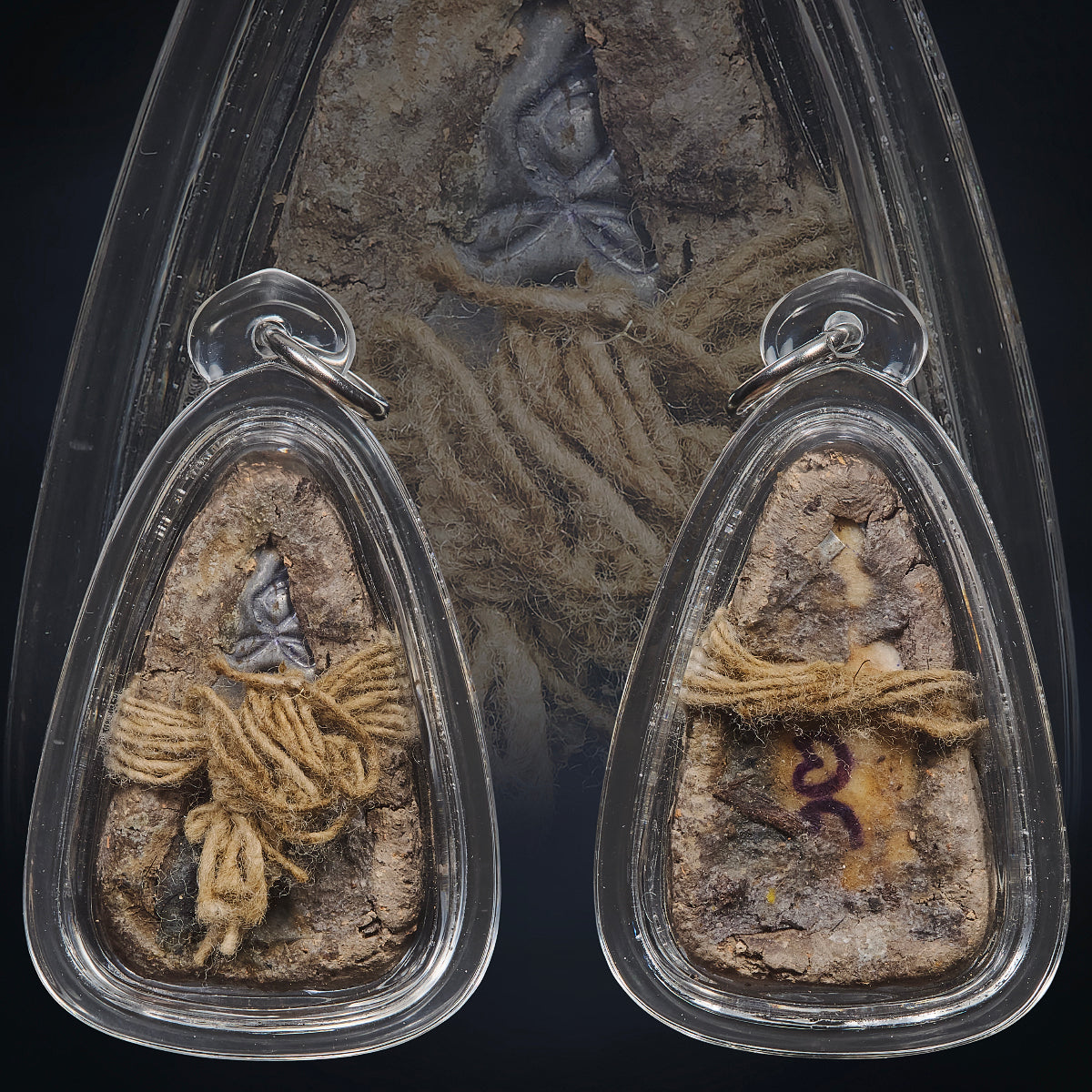
The Yant Maha Baramee was drawn directly onto the relic by hand.
A second formula concerned specifically with wealth was inscribed onto a sheet of lead. This was fitted around portions of the reverse and sides, allowing the metal sheet to serve both as a physical covering and as the carrier of the wealth yantra.
Soil from beneath the original coffin was then incorporated around the sides of the relic.
Finally, Sai Sin was wound and tied around the artifact, bringing the relic, grave earth and inscribed metal together as a single completed piece.
Blessings and Effects
The construction combines several traditional purposes rather than relying upon a single formula.
Yant Maha Baramee forms the principal element and is traditionally associated with personal standing, respect, authority and receiving favourable assistance from others.
The wealth yantra introduces the commercial aspect—business movement, opportunities, customers and the circulation of money.
The soil from beneath the coffin belongs to Por Sala Tan's spirit-related practice. Within folk-occult traditions, such earth can carry ideas of spiritual guardianship, boundaries, protection and the concentrated association between a spirit and its former resting place.
The artifact is therefore traditionally associated with Baramee and personal authority, Metta Maha Niyom, Maha Saneh, business and trade, Riak Sap or wealth attraction, Choke Lap or favourable opportunities, smoother negotiation, support from influential people and spirit-associated protection.
These qualities describe the traditional intentions of the wicha rather than guaranteed supernatural effects.
Modern Application
Yant Maha Baramee is particularly relevant to people whose livelihood depends upon trust, recognition and cooperation from others.
A business owner may keep it for customer relations and smoother commercial activity. A salesperson may carry it when meeting clients or negotiating agreements. Those in supervisory or managerial positions may connect more strongly with its Baramee aspect of authority accompanied by respect.
It can likewise be carried by anyone whose work regularly involves contracts, negotiations, returning customers or approaching people in positions of influence.
The combination is therefore broader than a simple wealth charm. Its traditional principle is that opportunity often depends upon how one is received by other people.
Physical Details
The artifact is formed around an irregular old relic individually prepared by Por Sala Tan. The Yant Maha Baramee is hand-drawn upon the relic, while an inscribed lead sheet carrying wealth wicha covers part of the reverse and sides. Cemetery soil recovered from beneath the original coffin remains incorporated around the body, and aged Sai Sin is visibly wound and knotted around the piece. The entire artifact is now preserved within a clear protective casing while leaving its original construction visible.
Recommended Pairing
Yant Maha Baramee may be paired with a Phra Somdej or another mainstream Buddhist amulet, particularly when carried for work or business.
The Buddhist image can remain the principal devotional piece, while Yant Maha Baramee provides the more specialised emphasis on Baramee, favourable human relations, commerce and opportunity.
Personal Notes
This piece shares its origin with several artifacts Por Sala Tan created following the discovery of the forgotten coffin, but its purpose is distinguished by the choice of Yant Maha Baramee.
Rather than carving or moulding a separate image, Por Sala Tan worked directly upon the retained relic. The wealth yantra, coffin soil and Sai Sin were then assembled around that original material.
The story therefore runs from the accidental uncovering of an anonymous burial, through the performance of proper funeral rites, to the preservation of a small portion of its materials as a sacred artifact.
Most importantly, the stated purpose for retaining those materials was not simply their association with a grave. According to Por Sala Tan's tradition, they were used with the spirit's permission so that future prayers, offerings and merit connected with the artifact could also be dedicated back to the deceased.
-
Free Shipping for Singapore| $15 Worldwide | $60 USA For Items Below $350