
OOBThaiAmulets
Por Sala Tan
Por Sala Tan
Temple-sourced certified artifacts since 2005. Questions before you buy? WhatsApp us at +65 9155 7000.
Couldn't load pickup availability
PST07
Phaya Khao Kham
Por Sala Tan
2.5 Inches
Barang Artifact
Individual Craftsmanship
As with many of Por Sala Tan's older handmade pieces, the natural material determined much of the finished form. Variations in colour, texture, carving and placement of the sacred components are part of the individual character of the artifact.
Personal Experiences Shared by Luksits
Phaya Khao Kham is particularly popular among luksits working in sales and business, where meeting new people, gaining trust and closing an agreement are part of everyday work.
One particularly vivid experience was shared with me by a follower working in the construction industry.
At the time, his sales record was poor. Business had become slow and he found that prospective customers rarely remained with him for long. Even when enquiries appeared, converting them into actual business was difficult.
A colleague eventually introduced him to Por Sala Tan's artifacts, and he obtained a Phaya Khao Kham.
The following day, he attended a meeting with a new prospect while carrying the artifact. He told me that the meeting felt noticeably different. The prospect responded very positively to his presentation, communication came easily, and he successfully closed the sale.
What surprised him further was what followed. That customer subsequently introduced him to additional referrals, giving him further opportunities beyond the original project.
He personally regarded this sudden change as an experience connected with Phaya Khao Kham.
Stories like this explain why salespeople and business owners are particularly drawn to the figure. Traditionally, the emphasis is not simply upon money appearing, but upon meeting the right people, being received favourably, communicating well and turning an opportunity into a lasting relationship.
Summary
Phaya Khao Kham, also known as Lord Golden Horn, is a figure associated with Northern Thai and Lanna charm traditions, with some accounts connecting the tradition to Tai Yai/Shan cultural influences.
In modern amulet practice he is sometimes described as the “Khun Phaen of Lanna”, reflecting his associations with personal magnetism, metta, saneh and popularity.
His traditional qualities extend naturally into business: good speech, customer goodwill, negotiation, social influence, opportunity and prosperity.
Por Sala Tan's interpretation combines this northern imagery with materials from his own practice. The figure was carved from an old relic retained from his northern travels, while the reverse brings together Nam Man Prai, maha saneh herbs, two takruts, Sai Sin and yantra sheets intended for choke lap.
The result is a particularly characteristic Por Sala Tan artifact centred upon people, opportunity and favourable movement in livelihood.
Historical Background
Phaya Khao Kham belongs to a body of northern folklore in which the golden horn represents unusual distinction, attraction and personal presence.
Several versions of the oral story exist. One commonly repeated account describes a ruler who prayed for a son and was eventually blessed with a remarkable prince born bearing golden horns.
As the prince matured, he became renowned for his appearance, charisma and ability to attract affection. Later interpretations consequently developed around saneh, metta maha niyom and personal magnetism.
Modern representations often show Phaya Khao Kham as a prosperous nobleman, ruler or warrior surrounded by female companions. These surrounding figures have come to symbolise popularity, affection and the ability to draw people towards oneself.
The tradition should not be reduced to romantic attraction alone.
Within contemporary northern amulet practice, Phaya Khao Kham has developed equally strong associations with commerce, negotiation, customers, influence, wealth and baramee.
For this reason, the figure has become particularly relevant to merchants, business owners and those whose livelihood depends upon dealing successfully with people.
Origins of the Materials
The foundation of this particular artifact comes from Por Sala Tan's own travels.
Por Sala Tan frequently travelled into remote northern areas, both for meditation and to search for unusual natural materials and herbs that could be retained for future sacred work.
Mountain caves occupied an important place in these journeys. Such environments are traditionally regarded by practitioners as secluded places suitable for meditation and as locations where old natural and spiritual materials may sometimes be encountered.
During one of these periods, Por Sala Tan recovered old relic material inside a northern cave.
He kept portions rather than immediately using everything he collected. Years later, selected material was chosen for carving into this Phaya Khao Kham.
This provenance is important to the character of the piece. The main figure was not moulded from newly prepared powder but individually carved directly into the old relic Por Sala Tan had preserved.
Ritual
After carving the image of Phaya Khao Kham, Por Sala Tan constructed the reverse around the traditional intentions of metta, maha niyom, saneh, livelihood and choke lap.
The back was first prepared with Nam Man Prai mixed with Wahn Maha Saneh, bringing together Prai oil and attraction herbs within the base of the artifact.
He then installed two takruts associated with maha niyom. These were positioned together and bound with Sai Sin of the type Por Sala Tan uses when binding and securing spiritual artifacts.
The binding has both a practical and ritual purpose within the construction: the individual components are gathered into a single working composition rather than treated as unrelated additions.
Alongside them are hand-inscribed metal yantra sheets for choke lap, traditionally directed towards favourable fortune, opportunities and beneficial circumstances.
The finished construction therefore combines several layers of Por Sala Tan's wicha: the carved Phaya Khao Kham provides the principal identity, while the herbs and Nam Man Prai reinforce attraction, the paired takruts strengthen maha niyom, and the yantra sheets introduce the element of opportunity and fortune.
Blessings and Effects
The central traditional qualities of Phaya Khao Kham are metta, maha saneh, maha niyom and baramee.
For salespeople and business owners, these qualities are interpreted in practical social situations: being received favourably when meeting a new customer, speaking with confidence, creating rapport and leaving a positive impression.
The choke lap element concerns favourable opportunities — an unexpected introduction, referral, enquiry or opening appearing at the right time.
Pokasap relates more broadly to building and maintaining livelihood and resources, while baramee concerns personal presence, credibility and the respect received from others.
Phaya Khao Kham is therefore especially associated with:
- Sales and closing opportunities
- Customer attraction and returning customers
- Good speech and negotiation
- Metta and favourable first impressions
- Social magnetism and saneh
- Business relationships and referrals
- Choke lap and timely opportunities
- Baramee, confidence and personal presence
Modern Application
Phaya Khao Kham is particularly relevant to people whose livelihood depends upon face-to-face relationships.
Salespeople, business owners, agents, consultants and those responsible for presenting proposals or negotiating contracts traditionally carry the figure for metta and favourable reception.
The symbolism also has a useful broader interpretation. Attraction may mean making people comfortable enough to begin a conversation. Maha niyom may be expressed through trust and goodwill. Good speech may help a person explain an idea clearly, while baramee can represent calm confidence when dealing with important customers.
In this sense, Phaya Khao Kham is not solely about attracting people. It is about being able to turn human connection into lasting opportunity.
Physical Details
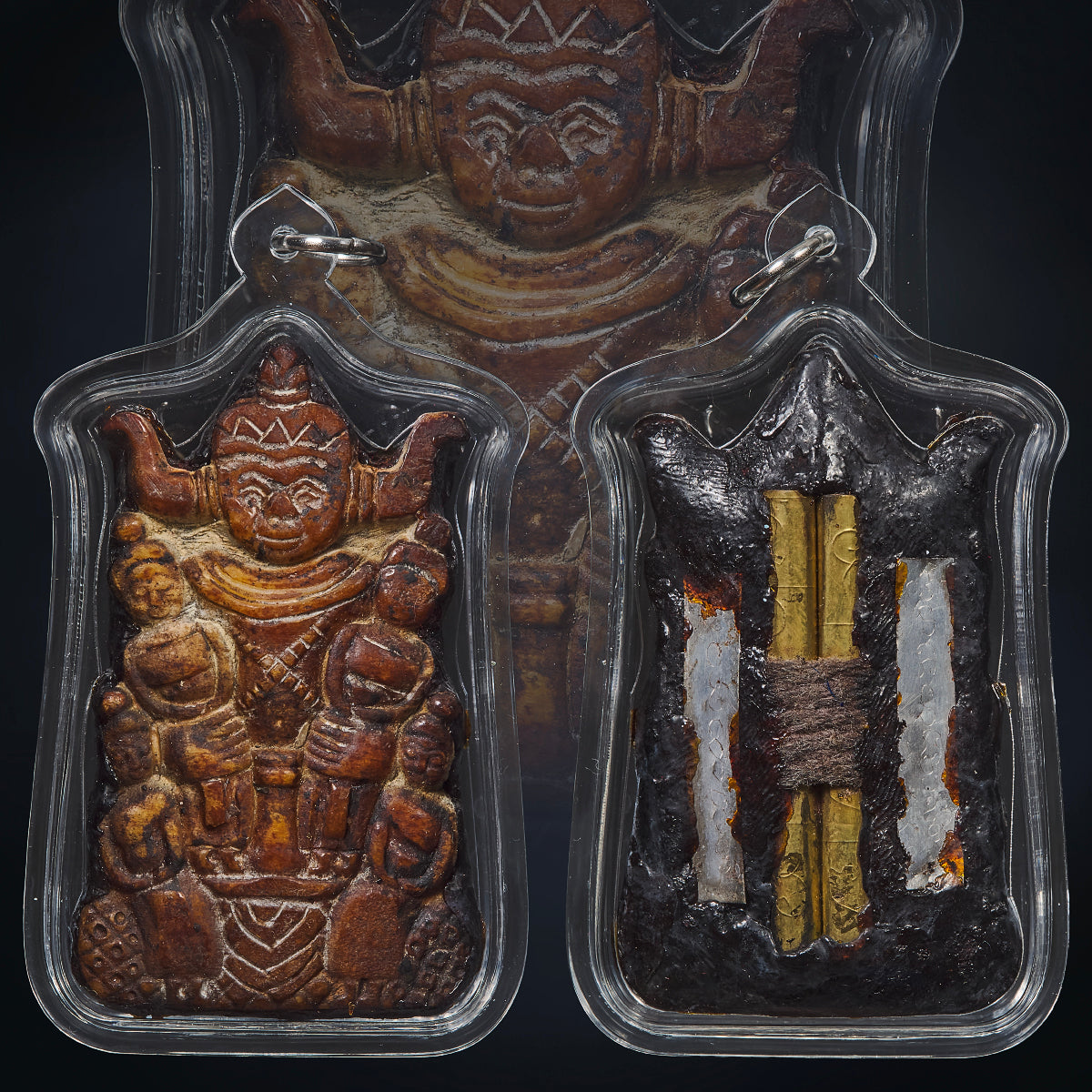
This is a substantial hand-carved Phaya Khao Kham by Por Sala Tan, created from an old relic he retained from his travels and meditation in the northern mountains. The front presents Lord Golden Horn as the dominant central figure, wearing his characteristic horned headdress and surrounded by multiple smaller companion figures. The carving retains the warm brown and ochre tones of the old natural material, with visible hand-worked lines and surface variations giving the composition a distinctly individual character.
The reverse reveals the more complex ritual construction. A dark layer of Nam Man Prai and Wahn Maha Saneh preparation forms the backing around the embedded components. At the centre are two pairs of brass-coloured takrut sections, arranged vertically and firmly bound together with dark aged Sai Sin, creating the principal ritual core of the reverse.
Flanking this central bundle are two pale metal yantra sheets, individually inscribed for choke lap and favourable fortune. The contrasting metals, old binding thread and dark herbal-oil base remain deliberately visible, allowing the construction of the artifact to be read rather than concealed.
The complete piece is housed within a clear custom protective casing, preserving the carved relic on the front while allowing the takruts, Sai Sin, yantra sheets and prepared reverse to remain fully visible.
Recommended Pairing
Phaya Khao Kham already contains a strong combination of saneh, maha niyom and choke lap, making it particularly complete for business and customer-facing work.
For those wishing to emphasise livelihood further, it may be paired with Phra Sivali. A Nang Kwak artifact can complement the customer-attraction aspect, particularly for shop owners and merchants.
For a Por Sala Tan luksit, pairing it with his Yant Kru is especially appropriate. The Yant Kru establishes the connection to the master's wicha, while Phaya Khao Kham provides the more specialised focus upon sales, people and opportunity.
Personal Notes
What I find particularly characteristic about this piece is the way Por Sala Tan kept materials long before deciding what they would eventually become.
During his journeys into the northern mountains, he would meditate in remote places and search for rare herbs and unusual natural materials. When something meaningful was encountered, he did not necessarily use it immediately. Materials could remain with him until he considered them appropriate for a particular artifact.
This old cave relic eventually became Phaya Khao Kham.
The choice suits the material and Por Sala Tan's style of work particularly well. A northern relic became the foundation for a northern figure associated with attraction, people, livelihood and personal presence. Por Sala Tan then strengthened that foundation with his own wicha — Nam Man Prai, Wahn Maha Saneh, paired maha niyom takruts, Sai Sin and choke lap yantra sheets.
The experience shared by the luksit in construction also captures why people continue to seek this figure. He had struggled with poor sales and customers who did not remain. After receiving Phaya Khao Kham, his next prospect meeting resulted in a successful sale, followed by referrals from the same customer.
Whether understood through faith, confidence or personal experience, the theme is remarkably consistent with the old symbolism of Lord Golden Horn: attracting people is only the beginning. The greater value lies in gaining their goodwill, building trust and allowing one favourable meeting to open the way towards the next opportunity.
-
SG: Free | Worldwide except USA: $20 Registered | USA: $25 Registered / $100 Courier (SGD)