

OOBThaiAmulets
LP Kuay · Wat Kositaram
LP Kuay · Wat Kositaram
Couldn't load pickup availability
MS03
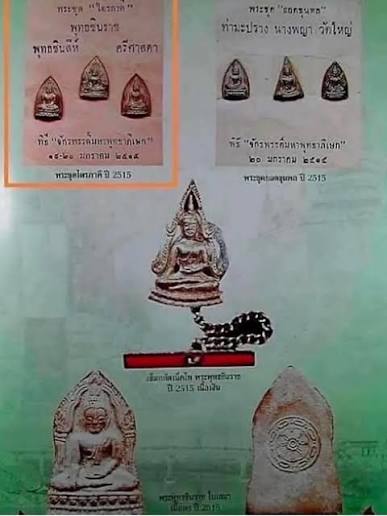
Phra Phuttha Chinnarat Bai Sema – Chakraphat Ceremony
Luang Por Kuay · Wat Kositaram
B.E. 2515 (1972)
Summary
Phra Phuttha Chinnarat Bai Sema from the Chakraphat Maha Phutthaphisek ceremony of B.E. 2515 is a respected period amulet connected with the major consecration held at Wat Phra Si Rattana Mahathat Woramahawihan, commonly known as Wat Yai, in Phitsanulok.
The ceremony brought together a large assembly of recognised monk-masters, with collector records commonly listing 109 participating masters, including Luang Por Kuay of Wat Kositaram.
This particular form depicts a seated Buddha beneath an ornamental aureole on the front, while the reverse carries a circular sacred yantra. Made from aged oil-bound sacred powder, the piece has developed the natural colour, surface texture and traces of ageing characteristic of old powder amulets.
For followers of Luang Por Kuay, it represents an interesting Phra Nok Wat—an amulet originating outside Wat Kositaram but directly connected with him through participation in its consecration.
Traditionally, the edition is associated with Khum Khrong, Klaew Khlaad, Metta Maha Niyom and Baramee, giving it the character of a balanced everyday Buddhist amulet.
Historical Background
The Chakraphat Maha Phutthaphisek ceremony was held at Wat Phra Si Rattana Mahathat Woramahawihan, Phitsanulok, on 20 January B.E. 2515 (1972).
The temple is home to Phra Phuttha Chinnarat, one of the most revered Buddha images in Thailand. Holding such an extensive consecration within this setting gave the ceremony particular religious significance.
Collector records describe the occasion as an unusually large gathering of monk-masters from across Thailand. Among those traditionally recorded as participating were:
- Luang Por Phae · Wat Phikun Thong
- Luang Por Kuay · Wat Kositaram
- Luang Pu To · Wat Pradu Chimplee
- Luang Por Daeng · Wat Khao Bandai It
- Luang Por Ngern · Wat Don Yai Hom
- Luang Por Hom · Wat Chak Mak
- Luang Por Thong · Wat Phra Prang
Luang Por Phae of Wat Phikun Thong is recorded as holding an important leading role in the consecration.
The presence of Luang Por Kuay is particularly significant to his collectors. It places the amulet within the wider history of important ceremonies to which he was invited beyond his own temple.
Luang Por Kuay & Wat Kositaram
Luang Por Kuay Suwanno of Wat Kositaram, Chainat, became one of the best-known monk-masters of central Thailand.
His amulets and sacred objects are traditionally associated with protection, avoidance of danger, Metta, livelihood and assistance during difficult circumstances.
His reputation extended beyond Wat Kositaram, and he was invited to participate in major consecrations organised by other temples. These outside-temple pieces form an interesting area of Luang Por Kuay collecting because they document his wider standing among the monk-masters of his generation.
The B.E. 2515 Chakraphat ceremony is one such example.
Sacred Material & Ritual
This example is made from Nuea Phong Namman, an oil-bound sacred powder composition traditionally formed by combining prepared powders with an oil-based binding medium before pressing.
With age, such material naturally develops individual characteristics. Surfaces may become dry or softly worn, colours may deepen, and small particles within the original mixture can become increasingly visible.
The amulets were subsequently brought into the great B.E. 2515 consecration, where Buddhist chanting, meditative blessing and ritual recitation were performed by the assembled masters.
Within Thai collecting tradition, the importance of such a ceremony lies in the convergence of numerous respected lineages within a single consecration.
The Bai Sema Form
Bai Sema refers to the leaf-shaped sacred boundary stones traditionally positioned around a Thai Buddhist ordination hall.
Their purpose is to establish the recognised sacred boundary within which important monastic ceremonies take place.
When this form appears in an amulet, collectors traditionally associate it with:
- Protection and maintaining a sacred boundary
- Stability during uncertain circumstances
- Klaew Khlaad and safe passage
- Buddhist refuge and mindfulness
Combined with a Buddha image, the form carries a particularly balanced character centred upon protection and spiritual steadiness.
Traditional Blessings
The Phra Phuttha Chinnarat pieces from the Chakraphat ceremony are generally regarded as broad-purpose Buddhist amulets.
Protection & Klaew Khlaad
The strongest traditional association is protection during everyday life and travel.
Devotees commonly carry such pieces when seeking safety, avoidance of unexpected danger and greater confidence when travelling frequently.
Metta Maha Niyom
The amulet is also traditionally associated with goodwill and favourable relationships.
This may be particularly meaningful for those working with customers, colleagues, employers or other people whose cooperation affects everyday progress.
Baramee & Career
Baramee concerns personal standing, respect and the gradual development of one's position.
For working professionals, this may be interpreted as gaining greater recognition, meeting helpful senior figures or receiving opportunities to progress through steady effort.
Stability & Peace of Mind
As a Buddhist image, the amulet also serves as a reminder of mindfulness and composure.
Its traditional purpose is therefore broader than material fortune alone. Protection, good relationships and calm judgement are understood as foundations from which other forms of progress may develop.
Modern Application
The balanced nature of this amulet makes it suitable for everyday wear, particularly for those who prefer one Buddhist piece covering several aspects of daily life.
It is traditionally suited to people seeking:
- Protection during frequent travel
- Greater stability at work
- Support from seniors and benefactors
- Better relationships with colleagues
- Metta during business or negotiation
- Confidence when facing uncertain situations
For Luang Por Kuay collectors, it also provides an opportunity to explore his participation in important ceremonies outside Wat Kositaram.
Physical Details
This example is formed in the traditional pointed Bai Sema shape.
The front carries a seated Buddha image surrounded by an ornamental aureole. The reverse is comparatively restrained, displaying a large circular sacred yantra impressed into the powder.
The aged Nuea Phong Namman has developed warm tan and brown tones, with areas of darker patination across the raised surfaces. Traces of green pigment or mineralised surface deposits are also visible on both faces, contributing to the naturally aged appearance of the piece.
The surviving surface remains visibly handmade and period in character, with slight irregularities in the edges, relief and powder distribution.
Each amulet was individually formed from carefully prepared sacred materials, so natural differences in pressing, texture, colour and ageing give every surviving piece its own unique character.
Personal Experiences Shared by Luksits
Among followers of Luang Por Kuay, accounts surrounding his blessed amulets frequently concern protection and assistance arriving during difficult periods.
Some devotees describe narrowly avoiding accidents or finding themselves unexpectedly delayed before a journey that later proved troublesome. Others speak of receiving help from people they did not expect, particularly when facing financial or workplace difficulties.
Business owners and working professionals also describe situations where previously difficult discussions became easier, senior figures became more supportive, or an introduction unexpectedly led to a useful opportunity.
For many collectors, these quieter experiences are particularly characteristic of Luang Por Kuay's reputation: circumstances do not necessarily change dramatically, but a difficult path seems to become easier to navigate.
Such accounts remain personal experiences passed among devotees and should be understood within the traditional faith surrounding the master.
Recommended Pairings
For Metta and communication, this piece pairs naturally with Salika, particularly for those involved in negotiation, teaching, sales or customer-facing professions.
For commerce and customer attraction, Nang Kwak adds a more specific business orientation.
For career advancement and authority, a Maha Amnaj or Baramee amulet complements the protective foundation of the Phra Phuttha Chinnarat.
For collectors concentrating on Luang Por Kuay himself, pairing it with one of his recognised Wat Kositaram amulets creates an interesting combination: one representing his own temple lineage and the other documenting his participation in a major national-scale consecration.
Personal Notes
This is the kind of amulet that becomes more interesting once its history is understood.
At first glance, it is a modest old powder Buddha amulet. Behind it, however, stands the B.E. 2515 Chakraphat ceremony at Wat Yai and an assembly of respected monk-masters that included Luang Por Kuay.
That connection gives the piece particular relevance for collectors exploring the less obvious parts of his legacy—the amulets he did not necessarily create himself, but personally participated in blessing.
Its naturally aged powder surface, simple Bai Sema form and traditional Buddhist imagery preserve the quiet character expected of an amulet from this period.
Its traditional purpose can be summarised simply:
To provide protection along the journey, goodwill among people, and steady Baramee as life moves forward.

-
Free Shipping for Singapore| $15 Worldwide | $60 USA For Items Below $350