
OOBThaiAmulets
LP Non - Wat Khao Phran Thup
LP Non - Wat Khao Phran Thup
Couldn't load pickup availability
MASS01
Phaya Tao Ruean Maha Baramee
LP Non Jantawiro · Wat Khao Phran Thup Monastic Retreat · Hua Hin, Prachuap Khiri Khan
B.E. 2567 (2024)
1.5 Inches
Mainstream Artifact
Individual Craftsmanship
The photographs are representative only. A piece will be selected at random, and the amulet supplied may differ from the exact piece shown in the images.
Individual examples naturally show small differences in casting, surface texture, finishing and the definition of the inscriptions. These variations are characteristic of individually finished sacred objects and give each piece its own character.
Personal Experiences Shared by Luksits
LP Non's sacred objects are closely associated by his luksits with the wicha for which he became known during his long monastic life — particularly protection, metta maha niyom, livelihood and traditional talismanic practice.
The turtle has an especially broad appeal because its symbolism is easy to apply to everyday life. Business owners traditionally connect it with steady commerce and retaining wealth; travellers with protection and safe return; older devotees with longevity; and families with stability and security.
Rather than representing sudden success, the turtle carries a quieter message: move steadily, preserve what has been accumulated, survive difficult periods and continue forward without abandoning one's path.
This makes the Phaya Tao Maha Baramee particularly fitting among the later sacred objects associated with LP Non.
Summary
The Phaya Tao Maha Baramee, B.E. 2567, is a Phaya Tao Ruean sacred object associated with LP Non Jantawiro of Wat Khao Phran Thup Monastic Retreat, Hua Hin.
Created during the final period of LP Non's long life, the piece combines the traditional symbolism of the sacred turtle with his established lineage of yantra inscription and talismanic practice.
In Thai sacred-object traditions, Phaya Tao Ruean is commonly associated with longevity, protection, metta, commerce, prosperity and the gradual accumulation and preservation of wealth.
The title Maha Baramee — “Great Baramee” adds another dimension. Baramee refers to accumulated spiritual virtue and perfection: qualities developed through generosity, discipline, endurance and good conduct. The artifact therefore carries a meaning broader than wealth alone — long life, stability, protection, perseverance and the gradual building of one's livelihood and merit.
Historical Background
LP Non Jantawiro was an old-generation monk whose lineage was closely connected with the famous LP Yid of Wat Nong Chok.
Biographical accounts place his birth in the Klam Rueang family at Ban Na Phrom, Tha Yang District, Phetchaburi. Sources differ slightly over whether his birth year was B.E. 2473 or 2474, although 3 July is consistently given. He ordained at the age of 21, with LP Ploen of Wat Nong Mai Lueang serving as his preceptor.
An important early teacher was LP Huan Jantasiri, an elder relative who transmitted traditional knowledge concerning medicinal herbs, the making of Palakit, and the inscription of sacred characters.
This placed LP Non within the same teaching environment as LP Yid.
When LP Yid later became particularly well known for his Palakit, demand from devotees increased considerably. LP Non was trusted to assist with the hand inscription of sacred characters upon the Palakit, a task traditionally entrusted only to practitioners considered sufficiently trained in the master's wicha.
Following LP Yid's passing, LP Non continued his wandering practice and further studied traditional methods associated with bone treatment and the countering of harmful occult influences.
Origins of the Lineage
LP Non eventually stayed at Wat Malai Thap Tai, where he produced Palakit under his own name and distributed them among villagers. He also remained there for several years assisting with the temple's development.
He later prepared to resume his travels, but local people invited him to stay at Khao Phran Thup and help develop the small monastic retreat.
LP Non settled there from approximately B.E. 2550 (2007).
According to accounts attributed to him, the place was extremely simple when he arrived — little more than a basic shelter suitable for escaping the sun and rain. He initially intended to remain only briefly for meditation.
During his practice, however, he reportedly experienced a vision of a completed religious complex with an ordination hall, pavilion and monks' dwellings.
He consequently decided to remain.
Rather than beginning with a major amulet issue, accounts state that he initially printed 1,000 donation envelopes and gradually sought support from villagers and disciples. Over the following years the site developed into a substantially completed religious establishment.
This part of his life gives particular meaning to the word Baramee: something accumulated slowly through persistence, faith and the support of many people.
Ritual
LP Non's ritual background was strongly connected with hand-inscribed yantra and traditional talismanic wicha.
His early training under LP Huan included the preparation of Palakit and the inscription of sacred characters. His later assistance to LP Yid further established this aspect of his practice, and LP Non subsequently became known for sacred objects of his own.
The B.E. 2567 Phaya Tao Maha Baramee belongs to this late period of his sacred-object tradition.
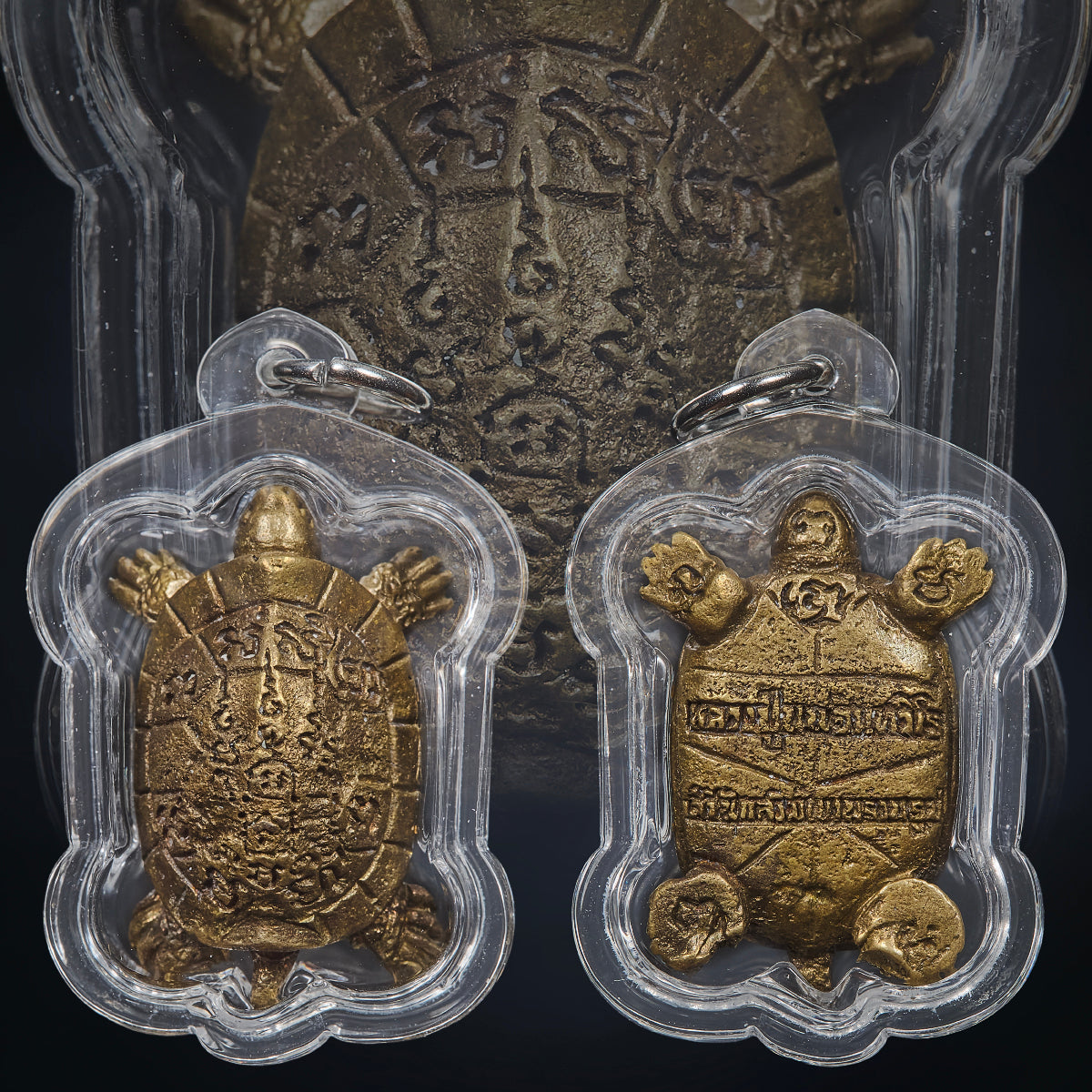
The turtle itself carries extensive sacred inscriptions. On one face, the shell is densely filled with yantra and characters arranged around the central axis of the turtle. The opposite face carries further inscriptions arranged across the shell, while additional sacred markings appear upon the limbs.
However, detailed surviving documentation for this specific B.E. 2567 issue remains limited. Without an original temple record or issue sheet confirming the details, it is better not to assign an exact number of pieces, a particular alloy composition, a precise number of consecrating monks, or a specific duration to its blessing ceremony.
What can be stated safely is that it belongs to the B.E. 2567 sacred-object tradition associated with LP Non and Khao Phran Thup, incorporating the yantra-based character of his established lineage.
Blessings and Effects
The Phaya Tao Ruean occupies an unusual position in Thai sacred culture because the turtle combines several complementary ideas.
Its hard shell naturally represents protection and security. Its long lifespan became associated with longevity and continuing health. Its steady movement represents patience and perseverance, while its ability to withdraw safely into its shell suggests caution and survival during unfavourable circumstances.
Within amulet traditions, devotees consequently associate Phaya Tao Ruean with:
- Metta Maha Niyom — goodwill and favourable reception.
- Kha Khai — support for trade and commerce.
- Choke Lap — favourable opportunities and fortune.
- Pokasap — accumulation and preservation of resources.
- Klaew Klad — avoidance of danger and safe passage.
- Ayuwattana — longevity and enduring vitality.
- Baramee — dignity, merit and respected presence.
Modern Application
The Phaya Tao Maha Baramee is particularly suitable in traditional practice for people seeking steadiness rather than haste.
For a business owner, its symbolism concerns attracting customers while also retaining what has already been earned. For someone building a career, it represents gradual advancement and endurance. For travellers, the protective shell carries an obvious association with safe journeys and returning home.
It is equally meaningful for someone passing through a difficult period. The turtle survives not through speed or aggression, but through patience, protection and persistent movement.
The practical lesson behind the symbolism is therefore straightforward: protect what matters, avoid unnecessary risk, build resources patiently and continue moving forward.
Physical Details
This example is a three-dimensional Phaya Tao Ruean in a warm golden-toned metal, formed with a rounded shell, raised head, four extended limbs and tail. Both faces are heavily worked with sacred inscriptions rather than being treated simply as decorative surfaces.
One side presents a dense central yantra running vertically through the shell, surrounded by numerous smaller sacred characters and markings. The opposite side has a broader arrangement of inscriptions divided across the shell, with further characters appearing around the upper body and limbs. The casting retains a slightly granular, aged-looking surface, allowing the recessed inscriptions and raised turtle form to remain strongly visible.
The piece is housed in a clear custom protective casing with a metal suspension ring. The transparent enclosure allows both sides of the turtle, including the extensive yantra work, to remain visible while protecting the projecting head, limbs and tail.
Recommended Pairing
Because Phaya Tao Maha Baramee already covers a broad range of traditional purposes, it can comfortably be worn alone.
For commerce, it may be paired with Nang Kwak to place greater emphasis on customer attraction and trade. Phra Sivali complements its livelihood and abundance symbolism, while a Buddha amulet can provide a more explicitly Buddhist devotional centre to the arrangement.
Collectors of LP Non may also naturally pair it with one of his Palakit, linking the turtle to the wicha for which his teacher-line became especially well known.
Personal Notes
What makes this B.E. 2567 issue particularly interesting is its position within the closing period of LP Non's life and practice.
His story stretches from old-style training in herbs, Palakit and hand-inscribed yantra, through periods of wandering practice, his close association with LP Yid's lineage, and eventually the development of Khao Phran Thup.
LP Non passed away in B.E. 2568 (2025) at an advanced age. Published accounts differ on some biographical details, including his exact birth year and even the reported January/February date of his passing, so these points are best recorded cautiously rather than forcing a single version without stronger documentation.
Against that long history, the name Phaya Tao Maha Baramee feels particularly appropriate.
The turtle represents longevity, patience and survival. Maha Baramee represents virtue and standing accumulated gradually over a lifetime. LP Non himself spent decades learning, travelling, assisting his teachers, helping villagers and eventually developing a simple mountain retreat into an established religious place.
For that reason, this piece can be appreciated as more than a wealth turtle. Its deeper theme is what can be built through time — merit, stability, livelihood, protection and the strength to keep moving forward.
-
Free Shipping for Singapore| $15 Worldwide | $60 USA For Items Below $350