
OOBThaiAmulets
Lp Dam - Wat Sri Monkol (Wat Kuti)
Lp Dam - Wat Sri Monkol (Wat Kuti)
Couldn't load pickup availability
MS06
Phra Phuttha
LP Dam · Wat Kuti · Prachinburi
Present-day Wat Sri Mongkhon
B.E. 2432–2442
1.5 Inches
Mainstream Artifact
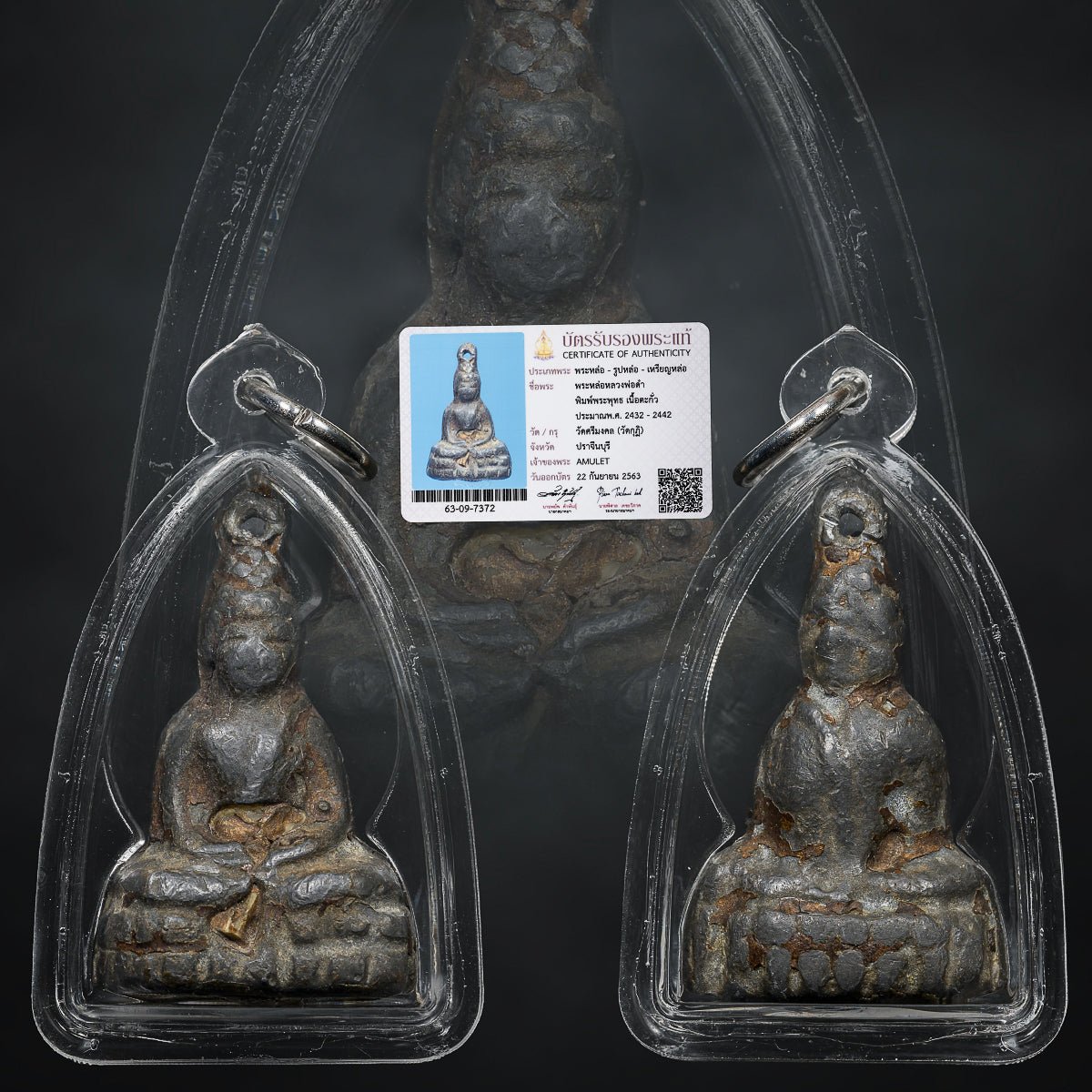
Samakom Certification Card (63-09-7372)
Individual Craftsmanship
Each artifact was individually cast and finished rather than produced to modern standards. Differences in the lead flow, surface, proportions and placement of the inserted fang are therefore part of the character of these early pieces.
Personal Experiences Shared by Luksits
Old collectors generally approach LP Dam's artifacts differently from later mainstream amulets.
They are not particularly refined pieces. Their attraction lies in the old casting, unusual materials and the reputation that developed around them through generations of local accounts.
The strongest stories surrounding LP Dam's lead artifacts concern Kong Grapan, Maha Udt and Klaew Klad — endurance against danger, protection and escaping serious situations.
There are also longstanding accounts of people carrying his artifacts because they believed them useful against Khun Sai, hostile occult practices and spiritually troublesome environments.
For someone whose work involves frequent travelling, isolated locations or unpredictable surroundings, this explains why LP Dam's old lead pieces remained respected long after his lifetime.
Summary
This Phra Phuttha Lor Boran is an early lead Buddha casting attributed to LP Dam of Wat Kuti, Prachinburi, the temple now known as Wat Sri Mongkhon.
Collector tradition generally places pieces of this type around B.E. 2432–2442, although surviving documentation from the period is limited and the dating should be understood as an established collector attribution rather than an exact recorded production date.
The artifact is particularly distinctive for its combination of old lead and an inserted fang traditionally identified as wolf fang.
Within the old Wat Kuti tradition, the Buddha image provides the central Buddhist refuge, while the animal fang adds the symbolic qualities of vigilance, survival and resistance against hostile forces.
Historical Background
The surviving history of LP Dam is fragmentary, which is not unusual for rural masters whose lives predate systematic documentation of Thai amulets.
Traditional accounts describe him as a Khmer-lineage wandering monk who travelled into Thailand practising meditation and older forms of wicha. Some accounts further relate that during his travels he encountered LP Suk of Wat Makham Thao, remaining for a period to exchange knowledge before continuing his thudong journey.
He eventually reached Wat Kuti in Prachinburi. The local community developed considerable respect for him and invited him to remain there.
LP Dam became particularly associated with lead sacred objects, including Buddha images and Phra Pidta. His Pidta pieces in particular later developed a strong reputation among collectors.
Much of this history survives through temple-area oral tradition and generations of collectors rather than detailed contemporary records, so the finer points of his biography are best regarded as lineage history.
Origins of the Materials
One of the most interesting traditions surrounding LP Dam concerns the origin of his lead.
According to the old Wat Kuti account, a pair of lead Singha figures once stood in front of the temple's old ubosot. Local children would sometimes carry these heavy figures away to play around the surrounding fields.
The story says that regardless of where the Singha were left, villagers would later find them back at their original position in front of the ubosot, without anyone knowing who had returned them.
These old Singha consequently acquired their own reputation within local tradition.
The account accompanying LP Dam's amulets says that this old lead was eventually melted and reused as sacred casting material for his artifacts.
Whether every surviving example contains material from these Singha cannot now be independently established, but the story remains an important part of the traditional provenance attached to LP Dam's lead work.
The second important material is the Khiaw Ma Pa, traditionally described as wolf fang, inserted into the artifact as an additional protective component.
Ritual
LP Dam is remembered in collector tradition as belonging to an older Khmer-influenced wicha lineage, where the preparation of the material, casting of the object and subsequent consecration formed parts of the same ritual process.
The lead Buddha therefore combines two different layers of symbolism.
The Buddha image represents refuge, composure, mindfulness and the overcoming of fear.
The fang represents the survival instinct of a powerful wild animal — alertness to danger, the ability to defend itself and resistance when confronted by hostile forces.
Within old folk-wicha practice, such animal materials were sometimes incorporated into sacred objects where their natural characteristics complemented the intended purpose of the artifact.
Here, the fang strengthens the distinctly protective character traditionally associated with LP Dam's lead work.
Blessings and Effects
LP Dam's artifacts are particularly remembered for Kong Grapan Chadtri and Maha Udt. These traditions concern physical resilience, protection and resistance against serious danger.
Klaew Klad is another important quality associated with the lineage — avoiding an accident, escaping a dangerous situation or circumstances changing before harm occurs.
The wolf-fang component is traditionally connected with protection against hostile influences, including Khun Sai and other forms of occult interference.
There is also a strong element of courage and mental steadiness. The symbolism is not simply about confronting danger, but having sufficient awareness and composure to avoid it whenever possible.
These qualities belong to the traditional reputation of the lineage and accounts passed down by devotees rather than being guarantees of physical protection.
Modern Application
This is especially suitable for collectors who appreciate very early Thai sacred objects with strong regional character.
Unlike a modern precision-cast amulet, much of its attraction comes from its age: heavy old lead, primitive casting, unusual construction and the visible evidence of individual workmanship.
For everyday devotion, its traditional character is primarily protective. It may appeal particularly to those who travel frequently, work outdoors or simply prefer an old Buddha artifact associated with Klaew Klad and protection.
It is also historically interesting for collectors exploring the intersection between Buddhist imagery, Khmer-influenced wicha and animal-material talismans in older central and eastern Thai traditions.
Physical Details
The artifact is an old hand-cast Buddha image made principally from lead, with a broad seated Buddha above a tiered base and an elongated upper section containing a fang traditionally identified as Khiaw Ma Pa, or wolf fang. The reverse retains the simple, substantial construction expected of an early casting. Its grey-black lead surface shows considerable natural oxidation, irregularities, exposed brown deposits and casting wear consistent with an object of substantial age. The present example is preserved within a clear protective casing and is accompanied by a certificate of authenticity.
Recommended Pairing
This is already a strongly protection-oriented artifact and can comfortably be worn on its own.
If pairing is preferred, I would keep the combination traditional. A Buddha image or Roop Lor of a respected monk master can add Baramee and Metta without changing the fundamental protective character of the piece.
For someone already wearing a wealth or Saneh artifact, LP Dam's Buddha can instead serve as the protective foundation of the combination — one piece for movement and opportunity, the other for stability and protection.
Personal Notes
What attracts me to this piece is how different it feels from later mainstream amulets.
There is very little concern here with perfect symmetry or a beautiful modern finish. The old lead, crude casting and fang incorporated directly into the Buddha form reflect an earlier approach to sacred-object making.
The local story concerning the old lead Singha at Wat Kuti gives the material an additional layer of history, while the inserted fang reflects the protective wicha for which LP Dam's artifacts became remembered.
The biography of LP Dam is admittedly not as thoroughly recorded as that of later famous masters. Much of what survives comes from temple-area tradition and older generations of collectors. For me, that is precisely why the physical artifact matters so much.
It is a surviving piece from an older period when the material, the master's wicha and local oral history were closely intertwined — an old-school protective Buddha with a character that is difficult to reproduce today.
-
Free Shipping for Singapore| $15 Worldwide | $60 USA For Items Below $350