
OOBThaiAmulets
King Bhumibol Adulyadej 2539
King Bhumibol Adulyadej 2539
Couldn't load pickup availability
MS04
Rian Phra Mahachanok –
The Mahajanaka Medal (Symbol of Perseverance)
King Bhumibol Adulyadej - Rama IX
B.E. 2539 (1996)
1.5"
Samakom Card
Sacred Craftsmanship
Each Mahajanaka medal was individually struck and finished from carefully prepared precious metal. In this example, the Pink Gold gives the surface its distinctive warm rose-gold character. Subtle natural differences in striking, surface texture, metal tone and finishing give every surviving example its own individual identity.
Personal Experiences Shared by Luksits
Among Thai collectors, the Rian Phra Mahachanok is respected for a character quite different from many conventional sacred medals. Its central meaning is Wiriya — perseverance: continuing one's effort even when success cannot yet be seen.
Many owners associate the medal with progress in business and career, particularly during periods when growth is slow, financial pressure is heavy or obstacles seem difficult to overcome. Collectors have shared accounts of carrying the Mahajanaka medal through difficult years, continuing their work despite repeated setbacks, and eventually rebuilding their circumstances into something considerably stronger.
Others associate the medal with the determination needed to complete long projects, survive demanding periods at work or continue pursuing an opportunity after earlier attempts had failed.
For many devotees, its strongest blessing is therefore not simply Choke Lap. It is the Baramee to endure, continue and eventually overcome.
Summary
This Rian Phra Mahachanok, created in B.E. 2539 (1996), belongs to the celebrated Mahajanaka medal tradition connected with the royal literary work Phra Mahachanok by King Bhumibol Adulyadej, Rama IX.
This particular example is the Pim Lek, or smaller format, produced in Pink Gold.
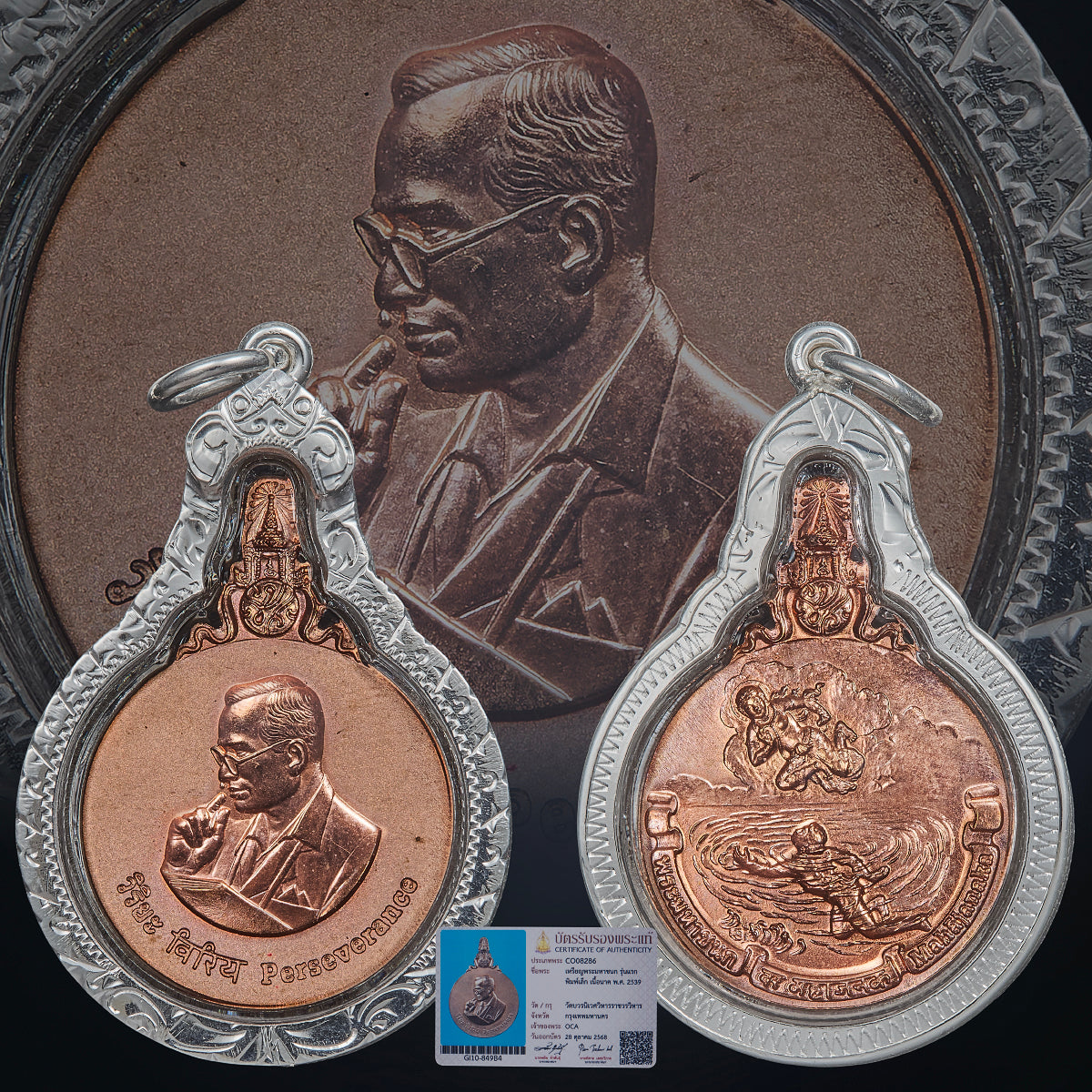
The obverse depicts King Bhumibol in his characteristic working posture, with his finger raised near his mouth and a visible drop of perspiration. The portrait represents tireless effort and dedication in service to the country.
Beneath the portrait appears the central concept:
Wiriya — Perseverance
The reverse depicts Phra Mahachanok swimming through the great ocean, with the celestial figure Manimekhalaappearing above.
Both sides therefore communicate the same principle: success through unwavering perseverance.
Historical Background
Phra Mahachanok is one of the important stories of the Buddhist Jataka tradition, recounting a former life of the Bodhisatta before his final birth as Siddhattha Gotama and attainment of Buddhahood.
The story is especially associated with:
Wiriya Baramee — the Perfection of Perseverance.
After his ship is destroyed at sea, Phra Mahachanok finds himself alone in an immense ocean.
There is no land in sight. He has no certainty that rescue will arrive, yet he continues swimming.
His effort is not based upon knowing that success is guaranteed. He continues because surrender would remove every possibility of survival, while perseverance keeps possibility alive.
This simple but profound principle became the spiritual heart of the Mahajanaka story.
King Bhumibol & Phra Mahachanok
King Bhumibol took particular interest in the story of Phra Mahachanok and its teaching concerning perseverance.
The principle closely reflected the character of his own working life — sustained effort towards difficult goals whose results might require many years to become visible.
Throughout his reign, numerous royal development initiatives addressed agriculture, water management, rural livelihoods and other long-term challenges facing communities throughout Thailand.
The portrait selected for the medal consequently carries considerable symbolic meaning.
King Bhumibol is depicted actively working, with perspiration visible upon his face.
Perseverance is therefore presented not simply as an abstract Buddhist virtue, but as something demonstrated through continuous effort and responsibility.
The Meaning of Wiriya Baramee
Wiriya refers to energy, diligence, effort and perseverance.
Within Buddhist practice, it represents the determination to continue wholesome effort despite fatigue, difficulty, disappointment or uncertainty.
Phra Mahachanok represents this quality at an exceptional level.
He does not know whether the shore is near.
He does not know whether anyone will rescue him.
Yet he continues swimming.
The teaching is therefore straightforward:
One continues because the effort itself remains meaningful, even before the result is known.
This is why the Mahajanaka medal has become especially meaningful to people pursuing difficult long-term goals.
The Obverse – King Rama IX
The obverse carries a finely modelled portrait of King Bhumibol Adulyadej, Rama IX, represented in a working posture.
A small drop of perspiration forms an important element of the portrait, symbolising the physical effort and persistence associated with his royal duties.
Beneath the portrait are inscriptions expressing the concept of Wiriya — Perseverance in multiple scripts.
Above the circular medal is the royal B.P.R. monogram, incorporated into an elaborate crowned element.
The composition unites the royal portrait with the central moral teaching of the Mahajanaka story: persistent effort undertaken for a meaningful purpose.
The Reverse – Phra Mahachanok in the Ocean
The reverse portrays the defining scene of the Mahajanaka Jataka.
Following the destruction of his ship, Phra Mahachanok continues swimming alone through the ocean.
Above him appears Manimekhala, the celestial guardian associated with the sea.
She questions why he continues exerting himself when the shore cannot even be seen.
Phra Mahachanok's response embodies the philosophy represented by the medal — one should continue performing one's duty and effort to the fullest extent possible, regardless of whether the final result can yet be seen.
The surrounding waves emphasise the scale of the challenge, while the solitary figure continuing forward becomes a powerful visual symbol of determination.
B.E. 2539 Mahajanaka Creation
The Mahajanaka medals were produced in connection with the publication of King Bhumibol's royal-authored Phra Mahachanok.
The original programme included prestigious precious-metal medals issued alongside particular editions of the publication.
Demand for the Mahajanaka publication and medals became considerable. Following the initial production, permission was subsequently granted for an additional smaller format, distinguished as Pim Lek.
This example belongs to that smaller Mahajanaka format and is distinguished by its Pink Gold material, giving the medal a warmer, rose-toned appearance than conventional yellow gold or silver examples.
Today, the different formats and precious-metal variations form an important specialised area within the collection of King Rama IX commemorative medals.
Chai Mangkhala Consecration
The Mahajanaka medals were connected with important Chai Mangkhala consecration rites at Wat Bowonniwet Vihara in B.E. 2539.
The royal ceremony brought together the symbolism of King Rama IX, Buddhist ritual and the teaching of Phra Mahachanok.
Somdet Phra Nyanasamvara, the Supreme Patriarch of Thailand, presided over the monastic side of the rites together with respected monks participating in meditation and blessing.
This sacred context gave the Mahajanaka medal a character extending beyond that of an ordinary royal commemorative medal.
It became an object combining royal history, Buddhist teaching, sacred consecration and Wiriya Baramee.
Pink Gold Material
This particular Pim Lek example was produced in Pink Gold, immediately distinguishing it through its characteristic warm rose-gold tone.
Pink Gold derives its distinctive appearance from the composition of the precious-metal alloy. Its softer reddish-gold character gives the portrait of King Rama IX and the Mahajanaka ocean scene a notably different visual presence from the silver and conventional gold versions.
The warm metallic surface also emphasises the raised portrait, inscriptions, waves and fine narrative details of the design.
With age, precious-metal surfaces may develop subtle variations in tone, particularly within protected and recessed areas. Such natural changes form part of the individual history of a surviving medal.
Traditional Blessings & Qualities
Although the Mahajanaka medal is principally associated with Wiriya Baramee, devotees connect its symbolism with several complementary qualities:
- Perseverance — maintaining effort through setbacks and delayed results.
- Baramee — developing credibility, inner strength and personal standing.
- Career & Business Progress — supporting long-term goals requiring patience and sustained work.
- Overcoming Obstacles — continuing forward without surrendering prematurely.
- Wisdom & Decision-Making — maintaining clarity during uncertain circumstances.
- Leadership — carrying responsibility with determination and patience.
- Protection & Auspiciousness — traditionally associated with its Buddhist symbolism and formal sacred rites.
The Mahajanaka medal is consequently meaningful for those whose goals depend upon consistent effort rather than immediate fortune.
Modern Application
The teaching represented by Rian Phra Mahachanok remains particularly relevant to modern life.
Entrepreneurs may carry it while building businesses through uncertain periods. Professionals may wear it during demanding projects, career transitions or periods when advancement appears slow.
Students can draw meaning from the medal during lengthy periods of study and examination preparation, while those rebuilding after setbacks may look towards Phra Mahachanok's ocean journey as a reminder that temporary difficulty does not determine the final outcome.
Its message becomes most relevant when the destination remains unclear, but the correct course is still to continue doing what must be done.
Physical Details
This example is a Pim Lek Pink Gold Rian Phra Mahachanok from B.E. 2539 (1996).
The obverse depicts King Bhumibol Rama IX in his characteristic working portrait, accompanied by the concept of Wiriya and surmounted by the royal monogram.
The reverse depicts Phra Mahachanok swimming through the ocean beneath Manimekhala, surrounded by the narrative imagery and inscriptions associated with the story.
The Pink Gold construction gives the medal its distinctive warm precious-metal appearance while retaining the fine relief of the King's portrait and the detailed ocean scene.
This example is accompanied by a Samakom certificate of authenticity.
Recommended Pairing
The Mahajanaka medal is particularly suitable as a principal daily piece for those focused upon career, business, leadership and long-term personal development.
For business use, it may be combined with amulets associated with Choke Lap, wealth or Metta Maha Niyom — qualities supporting opportunity and favourable circumstances, while Mahajanaka represents the perseverance required to develop those opportunities.
It may also be paired with a Roop Lor or sacred object associated with a respected meditation master where additional Baramee and spiritual guidance are desired.
The medal can equally be worn alone, as its symbolism is already broad and complete.
Sacred Craftsmanship
Each Mahajanaka medal was individually struck and finished from carefully prepared precious metal. In this example, the Pink Gold alloy gives the surface its distinctive warm rose-gold character. Subtle natural differences in striking, surface texture, metal tone and finishing give every surviving example its own individual identity.
Personal Notes
Few Thai medals communicate their meaning as clearly as the Rian Phra Mahachanok.
On one side is King Bhumibol working until perspiration appears.
On the other is Phra Mahachanok alone in an apparently endless ocean.
The two images tell the same story:
Continue.
Phra Mahachanok did not continue because success was guaranteed. He continued because abandoning his effort would remove every possibility of reaching his destination.
That philosophy explains why this medal remains meaningful beyond its importance as a royal commemorative object.
It represents Wiriya Baramee — the strength to continue when the destination cannot yet be seen.
For collectors of sacred royal objects, Buddhist symbolism and historically important Thai medals, this B.E. 2539 Pim Lek Pink Gold Rian Phra Mahachanok remains a particularly meaningful representation of perseverance from the reign of King Rama IX.
-
Free Shipping for Singapore| $15 Worldwide | $60 USA For Items Below $350