
OOBThaiAmulets
Arjan Piak
Arjan Piak
Temple-sourced certified artifacts since 2005. Questions before you buy? WhatsApp us at +65 9155 7000.
Couldn't load pickup availability
Box: MCBC03
Pha Yant Maha Rangap B.E. 2568 (2025)
- Master / Lineage: AC Piak, Khao Ao tradition
- Year: B.E. 2568 (2025)
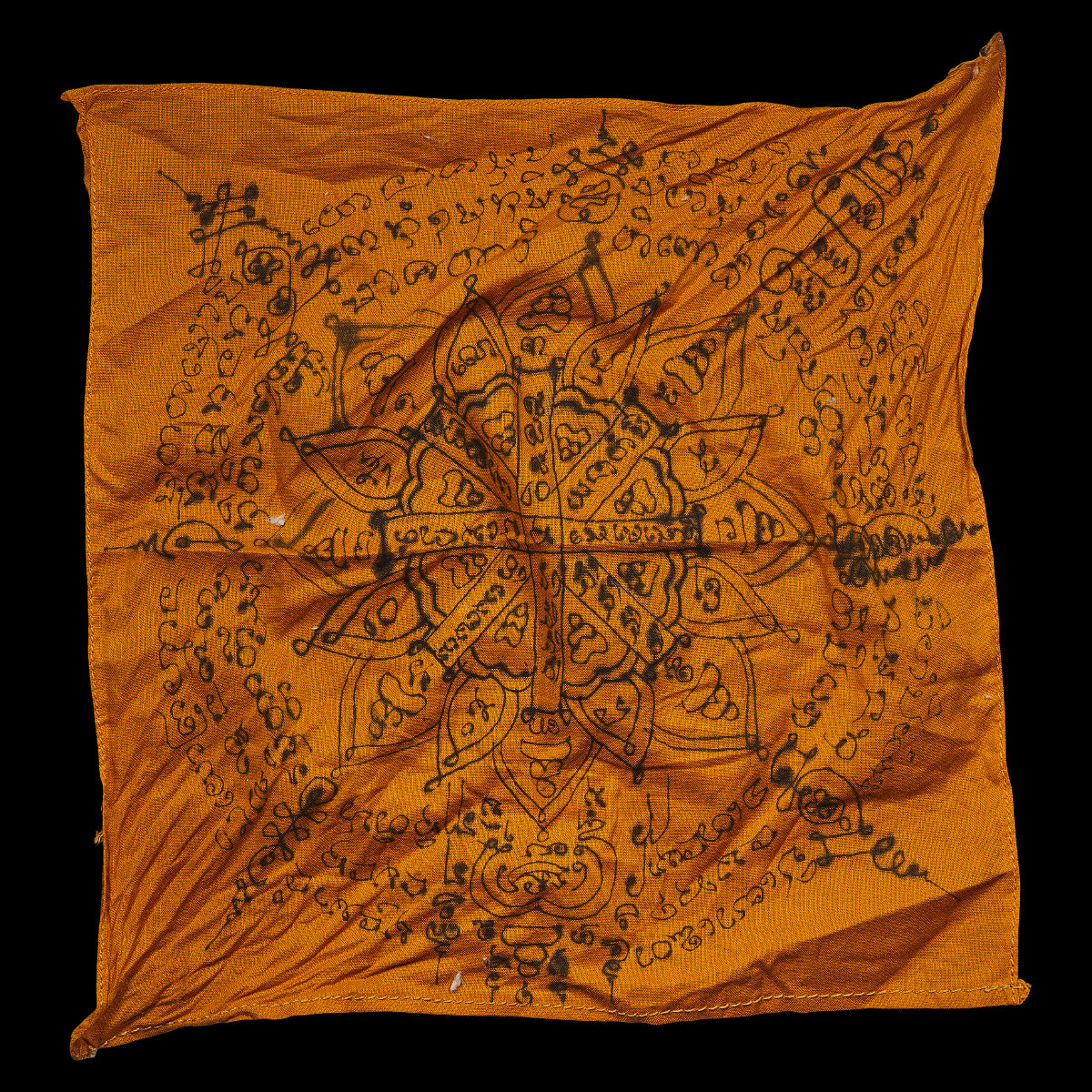
- Materials: Square saffron cloth, hand drawn in black ink, with a central lotus mandala and Khom script
- Size: 20cm x 20cm
- Casing: None. Sold as is (no frame or casing)
Summary
This is a Pha Yant, a hand drawn yantra cloth, made by AC Piak in B.E. 2568 (2025), in the Khao Ao tradition of Phatthalung.
It was used to bless the Takrut Maha Rangap, the same takrut later sealed inside AC Piak's Mai Kru. In this tradition, Maha Rangap is the great calming of trouble. It is believed to suppress danger, still hostile intent, and protect the one who keeps it.
The cloth is square and saffron, twenty centimetres on each side. AC Piak drew it by hand in black ink. A lotus mandala sits at the centre, with Khom script worked around it. It is sold as is, with no frame or casing.
Historical Background
The cloth belongs to AC Piak's Khao Ao line.
Khao Ao is one of the old esoteric schools of southern Thailand. Its home is Wat Khao Ao, in Khuan Khanun, Phatthalung. Local tradition says the hill was first a Brahmin place of learning, and later became a Buddhist temple. Official accounts still describe it as a school of sacred knowledge, herbal medicine, and the rites of invulnerability. Among the earlier masters named in this school are Ajarn Thong Thao of Wat Khao Ao, Ajarn Iat of Wat Don Sala, and Ajarn Kong of Wat Ban Suan.
AC Piak works in that tradition today. On the Mai Kru from the same master, the line is tied to the teachings of Por Kaew, and includes Arjan Chum Chaikiri (Achan Chum Chaiyakhiri). Arjan Chum Chaikiri was a lay master of the Khao Ao school. He studied there, gathered texts that had been scattered, and is remembered as a teacher of that line. He passed away in B.E. 2525 (1982).
AC Piak is also a close disciple of LP Sawaeng of Wat Sawang Phop. He once spent five years in the robes at a cave in Phrae. He does not name the cave. Yants are a central part of his work.
This cloth was used to bless the Takrut Maha Rangap. That takrut was then sealed inside AC Piak's Mai Kru, together with Phong Maha Rat and a takrut for invulnerability.
Maha Rangap is an older Thai wicha in its own right, not a name that belongs only to Khao Ao. The word "rangap" means to suppress, to restrain, and to bring something back to calm. "Maha" means great. Old amulet accounts trace the formula to the Ayutthaya period. They say Somdet Phra Phonnarat of Wat Pa Kaew prepared a yant in this line for King Naresuan, who wore it when he went to war. That is the traditional story of the wicha. It is not a claim about the age of this cloth. What passed into AC Piak's work is the meaning of the name: to stop trouble before it takes hold.
Origins of the Material
It is a square saffron cloth, twenty centimetres on each side. Cloth of this colour has long been used for sacred writing.
AC Piak drew the yant by hand in black ink. A lotus mandala sits at the centre. Around it is Khom script, the old script used on Thai yantra.
In traditional practice, a pha yant is written first and then blessed. This cloth was not only written and blessed for keeping. It was used to bless the Takrut Maha Rangap. Objects used in a consecration are themselves regarded as carrying that blessing. So this piece is kept not only as a written yant, but as a cloth that took part in the rite.
Blessings
- Maha Rangap: the great calming and suppression of trouble
- Protection, including the calming of danger and hostile intent
- Authority, in the sense that harm is believed to fall quiet
The heart of this wicha is not a shield that waits to be struck. It is a settling.
The word "rangap" is the same word used when a fire is put out, when a quarrel is stilled, or when a noisy room is brought back to quiet. Together with "maha", it names a blessing that is believed to stop trouble as it begins.
Old accounts of the Takrut Maha Rangap speak of this in plain terms. They say it is kept to suppress theft and violence, to calm the danger of fire, and to still misfortunes of many kinds. Some keep it to make holy water when a household needs to be set right. The aim is the same in each case. What has risen up is brought back down.
This is why the wicha is also spoken of in terms of authority. In the Khao Ao line, protection is often described as invulnerability, the quality of walking through harm unhurt. Maha Rangap sits beside that idea. It is the belief that hostile intent loses its force, and that a person who keeps this blessing is not easy to approach with harm.
This cloth was used to bless the takrut of that name. In traditional belief, the blessing that entered the takrut also rests in the cloth that was used to charge it. It is a quiet piece. It does not need to be worn to be at work. Kept with respect, it is believed to hold that same settling power over a home, a room, or the person who looks after it.
How to Wear
This is a cloth, so it is kept rather than worn.
Tradition favours a clean place, high and respectful. Many hang a pha yant above a door, or on a wall, above head height. It can also be framed and displayed, or folded neatly and kept on an altar or in a clean drawer. It should not be placed on the floor, sat on, or left in a low or careless place.
Keep it dry and out of strong sun, so the ink and the cloth last. Do not wash it. If it only needs dusting, a soft dry brush is enough.
When it is not on display, keep it somewhere clean and respectful.
-
SG: Free | Worldwide except USA: $20 Registered | USA: $25 Registered / $100 Courier (SGD)