
OOBThaiAmulets
Ajahn Plian Panyapatipo - Wat Aranyawiwek
Ajahn Plian Panyapatipo - Wat Aranyawiwek
Temple-sourced certified artifacts since 2005. Questions before you buy? WhatsApp us at +65 9155 7000.
Couldn't load pickup availability
MS07
Roop Tai
Ajahn Plian Panyapatipo · Wat Aranyawiwek · Chiang Mai
Before B.E. 2519
4.5cm
Mainstream Artifact
Individual Craftsmanship
Bio of Ajahn Plian Panyapatipo can be found here:
https://oobamulets.com/blogs/news/ajahn-plian-panyapatipo-wat-aranyawiwek
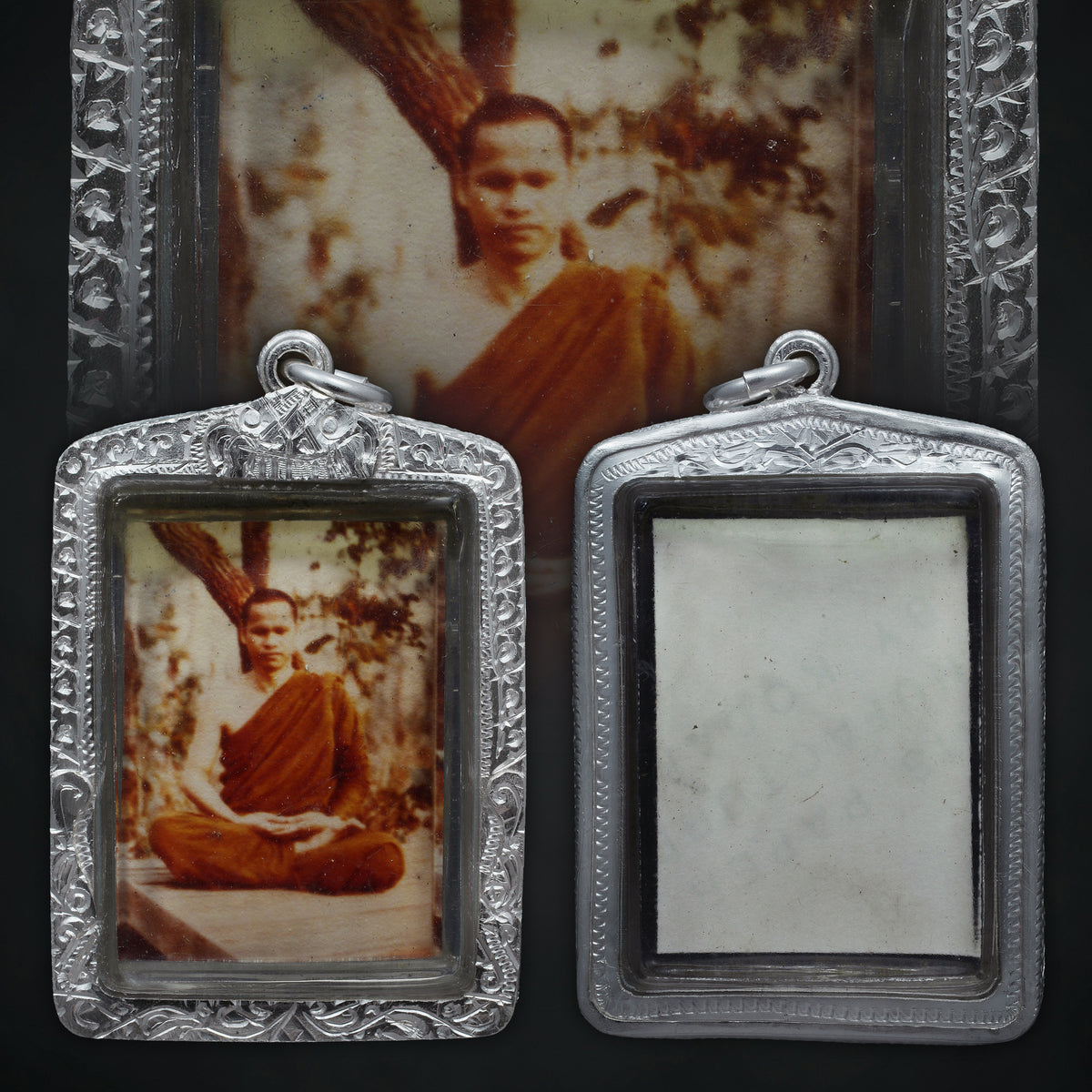
The original photograph has been preserved within a hand-worked silver casing. Natural differences in photographic tone, paper texture, ageing and the later casing are part of the individual character of surviving early examples.
Personal Experiences Shared by Luksits
Among the early photographs of Ajahn Plian, I particularly appreciate images such as this because they show the simplicity of his life before Wat Aranyawiwek became widely known.
There is little formality in the photograph. Ajahn Plian is still relatively young, seated beneath a tree in meditation, surrounded by the natural environment of the monastery.
For me, this is precisely what makes an early Roop Tai meaningful. It does not simply preserve the appearance of the monk; it preserves something of the atmosphere of the early forest monastery itself.
Examples from this period have also become increasingly difficult to encounter in well-preserved condition.
Summary
This is an early Kradas Nang Kai Roop Tai of Ajahn Plian Panyapatipo, traditionally identified with B.E. 2519 (1976).
The photograph belongs to the early Samnak Song period of the monastery and depicts Ajahn Plian seated in meditation beneath a tree.
Early photographs of this type are significant within his collecting tradition because they document Ajahn Plian during the formative period of Wat Aranyawiwek, Mae Taeng, Chiang Mai, before the monastery and its abbot became widely recognised.
The photograph has subsequently been protected within a finely engraved silver casing.
Historical Background
Ajahn Plian Panyapatipo was born on 16 November 1933 in Ban Khok Kon, Sakon Nakhon.
His interest in Buddhist practice developed at an early age. While still a layman, he learned walking meditation from LP Phrom Jirapunyo, a disciple within the forest tradition associated with LP Mun Bhuridatta.
Ajahn Plian was ordained on 31 March 1959 at Wat That Michai and received the monastic name Panyapatipo.
After ordination, he devoted himself increasingly to the Thai Forest Tradition, seeking instruction from respected Kammatthana masters. Among the important teachers connected with his development were LP Phrom Jirapunyo, LP Thet Thetsarangsi and LP Waen Sujino.
The Early Wat Aranyawiwek
In 1966, Ajahn Plian became abbot of Wat Aranyawiwek in Mae Taeng, Chiang Mai.
During these formative years, the monastery was still a simple forest practice centre and was associated with the earlier designation Samnak Song Ban Pong Aranyawiwek.
This context is important when looking at early photographs such as the present piece. Rather than showing the established senior master familiar from later photographs, it records Ajahn Plian during the earlier development of both his monastic life and the monastery.
Origins of the Materials
The principal material is the original Kradas Nang Kai photographic paper.
The Thai term literally refers to its distinctive textured surface, which gives the photograph a fine raised pattern visible when examined closely. This type of photographic paper appears on a number of older devotional portraits.
Before inexpensive modern reproduction became widespread, photographs of respected monks were themselves treasured objects. Disciples might keep one on an altar, carry it personally or place it within a protective casing.
For a forest monk whose teaching emphasised practice rather than elaborate sacred objects, such a photograph had an especially straightforward meaning: it preserved the image of the teacher for his disciples.
Ritual
Ajahn Plian's lineage belongs principally to the Kammatthana meditation tradition.
His practice centred upon moral discipline, mindfulness, samadhi and contemplation directed towards understanding the nature of suffering and liberation.
A Roop Tai consequently carries a somewhat different character from an artifact constructed around complicated sacred ingredients. Its spiritual meaning rests strongly upon Acariyanussati — recollection of the teacher.
Looking upon the teacher's image becomes a reminder of his conduct, instructions and the discipline expected of those who follow the path.
Blessings and Effects
Within traditional Thai Buddhist practice, photographs of respected meditation masters are commonly kept as reminders of the teacher and as objects of faith.
For devotees of Ajahn Plian, this Roop Tai may therefore be associated with:
- mindfulness and mental steadiness;
- protection through recollection of the Triple Gem and one's teacher;
- encouragement towards disciplined conduct;
- calmness during periods of difficulty or uncertainty;
- support for meditation and Dhamma practice.
The emphasis remains closely connected with Ajahn Plian's life as a forest monk rather than with promises of immediate worldly results.
Modern Application
The Roop Tai may be worn as a personal devotional artifact or kept on an altar together with other objects from the Thai Forest Tradition.
Its compact size and protective silver casing make it particularly suitable for carrying, while the early photograph gives it considerable historical interest for collectors of Ajahn Plian.
It can also serve as a simple meditation reminder: an image of the teacher himself seated quietly in practice.
Physical Details
The artifact contains an early B.E. 2519 Kradas Nang Kai photograph of Ajahn Plian seated cross-legged beneath a tree. The image has naturally developed a warm brown and reddish tone with age, while the characteristic textured photographic surface remains visible. The reverse is plain beneath the casing. The photograph is protected within a substantial hand-engraved silver frame with a suspension ring for wearing.
Recommended Pairing
This Roop Tai pairs naturally with Buddha images or sacred objects connected with the LP Mun forest lineage, particularly those associated with LP Mun, LP Phrom, LP Thet and LP Waen.
It may equally be worn alone. As a direct photographic representation of Ajahn Plian in meditation, the piece already carries a clear devotional identity without requiring additional artifacts.
Personal Notes
Ajahn Plian passed away peacefully on 15 February 2018, aged 84, after 59 rains retreats. His royal cremation ceremony was held at Wat Aranyawiwek on 16 February 2019.
What I find particularly attractive about this Roop Tai is not elaborate construction, but the photograph itself.
Ajahn Plian is shown as a comparatively young monk, sitting beneath a tree in the surroundings of the early monastery. There is no ceremonial backdrop and very little separating the monk from the forest environment in which he practised.
For collectors today, an early photograph such as this therefore preserves more than his likeness. It is also a small surviving record of the early Samnak Song period of Wat Aranyawiwek and Ajahn Plian's life as a Kammatthana forest monk.
-
SG: Free | Worldwide except USA: $20 Registered | USA: $25 Registered / $100 Courier (SGD)