
OOBThaiAmulets
Ajahn Plian Panyapatipo - Wat Aranyawiwek
Ajahn Plian Panyapatipo - Wat Aranyawiwek
Temple-sourced certified artifacts since 2005. Questions before you buy? WhatsApp us at +65 9155 7000.
Couldn't load pickup availability
MS07
Roop Tai
Ajahn Plian Panyapatipo · Wat Aranyawiwek · Chiang Mai
Before B.E. 2519
3.5cm
Mainstream Artifact
Individual Craftsmanship
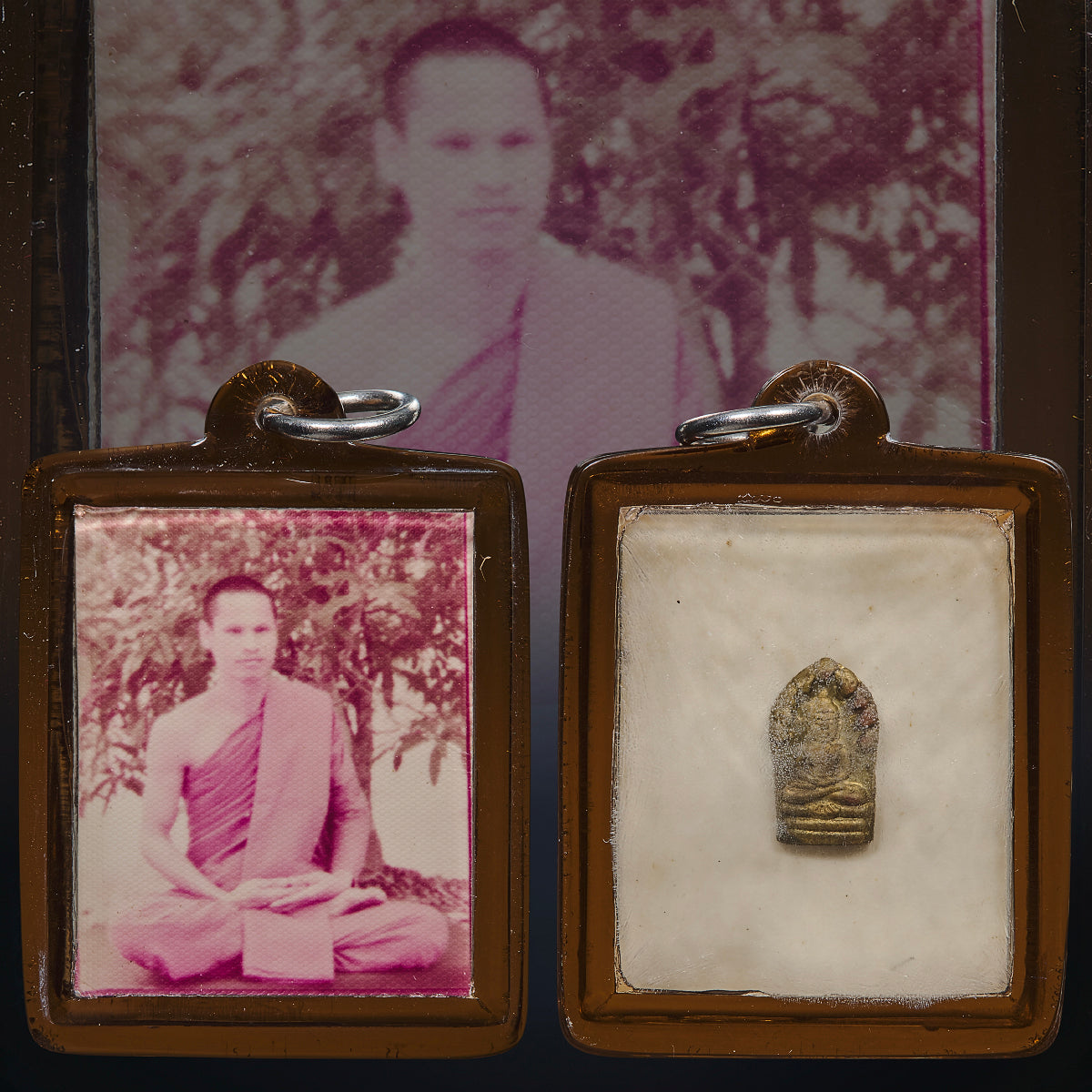
These pieces were individually assembled rather than produced as modern factory-made lockets. Differences in the photograph, backing, positioning of the miniature amulet and ageing are therefore natural characteristics of each surviving example.
Personal Experiences Shared by Luksits
Early photographs such as this have a very different character from the later formal portraits of Ajahn Plian.
The photograph records him while Wat Aranyawiwek was still associated with its earlier and much simpler period as Samnak Song Ban Pong Aranyawiwek. There is no elaborate presentation: Ajahn Plian is simply seated in his robes within the monastery grounds.
For me, the small first-batch Nak Prok Bai Makham on the reverse is what makes this example particularly meaningful. It brings together two early forms of remembrance in one piece — his actual image and a miniature sacred object associated with him.
It is a quiet piece, closely connected with the early forest-monastery period of Ajahn Plian's life.
Summary
This early Roop Tai of Ajahn Plian Panyapatipo is traditionally dated to before B.E. 2519 (1976).
The front contains an early photographic portrait printed on textured photographic paper. The reverse contains a first-batch Phra Nak Prok Bai Makham, a very small Buddha image in the Nak Prok form, named Bai Makham because its miniature size is compared with a tamarind leaf.
Rather than being valued for elaborate workmanship, the piece is significant for its connection to the formative years of Wat Aranyawiwek and to one of the respected meditation masters of the Thai Forest Tradition.
Historical Background
Ajahn Plian Panyapatipo was born on 16 November 1933 in Ban Khok Kon, Sakon Nakhon.
From an early age he was drawn towards monastic practice. While still a layman, he became acquainted with meditation and learned walking meditation from LP Phrom Jirapunyo, who belonged to the forest lineage associated with LP Mun Bhuridatta.
Ajahn Plian eventually received permission from his family to ordain and entered the monkhood on 31 March 1959 at Wat That Michai. He received the monastic name Panyapatipo.
Following ordination, his life became centred upon meditation, discipline and the search for experienced forest teachers.
Among the important masters from whom his biography records that he received guidance were LP Phrom Jirapunyo, LP Thet Thetsarangsi and LP Waen Sujino.
Wat Aranyawiwek
In 1966, Ajahn Plian became abbot of Wat Aranyawiwek in Mae Taeng, Chiang Mai.
The monastery was considerably simpler during this early period and was formerly known in connection with Samnak Song Ban Pong Aranyawiwek. The photograph used in this Roop Tai is important precisely because it records Ajahn Plian during this earlier stage.
Over the following decades, he became widely respected as a meditation teacher within the Thai Forest Tradition.
His teachings remained firmly centred upon Buddhist practice rather than occultism: mindfulness, samadhi, observance of the monastic discipline, contemplation of the nature of mind and body, and ultimately liberation from suffering.
Origins of the Materials
The principal material is the early photograph itself.
Old photographs of revered monks occupied an important place in Thai devotional culture. Before modern printing made portraits inexpensive and widely available, small photographs could be kept on an altar, carried personally or placed inside a protective case.
This example becomes more unusual through the addition of the miniature amulet on its reverse.
First-Batch Phra Nak Prok Bai Makham
The small image embedded at the back is identified in the supplied provenance as Ajahn Plian's first-batch Nak Prok Bai Makham.
Phra Nak Prok depicts the Buddha sheltered by the Naga Mucalinda during meditation. The image traditionally conveys steadfast meditation and protection — remaining composed despite difficult external conditions.
Bai Makham, literally "tamarind leaf," is a familiar Thai collector's term for exceptionally small amulets of this elongated format.
Its inclusion transforms the portrait from a photograph alone into a compact devotional artifact incorporating both Roop Tai and Phra Kreung.
Ritual
Ajahn Plian belonged principally to the Kammatthana, or meditation, tradition.
Within this tradition, the significance of an object associated with a respected teacher is closely connected with the teacher's practice, discipline and the faith of his disciples.
The miniature Nak Prok on the reverse provides the explicitly Buddhist sacred image, while Ajahn Plian's portrait preserves remembrance of the teacher.
Together they form a particularly personal type of devotional object: Buddha, teacher and lineage brought together within a piece small enough to carry.
Blessings and Effects
Within traditional Thai Buddhist understanding, objects associated with respected forest masters are commonly kept for Buddhanussati and Acariyanussati — recollection of the Buddha and recollection of one's teacher.
The Nak Prok image is traditionally associated with protection, composure and remaining steady through adversity.
Ajahn Plian's photograph carries a complementary meaning. For his disciples, seeing the teacher can serve as a reminder of his emphasis upon mindfulness, moral discipline and meditation.
Its deeper significance is therefore not simply the expectation of worldly benefits, but the reminder to keep one's mind composed and return to Dhamma when facing uncertainty.
Modern Application
This Roop Tai can be worn as a personal devotional piece or kept together with a collection of Thai Forest Tradition artifacts.
Its small format makes it particularly suitable for daily carrying. The front presents Ajahn Plian directly, while the concealed reverse preserves the first-batch Nak Prok.
For collectors of Ajahn Plian, early material is also valuable for documenting the development of Wat Aranyawiwek before the monastery and its abbot became widely known.
Physical Details
The artifact measures approximately 1 inch and is housed in a protective brown plastic casing. The front contains an early magenta-toned photograph of Ajahn Plian seated cross-legged in meditation, printed on textured Kradas Nang Kai photographic paper. The reverse has a pale backing into which a very small first-batch Phra Nak Prok Bai Makham has been set. Ageing, fading and minor surface changes are consistent with the character of an early photographic devotional piece.
Recommended Pairing
This piece is already unusually complete because it combines the Roop Tai of Ajahn Plian with his miniature Phra Nak Prok.
If worn with another amulet, an appropriate pairing would be a Buddha image or an artifact associated with one of the forest masters connected with his practice lineage, particularly LP Mun, LP Phrom, LP Thet or LP Waen.
The emphasis remains on meditation, mindfulness and remembrance of the Kammatthana teachers rather than creating an elaborate combination.
Personal Notes
Ajahn Plian passed away peacefully on 15 February 2018, aged 84, after 59 rains retreats. His royal cremation ceremony was held at Wat Aranyawiwek on 16 February 2019.
What makes this particular Roop Tai special is its simplicity.
It preserves an image of Ajahn Plian from before B.E. 2519, when the monastery was still in its early period, while the first-batch Nak Prok Bai Makham on the reverse gives the piece a direct connection with his early sacred objects.
It is therefore more than a portrait of a famous monk in later life. It preserves a small record of Ajahn Plian's early years at Wat Aranyawiwek and the beginnings of the monastery that would later become closely associated with his name.
-
SG: Free | Worldwide except USA: $20 Registered | USA: $25 Registered / $100 Courier (SGD)