
OOBThaiAmulets
Ac Lek
Ac Lek
Couldn't load pickup availability
PST02
Mae Prai
Forest Monk from Isan
4cm
Barang Artifact
Sacred Craftsmanship
This Mae amulet came through Ajarn Lek, who originally received it from a reclusive forest monk encountered during the monk's travels through the Isan region of northeastern Thailand.
Each artifact was individually prepared from sacred powders and ritual materials, so natural differences in texture, colour, embedded substances and finishing make every surviving piece distinct.
Personal Experiences Shared by Luksits
Ajarn Lek's own experience with this Mae began immediately after receiving it from the forest monk.
According to him, when the amulet was first placed in his hands, he became aware of what he described as an unusually strong spiritual presence. It was sufficiently distinctive that the piece remained memorable to him even among the many ritual objects he had encountered.
During periods around the full moon, Ajarn Lek repeatedly noticed the fragrance of flowers around the amulet. He associated the scent with the Mae and regarded it as one of the indications that the spiritual element of the piece remained active.
I later collected this particular amulet directly from Ajarn Lek during one of my regular trips to Thailand.
Before passing it to me, he specifically spoke about the unusual feeling surrounding the piece and explained its background, including how it had come from the forest monk and the materials incorporated into its construction.
Ajarn Lek regarded the Mae particularly highly for saneh and wish granting. In his experience, it was not simply a decorative Prai amulet but a piece with a noticeably strong character.
Summary
This Mae is an uncommon spirit-based amulet originating from the practices of a low-profile Isan forest monk and later passing into the hands of Ajarn Lek.
Its construction combines Phong Prai Mae Nuea Hom, a Maha Saneh Takrut, coffin wood fragments, a Yoni ball made from Graduk Pii, sacred powder and Yant Maha Saneh.
The character of the piece is strongly centred upon saneh, attraction, Metta Maha Niyom and wish granting, while its funerary materials connect it to an older tradition of spirit-related sacred craftsmanship.
Its significance is further strengthened by its traceable personal provenance: from the forest monk to Ajarn Lek, and subsequently collected directly from Ajarn Lek during one of my regular journeys to Thailand.
Historical Background
Forest monks have long occupied a distinctive place within the religious landscape of Thailand.
Some belonged firmly to established monastic traditions centred upon meditation and disciplined forest practice. Others, particularly in remote rural areas, also became repositories of local knowledge concerning herbs, protective rites, funerary customs and traditional wicha.
The monk associated with this Mae was remembered as one such secluded practitioner.
He travelled through parts of Isan, lived simply and generally avoided public attention. Nevertheless, villagers knew of him and approached him when assistance was required.
His involvement in cremation ceremonies is particularly relevant to understanding this amulet.
In traditional communities, a cremation could involve more than the physical disposal of the deceased. Chanting, merit transfer and rites concerning the peaceful transition of the dead could all form part of the ceremony.
According to the history accompanying this piece, the monk occasionally retained appropriate ritual materials connected with individuals who had suffered tragic deaths and later incorporated selected materials into a very limited number of sacred objects.
The Mae belongs to this tradition.
Origins of the Materials
The principal substance is Phong Prai Mae Nuea Hom.
Within this tradition, Prai powders are associated with the spiritual essence of the deceased and may be combined with other prepared sacred powders, herbs and ritual substances. The precise preparation can vary considerably according to the practitioner and lineage.
The second important material is coffin wood.
Rather than ordinary timber, small fragments associated with funerary use were incorporated because of their direct symbolic relationship with death, transition and the rites performed for the deceased.
A particularly unusual component is the Yoni ball made from Graduk Pii.
The Yoni symbolism gives the material a specifically feminine dimension and, within the intended wicha of this piece, reinforces its association with Mae and Maha Saneh.
A Takrut prepared for Maha Saneh was incorporated to direct the attraction aspect of the amulet, while the reverse carries a moulded Yant Maha Saneh.
Together, these materials create a deliberately layered construction rather than relying upon a single Prai ingredient.
Ritual
The precise details of the forest monk's consecration were not publicly documented, which is consistent with his low-profile character.
What was passed down through Ajarn Lek was the monk's familiarity with funerary ceremonies and his practice of preparing certain artifacts from materials connected with those who had died tragically.
The construction itself reveals the intended direction of the ritual.
The female Prai powder established the Mae character. The Graduk Pii Yoni material strengthened the feminine spirit association. The coffin wood maintained a connection with the funerary origin, while the Maha Saneh Takrut and Yant gave the finished piece a defined purpose.
The amulet was therefore not constructed simply as a container for old materials. Its components were arranged according to a particular spiritual function, with saneh at the centre of the work.
Blessings and Effects
According to Ajarn Lek, the most prominent quality of this Mae is Maha Saneh.
Within traditional belief, saneh concerns attraction and personal magnetism — the ability to be noticed, remembered and received warmly by others.
Its Metta aspect is complementary rather than identical. Metta Maha Niyom concerns goodwill, kindness, sympathy and favourable treatment, making the combination useful not only for romantic matters but also for everyday human relationships.
Ajarn Lek additionally associated the piece strongly with wish granting. Owners approaching such an artifact traditionally formulate reasonable intentions and accompany their requests with merit-making rather than treating the spirit merely as something commanded to produce results.
The principal qualities traditionally associated with the Mae may therefore be understood as saneh, Metta Maha Niyom, attraction, interpersonal support, relationship assistance and wish fulfilment.
Modern Application
Although its construction belongs to an older spirit-based tradition, its intended qualities translate readily into modern life.
Those working in sales, customer service, negotiation or businesses dependent upon personal relationships may appreciate the combination of saneh and Metta Maha Niyom.
In personal relationships, the Mae may traditionally be approached for greater warmth, attraction and improved communication between people.
For single owners, its saneh character may be directed towards creating opportunities to meet a compatible partner rather than attempting to force the affection of a particular person.
Because of the funerary and Prai materials involved, this is also a piece that should be approached respectfully. Within the traditional framework surrounding such artifacts, merit-making and acknowledgement of the deceased are considered more appropriate than treating the Mae merely as a tool for attraction.
Physical Details
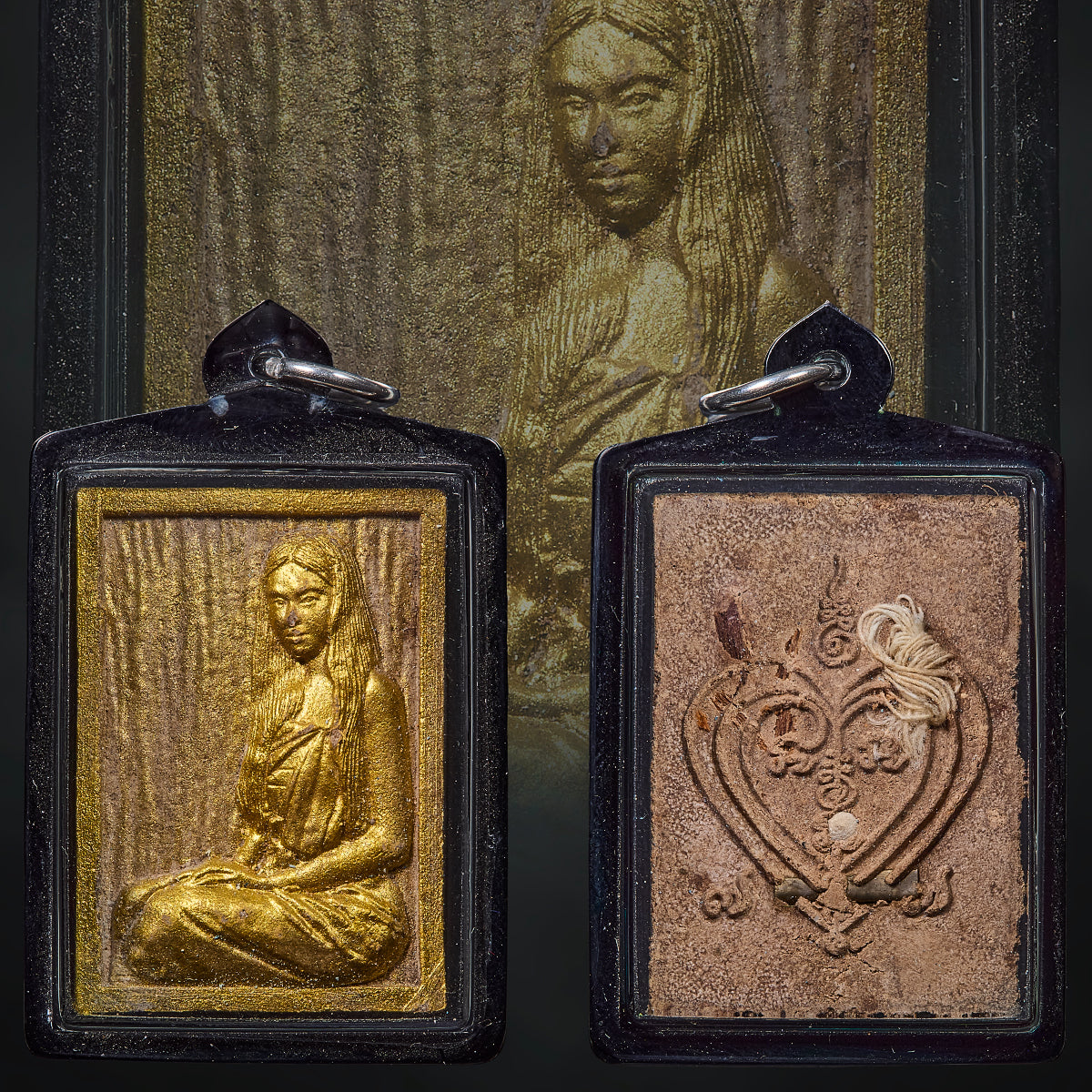
The front depicts a seated female figure, representing Mae, within a rectangular powder tablet. The raised image has been finished in a warm gilded tone, while the surrounding powder retains a naturally aged brown appearance.
The reverse displays a deeply moulded Maha Saneh Yant. Original ritual material and cord remain visible towards the upper portion, together with small embedded elements within the powder body.
The amulet is presently protected within a simple dark casing, allowing both front and reverse to remain visible.
Its irregular powder texture, ageing, embedded materials and surviving ritual elements are consistent with the handmade nature of the piece and should be preserved rather than cosmetically cleaned.
Recommended Pairing
Because this Mae is strongly directed towards Prai, saneh and wish granting, pairing it with a Buddhist amulet can provide a complementary Baramee-centred foundation.
A Phra Somdej is particularly suitable where the owner wishes to balance the Mae's attraction qualities with Buddhist Baramee, stability and calm authority.
For business owners, Phra Sivali is another natural pairing. The Mae may remain focused upon customers, interpersonal favour and saneh, while Phra Sivali represents livelihood, abundance and support in obtaining necessities.
A Lersi may also complement the piece for those seeking guidance, discipline and progress in their chosen path.
The Mae itself, however, already possesses a highly specific construction. Its combination of Phong Prai Mae Nuea Hom, Graduk Pii Yoni material, coffin wood, Maha Saneh Takrut and Yant Maha Saneh makes it a complete spirit-based work in its own right.
-
Free Shipping for Singapore| $15 Worldwide | $60 USA For Items Below $350