
OOBThaiAmulets
LP Anucha - Wat Pho Ratchaburana
LP Anucha - Wat Pho Ratchaburana
Couldn't load pickup availability
ANU01
Rian Ayu 60
LP Anucha • Wat Pho Ratchaburana, Ratchaburi
1st batch (60th birthday)
Test mould
B.E 2568
1.5 Inches
Mainstream Artifact
Bio of LP Anucha: click here
Sacred Craftsmanship
The Rian Ayu 60 holds particular importance within the amulet lineage of LP Anucha Anuchato of Wat Pho Ratchaburana. Created to commemorate his 60th birthday, it also represents the first official batch of Rian issued under LP Anucha, giving the medal significance beyond that of an ordinary commemorative release.
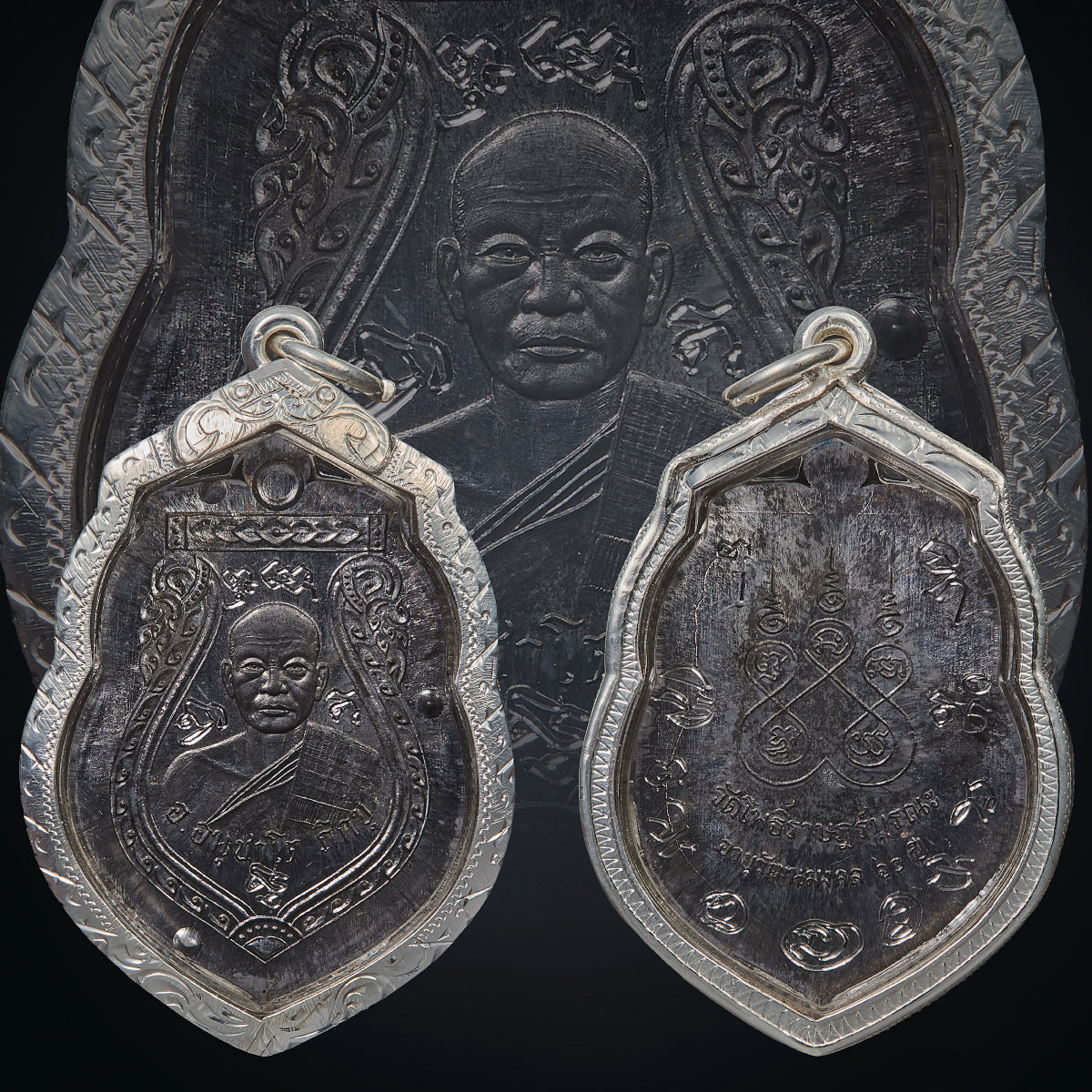
It is a test-mould piece cast in lead, produced during the preparation and evaluation of the Rian before the regular issue.
LP Anucha personally hand-Yanted this individual example on both the front and reverse.
Each medal was individually produced from prepared sacred metal, and the nature of rian means that differences in tone, patina, oxidation and surface character naturally occur from piece to piece. Such variations are part of the individuality of each example.
The photographs are representative only. A piece will be selected at random, and the item supplied may differ slightly from the exact piece shown in the images.
Personal Experiences Shared by Luksits
Among LP Anucha's established followers are a noticeable number of business owners, entrepreneurs and families whose relationships with respected Central Thai masters extend across generations.
During visits to Wat Pho Ratchaburana, I have met devotees who explained that their fathers had previously followed older masters such as LP Deang of Wat Khao Bandai-It, while their own generation gradually developed a relationship with LP Anucha.
One businessman involved in Thailand's beauty industry spoke particularly strongly about this continuity. His father had been a devoted collector of LP Deang, while he himself later began carrying LP Anucha's sacred objects. As his business expanded, he came to regard LP Anucha's blessings as an important spiritual companion alongside his own work and decision-making.
Other entrepreneurs have spoken of smoother negotiations, stronger customer relationships and greater confidence when confronting difficult periods.
What repeatedly appears in these accounts is the idea of steady progress rather than sudden transformation.
Customers return. Opportunities emerge. Difficult periods become manageable. Decisions become clearer.
For close devotees, personally hand-Yanted pieces carry another dimension. They are valued not simply because they belong to a particular batch, but because the individual object passed directly through the master's hands and received additional personal ritual attention.
Summary
This example of the Rian Ayu 60 brings together several characteristics that distinguish it from the ordinary first-batch medal.
It commemorates LP Anucha's 60th birthday and first Rian issue.
It is a lead test-mould example, connecting it directly with the developmental stage of the medal.
And it was subsequently hand-Yanted individually by LP Anucha on both sides.
The formal portrait and reverse Yant establish the intended identity of the Rian, while the additional handwritten characters transform this particular test piece into something individual.
For the collector, its importance therefore lies not simply in rarity for rarity's sake. It preserves part of the process through which LP Anucha's first Rian moved from mould preparation to finished sacred object.
Historical Background
LP Anucha of Wat Pho Ratchaburana, Ratchaburi, is known among his followers for combining Buddhist practice with traditional Central Thai Wiccha inherited and studied through several senior teachers.
His early spiritual foundation included study with LP Sanga, followed by further learning associated with masters including LP Non of Wat Khao Phran Thup and LP Boonkham. Over decades of practice, he developed knowledge in sacred inscription, consecration and protective ritual disciplines.
One area particularly associated with LP Anucha is Na Ma Pa Ta, the traditional contemplation and ritual application of the Four Great Elements — Earth, Water, Wind and Fire.
A frequently repeated account among his disciples concerns a major ceremony at Wat Pho Ratchaburana when severe weather approached the temple. Witnesses recalled LP Anucha performing his Wiccha as the wind direction subsequently changed and the storm moved away from the immediate ceremony area. The incident became well known among followers and contributed to his reputation for elemental practice.
LP Anucha nevertheless teaches that Wiccha and sacred objects should accompany Buddhist conduct rather than replace it.
His emphasis remains upon merit, discipline, generosity and personal effort.
Origins of the Materials
Unlike the Nuea Chanuan production examples of the Rian Ayu 60, this particular piece is made from lead.
Its significance therefore comes not from being a complex sacred alloy, but from its role as a test-mould material.
Lead has practical qualities that make it suitable for examining a mould. Its softness allows the relief and recesses of a design to register clearly, giving the maker an opportunity to assess the portrait, borders, inscriptions and other details before proceeding with wider production.
On this example, the material has developed a dark grey to charcoal appearance, giving the medal a very different visual character from copper or mixed-alloy versions.
The metal also provides an effective surface for the later hand-Yant work.
Here, the material tells part of the object's history.
It was not simply selected as another colour or metal variation within the finished series. It belongs to the preparatory stage of the Rian's creation.
Ritual
The ritual character of this piece developed beyond its original function as a test mould.
After the medal had served as part of the preparation of the issue, LP Anucha personally inscribed sacred Yant and characters upon both surfaces.
This distinction is important.
The moulded elements belong to the design of the Rian.
The additional lines belong to the master's hand.
On the front, individual sacred characters were added around the portrait and surrounding fields. On the reverse, the formal symmetrical Yant remains at the centre while additional hand inscriptions appear around the composition.
Within traditional Wicha, the act of writing Yant is connected with concentration, sacred formulae and the intention of the practitioner. It is therefore not treated merely as embellishment.
Because the inscriptions were made individually, their positioning, depth and composition naturally vary from one personally Yanted medal to another.
The result is effectively a one-to-one ritual intervention upon an already significant test piece.
Blessings and Effects
The Rian Ayu 60 is traditionally approached as a broad daily amulet rather than an object limited to one specialised branch of Wicha.
Protection and Klaew Klaad form an important part of this character. The medal may be carried for safe passage, avoidance of harmful circumstances and greater steadiness when confronting uncertain situations.
Baramee concerns personal standing, confidence and the ability to receive appropriate respect. This makes the Rian particularly relevant to people responsible for leadership, management or important decisions.
Metta Maha Niyom concerns goodwill and favourable human interaction. For businesspeople, this may be understood through smoother relationships with customers, colleagues, partners and those in positions of authority.
Prosperity and stability complete the broader character of the medal. Rather than being interpreted solely as sudden windfall fortune, this aspect is better understood through maintaining livelihood, recognising opportunities, protecting what has already been built and encouraging gradual progress.
In simple terms:
Protection guards the path.
Baramee strengthens one's position.
Metta improves the people around that path.
Prosperity helps the journey continue.
Modern Application
The broad character of the Rian Ayu 60 makes it appropriate for people whose daily lives involve responsibility and decision-making.
A business owner may approach it for stability, customer relationships and continued opportunity.
A manager or executive may value the Baramee and authority aspects.
Those involved in sales or negotiation may find its Metta associations particularly relevant.
For travellers, its protective and Klaew Klaad qualities provide another traditional dimension.
As a collector's piece, however, this particular example occupies a more specialised position.
Someone collecting LP Anucha by metal variation may seek copper or Chanuan examples. Someone documenting the development of his first Rian, however, will naturally pay particular attention to test-mould pieces because they belong to the period before the standard medal became established.
The personal hand-Yant work further separates this example from an ordinary production specimen.
Physical Details
The Rian Ayu 60 measures approximately 1.5 inches and this example is produced in lead as a test-mould piece.
Its obverse carries the familiar first-batch portrait of LP Anucha in monastic robes, surrounded by an ornate frame and Thai inscription. Across the field are additional individually engraved sacred characters personally applied by LP Anucha.
The reverse carries the formal looping Yant associated with the issue, together with the commemorative temple inscriptions beneath. Further hand-Yanted characters appear around the central composition.
The lead has developed a naturally dark charcoal-grey surface with lighter highlights over raised portions of the design. Marks and irregularities across the fields are consistent with the working character of a test piece and the subsequent process of hand inscription.
The medal is housed in a fitted silver-coloured protective casing, leaving both faces clearly visible.
Its appeal lies precisely in this combination of prototype character, dark lead surface and unmistakably individual hand work.
Recommended Pairing
For livelihood and continued material support, Phra Sivali provides a natural pairing, adding a more focused emphasis upon resources, sustenance and smooth passage.
For business and customer attraction, Nang Kwak complements the Rian's broader prosperity qualities.
For occupations dependent heavily upon communication, Salika adds persuasive speech and Metta Maha Niyom.
The Rian Ayu 60 itself remains broad enough to serve as a principal standalone amulet.
Personal Notes
There are several ways to collect a first-batch Rian.
One can collect the standard issue.
One can collect different metals.
One can seek unusual hand-Yanted examples.
But a test-mould piece personally hand-Yanted by the master records something different.
It preserves part of the process before the finished issue became established.
The lead body belongs to the development of the medal. The moulded portrait records the intended design. The individually scratched sacred characters record LP Anucha's subsequent personal involvement.
This makes the piece particularly fitting for a first batch.
The first Rian represents a beginning.
The test mould represents the stage before that beginning was finalised.
And the Yant across its surfaces preserve the hand of the master whose first medal was being created.
Not merely an early Rian, but a surviving part of how the first Rian came into being.
-
Free Shipping for Singapore| $15 Worldwide | $60 USA For Items Below $350