
OOBThaiAmulets
LP Anucha - Wat Pho Ratchaburana
LP Anucha - Wat Pho Ratchaburana
Couldn't load pickup availability
ANU01
Rian Sema Ayu 60
LP Anucha • Wat Pho Ratchaburana, Ratchaburi
B.E 2568
1 piece made (Test Mould, Uncut)
2.5 Inches
Mainstream artifact
Bio of LP Anucha: click here
Sacred Craftsmanship
The Rian Sema Ayu 60 was created to commemorate the 60th birthday of LP Anucha Anuchato of Wat Pho Ratchaburana, marking the completion of 5 Rob and forming part of his important first-batch medal lineage.
This particular example stands apart from the regular production pieces.
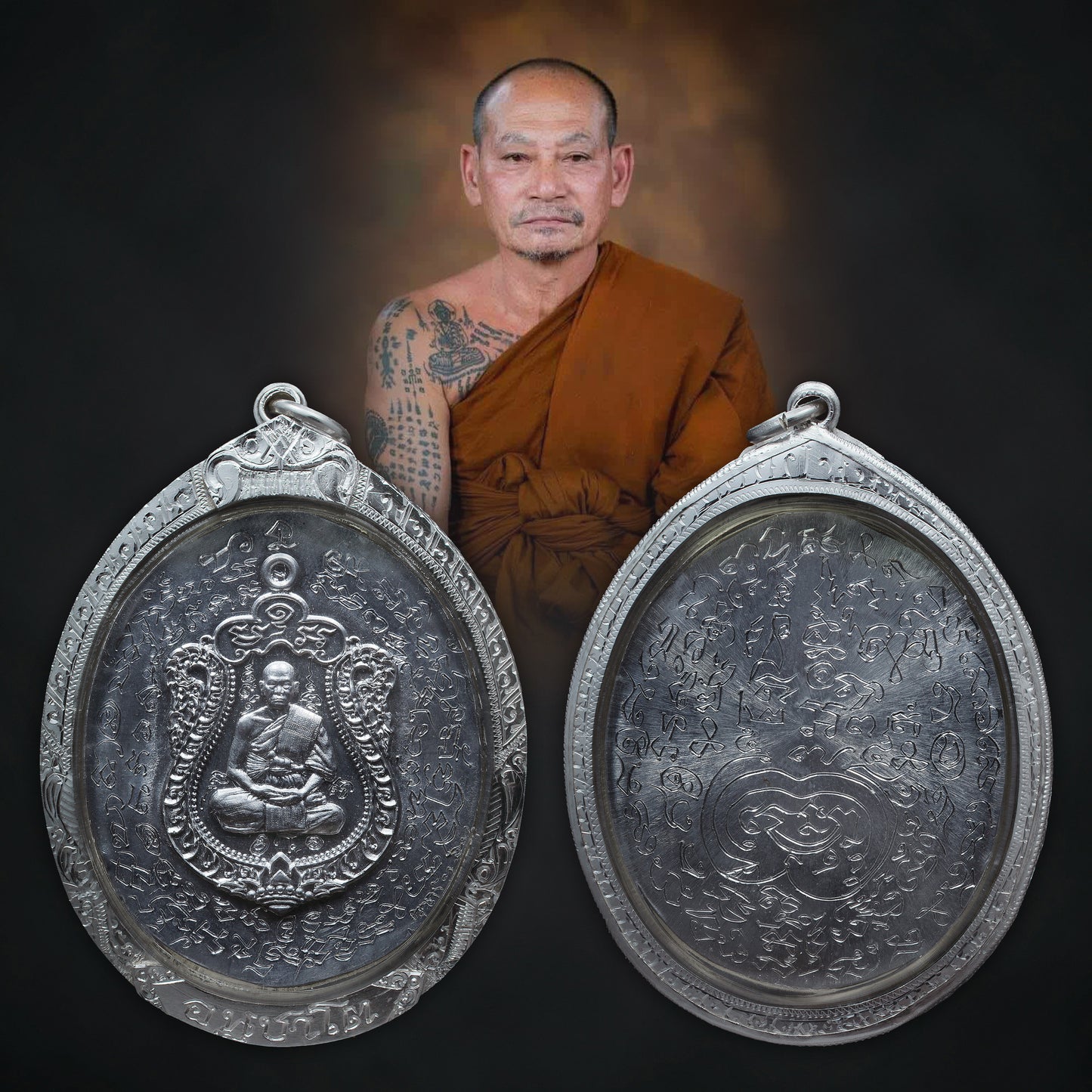
It is a lead test-mould example preserved in its uncut state. The reverse is Lang Liap — smooth-backed.
LP Anucha personally hand-Yanted the entire piece, front and back.
Each example was individually prepared from metal and personally worked by hand; variations in casting, surface, patina, inscription and form are therefore an integral part of its character and make every piece unique.
Personal Experiences Shared by Luksits
Among LP Anucha's followers, personally hand-Yanted pieces tend to occupy a different position from ordinary production medals.
Long-standing Luksits often value the physical evidence of the master's involvement. A standard Rian may have passed through the same consecration ceremony, but a piece such as this required LP Anucha to handle the medal directly and spend considerable time writing across its surfaces.
During visits to Wat Pho Ratchaburana, I have also encountered a notable number of business owners and established local devotees whose relationship with the tradition extends across generations.
Some explained that their fathers had followed respected older masters such as LP Deang of Wat Khao Bandai-It, while they themselves eventually developed a close relationship with LP Anucha.
One businessman involved in Thailand's beauty industry described how his father had collected LP Deang, while he later began carrying LP Anucha's sacred objects. As his business expanded, he came to regard LP Anucha's blessings as an important spiritual companion alongside his own work and judgement.
Other Luksits have spoken about smoother negotiations, stronger customer relationships, increased confidence during difficult decisions and greater stability during challenging periods.
Their accounts generally concern gradual improvement rather than sudden windfalls — customers returning, difficult situations becoming manageable and useful opportunities appearing at the right moment.
With a fully hand-Yanted piece such as this, the attraction is also more personal. The owner is not simply carrying LP Anucha's portrait.
He is carrying a piece upon which LP Anucha personally wrote his Wicha across virtually every available surface.
Summary
The Rian Sema Ayu 60 commemorates LP Anucha's 60th birthday and completion of 5 Rob, while belonging to his important first-batch medal lineage.
This particular example is distinguished by four characteristics:
Lead construction.
Test-mould origin.
Uncut form.
Fully hand-Yanted front and back by LP Anucha.
The front preserves the original moulded Sema portrait within a much larger uncut metal field. The reverse is Lang Liap, leaving an equally broad surface for personal inscription.
LP Anucha used both.
Rather than restricting his sacred writing to a small section, he covered the front and reverse extensively with handwritten Yant and sacred characters.
The result sits somewhere between a conventional Rian and a personally inscribed ritual object.
For collectors, its importance therefore comes not merely from rarity of format, but from the amount of direct work carried out upon it by the master himself.
Historical Background
In the traditional Thai calendar system, one Rob represents a twelve-year zodiac cycle. Five complete cycles equal sixty years, making 5 Rob an important milestone associated with maturity, accumulated experience and the completion of a major cycle of life.
The number five also carries established significance within Buddhist Wicha, most recognisably through Na Mo Phut Tha Ya, the five-syllable heart formula traditionally associated with the Five Buddhas of the present aeon.
The Ayu 60 issue therefore commemorates more than an ordinary birthday. It records LP Anucha reaching the completion of five full twelve-year cycles.
LP Anucha was born on 23 August 1964 in Nakhon Pathom Province. His early development was closely associated with LP Sanga of Wat Nong Muang, through whom he was introduced to meditation, sacred inscription and traditional Buddhist Wicha.
He first entered the monkhood in B.E. 2527 (1984) at Wat Nong Pho. After spending a period in lay life, he returned permanently to the monkhood at Wat Pho Ratchaburana on 10 August B.E. 2552 (2009).
His later development combined formal Buddhist study with traditional Wicha. Between B.E. 2556 and 2558 (2013–2015), he completed the Nak Tham sequence while continuing his ritual studies.
Additional branches of his learning are associated with masters including LP Non of Wat Khao Phran Thup, LP Boonkham of Wat Chaiyaphum and LP Od of Wat Bang Muang.
Sacred Yant inscription remains particularly relevant when examining a piece such as this. Rather than existing merely as imagery upon the medal, the inscriptions represent the living handwritten component of LP Anucha's Wicha.
Origins of the Materials
This example is made from lead, a material particularly suited to the production and examination of test impressions.
Its importance here does not lie in being an elaborate precious alloy. Instead, the material records part of the actual developmental process behind the first-batch Rian Sema.
The piece was produced as a test mould and remained uncut.
Normally, excess metal surrounding a medal would be removed as the piece progressed towards its finished form. Here, that stage was never completed. The broad outer field remains, surrounding the central Sema portrait like a frame.
That surviving metal subsequently became useful in an entirely different way.
LP Anucha used it as additional space for sacred inscription.
What originally existed because the medal was unfinished therefore became part of the finished ritual character of the object.
The same principle applies to the reverse. Because it is Lang Liap, the absence of a moulded reverse provided LP Anucha with a broad uninterrupted field upon which to write.
The production characteristics and ritual preparation consequently became inseparable.
Ritual
The defining ritual characteristic of this piece is the extent of LP Anucha's personal hand-Yant work.
The mould provided the portrait.
LP Anucha supplied the remainder.
On the obverse, sacred characters extend around the central Sema design and continue into the large uncut field. Rather than treating the excess metal as waste, he transformed it into additional space for Wicha.
The reverse was even more suitable for this purpose.
As a Lang Liap piece, its smooth surface provided an almost unrestricted field for individual sacred writing. LP Anucha filled the reverse extensively, combining larger central forms with numerous smaller sacred characters distributed around them.
This manner of preparation differs fundamentally from a medal carrying a pre-existing moulded Yant.
A mould reproduces the same composition repeatedly.
Hand-Yant records the master's individual action upon that particular object.
Within traditional Wicha, sacred writing is connected with the formula, concentration and intention of the practitioner. The writing is therefore not treated merely as decoration; it forms part of the ritual preparation itself.
This also explains why individually worked Lang Liap examples need not be identical. LP Anucha could adapt the composition to the available surface rather than reproduce a fixed mechanical pattern.
Blessings and Effects
Because the piece carries extensive personal inscriptions rather than being centred upon a single clearly specified specialised Yant, it is best approached as a broad LP Anucha Wicha piece.
Traditional protective qualities include Klaew Klaad, associated with avoiding accidents and dangerous circumstances, together with Kongkrapan Chatree, traditionally understood in relation to endurance and protection against physical harm.
Metta Maha Niyom concerns goodwill, acceptance and favourable treatment from others. This is particularly relevant for those whose occupations depend upon customers, negotiations and interpersonal relationships.
Baramee supports personal standing, composure and the ability to command respect without unnecessary confrontation.
Prosperity is approached in the same balanced manner found among many of LP Anucha's followers — not simply as sudden wealth, but as the ability to preserve one's position, recognise opportunities and continue progressing without unnecessary setbacks.
The 5 Rob symbolism adds a further dimension of completeness and stability.
Its traditional character may therefore be understood through four ideas:
Protection for the journey.
Metta for dealing with people.
Baramee for maintaining one's position.
Prosperity for continuing forward.
Modern Application
Despite its unusual construction, the underlying purpose remains practical.
For a business owner, the combination of prosperity, Metta and Baramee makes it relevant to customer relationships, negotiations and maintaining commercial stability.
For executives and managers, it can be approached for authority, calm judgement and protection during periods of responsibility.
Those who travel frequently may value its traditional protective associations.
Yet this particular example may appeal most strongly to the established collector of LP Anucha.
A standard production Rian represents the official issue.
An uncut test-mould piece represents part of the process by which that issue came into existence.
When that same test piece was subsequently covered front and back with LP Anucha's personal inscriptions, it acquired another level of individuality altogether.
Physical Details
This Rian Sema Ayu 60 measures approximately 5 cm and is produced from lead.
It is a test-mould example preserved uncut, leaving a broad oval field of metal surrounding the smaller moulded Sema portrait on the obverse.
The central front depicts LP Anucha seated in monastic robes within an ornate Sema-shaped frame. The surrounding lead field is densely covered with individually engraved sacred characters, extending around and beyond the original moulded design.
The reverse is Lang Liap, without the standard moulded reverse imagery. LP Anucha has used the broad surface extensively, filling it with individually written Yant, Na and sacred characters.
The lead displays a dark grey to charcoal appearance, with brighter highlights where the inscriptions and raised details catch the light.
The entire piece is housed within a fitted silver-coloured protective casing, leaving both of the heavily worked surfaces visible.
Its irregular hand inscriptions, surface marks and differences in depth are not shortcomings. They are evidence of the individual manner in which the piece was worked.
Recommended Pairing
For those carrying the Rian primarily for Buddhist Baramee and spiritual steadiness, Phra Somdej provides a natural and balanced pairing.
For livelihood and continuing resources, Phra Sivali complements the prosperity aspect without duplicating the character of the Rian.
Those working in sales, negotiation or customer-facing occupations may pair it with Salika, placing additional emphasis upon communication, persuasive speech and Metta Maha Niyom.
For a stronger specialised protective arrangement, a Klaew Klaad or Kongkrapan Takrut can complement the broader protective character of LP Anucha's handwritten Wicha.
The Rian itself, however, is sufficiently comprehensive to function as a principal standalone piece.
Personal Notes
There is something particularly revealing about an uncut test-mould medal.
Ordinarily, a test piece belongs to the technical history of an amulet. It records mould preparation, metal behaviour and the transition towards the final production piece.
This example went further.
LP Anucha took that unfinished object and personally filled it with Wicha.
The excess metal was no longer simply excess metal. It became additional room for sacred writing.
The smooth reverse was no longer simply an unfinished reverse. It became an entire field for handwritten Yant.
In that sense, the piece preserves two different stages of creation at once:
The mould records the hand of the craftsman.
The inscriptions record the hand of the master.
And because LP Anucha worked extensively across both front and back, this is not simply a rare variation of the Rian Sema Ayu 60.
It is an individually completed piece in which the unfinished character of the test mould became the very reason LP Anucha was able to place so much of his personal Wicha upon it.
-
Free Shipping for Singapore| $15 Worldwide | $60 USA For Items Below $350