
OOBThaiAmulets
LP Anucha - Wat Pho Ratchaburana
LP Anucha - Wat Pho Ratchaburana
Couldn't load pickup availability
ANU01
Phra Somdej
LP Anucha • Wat Pho Ratchaburana, Ratchaburi
B.E. 2565–2568
2 Inches
Mainstream Artifact
Bio of LP Anucha: click here
Sacred Craftsmanship
The Phra Somdej belongs to the earlier period of sacred-object creation by LP Anucha of Wat Pho Ratchaburana, produced before many of his later medal issues became more widely known among collectors.
Each artifact is individually handmade from carefully prepared sacred materials, so natural variations in texture, colour, form, moulding and handwritten Yant make every piece truly unique.
The photographs are representative only. A piece will be selected at random, and the item supplied may differ slightly from the exact piece shown in the images.
Personal Experiences Shared by Luksits
I personally collected this Phra Somdej during my visit to LP Anucha in B.E. 2568.
There was quite a queue of devotees waiting to see him.
Meeting LP Anucha could require patience because he was not necessarily at Wat Pho Ratchaburana throughout the day. At times he would be invited to other temples to participate in ceremonies, while on other occasions he might be away blessing the homes, shops or businesses of his devotees.
This gave an interesting perspective on the relationship between LP Anucha and his luksits. His role extended beyond simply producing sacred objects at the temple; devotees also approached him for blessings connected with their homes, livelihoods and important occasions.
These earlier powder amulets were particularly memorable because of the direct involvement of LP Anucha.
When the amulets were collected, LP Anucha personally hand-Yanted individual pieces. The reverse became a surface upon which he could write according to his Wicha rather than merely following a standard design already produced by the mould.
As a result, when several examples are compared, the Yant may differ considerably.
One piece may carry a dense arrangement of characters. Another may have a more open composition. Certain sacred forms may appear prominently on one example but differently on another.
For the collector, this individuality preserves something of the direct encounter with the master: the amulet was moulded by hand, and its sacred inscription was completed by hand.
Summary
This early Phra Somdej of LP Anucha combines three elements that give it particular character.
The first is the traditional Phra Somdej Buddha image.
The second is its material body, prepared from numerous older temple and religious substances rather than a simple modern powder mixture.
The third is LP Anucha's direct involvement through his personal handwritten Yant.
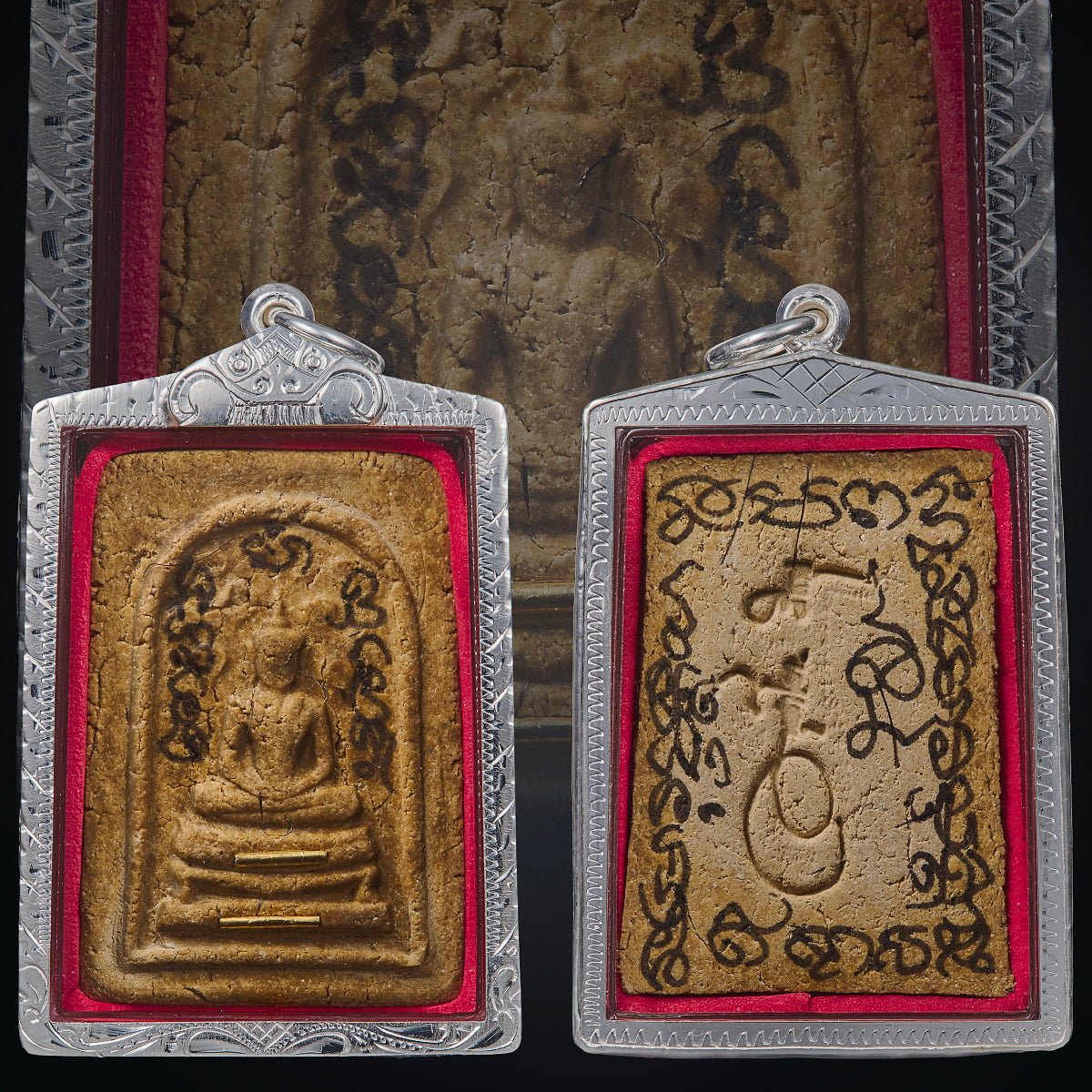
The example shown is further distinguished by two Takruts embedded within the front base beneath the Buddha.
Rather than being valued for perfect uniformity, these pieces are better understood through their individuality. Differences in powder, surface, moulding and Yant record the handmade process through which they were created.
They represent an earlier and particularly personal chapter of LP Anucha's sacred-object work.
Historical Background
The Phra Somdej is one of the most enduring forms within Thai Buddhist amulet culture.
Its visual language is remarkably simple: the Buddha seated in meditation, usually beneath an arch and upon a tiered base. Yet this simplicity is precisely what has allowed generations of monks and temples to interpret the form through their own materials, moulds and Wicha.
For devotees, the seated Buddha represents composure and stability. The surrounding arch creates the impression of a protected sacred space, while the ascending tiers beneath the Buddha establish a firm visual foundation.
LP Anucha's early Phra Somdej follows this established tradition while incorporating the practices associated with his own temple work.
Rather than separating old sacred materials from newly produced amulets, materials connected with earlier religious use were incorporated into a new powder mixture. Ancient temple substances, devotional materials and ritual powders could therefore continue within another generation of sacred objects.
This principle of continuity is an important feature of traditional Thai amulet making.
Something old is not necessarily discarded.
It may instead become part of something new.
Origins of the Materials
The powder body of this Phra Somdej was prepared from a mixture of materials carrying different associations within Thai Buddhist practice.
Powdered ancient temple bricks connect the physical body of the amulet with older religious structures and places where generations of worship had taken place.
Old gold leaf from principal Buddha images originated from the devotional practice of applying gold as an offering and expression of reverence.
Sacred incense ash from long-standing altars represents another form of accumulated temple material, produced through repeated acts of prayer and offering.
The mixture also incorporated fragments of relic materials associated with respected monks, together with traditional Yant powders prepared during temple ceremonies.
Particularly interesting is the inclusion of material from old palm-leaf scriptures. Palm leaves were historically used throughout the region to preserve Buddhist scripture, teachings and traditional knowledge. Their inclusion gives the powder another connection with older religious practice.
Because these substances were combined rather than refined into a perfectly homogeneous industrial mixture, the finished amulets naturally vary.
Small fibres, particles and occasional hairs may remain visible within certain examples.
These are characteristics of the material rather than something that should automatically be regarded as an imperfection.
Ritual
The preparation of the Phra Somdej began with the gathering and combining of its various sacred materials.
Once prepared, the powder mixture was pressed individually into the mould by hand.
The front mould established the Buddha image, arch and tiered throne. In examples such as the piece shown, Takruts were incorporated into the lower front section, physically joining these ritual components to the powder body.
After the amulet had been formed, LP Anucha's personal involvement continued through sacred inscription.
He hand-Yanted individual pieces himself.
This is an important distinction.
A moulded Yant is reproduced whenever another amulet is pressed. A handwritten Yant records a separate act carried out upon the individual object.
The reverse of this example shows precisely this character. The powder surface carries a broad arrangement of sacred characters and lines applied directly over the amulet rather than being formed as part of the mould.
Within traditional practice, such Yant are not regarded merely as decoration. They belong to systems of sacred writing connected with particular formulas, intentions and recitations.
The completed amulet therefore brings together sacred material, Buddha image, embedded Takruts, handwritten Yant and consecration.
Blessings and Effects
The Phra Somdej is traditionally regarded as a broad and balanced Buddhist amulet rather than one confined to a single specialised purpose.
Within LP Anucha's practice, such pieces are associated particularly with Metta Maha Niyom, protection, business prosperity, luck and Baramee.
Metta Maha Niyom concerns goodwill and favourable human relationships. For someone working with customers, colleagues, business partners or people in authority, this is traditionally approached as support for smoother interaction and greater receptiveness from others.
Baramee concerns personal standing. Rather than aggressive authority, it is associated with the ability to command natural respect through one's presence and conduct.
Protective qualities complement this by supporting the wearer against adverse circumstances and helping maintain stability during difficult periods.
Prosperity and luck are approached in a similarly practical manner: opportunity, continuity of livelihood, smoother progress and the ability to preserve what has already been built.
The combination may therefore be understood as:
Somdej for Baramee and stability.
Yant for the directed Wicha.
Takrut for concentrated ritual support.
Sacred powders for continuity with older temple materials.
Modern Application
The broad nature of the Phra Somdej makes this piece particularly suitable for daily wear.
A business owner may approach it for customer relations, stability and continued prosperity.
Someone working in sales or client-facing occupations may place greater emphasis upon its Metta Maha Niyom qualities.
Managers and professionals may appreciate the traditional association with Baramee, composure and favourable dealings with others.
Those who travel frequently may approach its protective aspect, while collectors may value the piece for an entirely different reason: it documents an earlier handmade period of LP Anucha's amulet production.
It can therefore be understood both as a devotional amulet and as an object recording the development of LP Anucha's sacred-object lineage.
Physical Details
This Phra Somdej has a rectangular sacred-powder body of warm brown to ochre tone, with a naturally granular surface, visible age and small variations arising from its hand-prepared composition. The obverse depicts a seated Buddha beneath a rounded arch and upon a multi-tiered base, with two small horizontal Takruts visibly embedded into the lower tiers. Sacred writing is also present around portions of the front. The reverse remains comparatively flat and is extensively hand-Yanted in black by LP Anucha, with the individual strokes clearly distinguishable from moulded relief. The example shown is housed within a silver-coloured protective casing with a red inner surround.
Recommended Pairing
For devotees seeking greater emphasis upon livelihood and continuous resources, Phra Sivali is a natural companion to the broad Baramee and protective qualities of Phra Somdej.
For occupations strongly dependent upon speech, sales and negotiation, Salika can provide a more specialised Metta and communication emphasis.
A protective Takrut may also complement the Somdej for those who travel extensively or work in environments where additional Klaew Klaad qualities are desired.
Nevertheless, the strength of the Phra Somdej tradition lies partly in its completeness. This piece can comfortably function as a principal standalone daily amulet.
Personal Notes
What appeals to me about these earlier LP Anucha powder amulets is that their individuality is immediately visible.
They were not created to look perfectly identical.
One piece may be darker. Another may contain more visible fibres or fragments. The Buddha impression may differ slightly according to the pressure used when moulding it. Even the texture of the powder can change according to the distribution of the old sacred materials.
Most importantly, the handwritten Yant are individual.
I collected this example during my B.E. 2568 visit to LP Anucha, at a time when there was already a considerable queue of people waiting to see him. Yet the practice of personally applying Yant to individual amulets retained the intimate character of older Thai sacred-object traditions.
The two embedded Takruts add another dimension to this particular piece, but its deeper appeal remains the relationship between the old materials and the hand of the living master.
Old temple materials formed its body.
The Buddha gave it its sacred form.
Takruts were incorporated into its foundation.
LP Anucha's own hand completed its Yant.
For a collector of his work, this Phra Somdej preserves an especially personal record of the earlier period of LP Anucha and Wat Pho Ratchaburana.
-
Free Shipping for Singapore| $15 Worldwide | $100 USA All products