
OOBThaiAmulets
LP Anucha - Wat Pho Ratchaburana
LP Anucha - Wat Pho Ratchaburana
Couldn't load pickup availability
ANU01
Phra Somdej Pro Pok
LP Anucha • Wat Pho Ratchaburana, Ratchaburi
B.E. 2565–2568
1.5 Inches
Mainstream Artifact
Bio of LP Anucha: click here
Sacred Craftsmanship
The Phra Somdej Pro Pok belongs to the earlier period of sacred-object creation by LP Anucha of Wat Pho Ratchaburana, produced before many of his later medal issues became more widely known among collectors.
Each artifact is individually handmade from carefully prepared sacred materials, so natural variations in texture, colour, form, moulding and handwritten Yant make every piece truly unique.
The photographs are representative only. A piece will be selected at random, and the item supplied may differ slightly from the exact piece shown in the images.
Personal Experiences Shared by Luksits
I personally collected this Phra Somdej Pro Pok during my visit to LP Anucha in B.E. 2568.
There was already quite a queue waiting to see him.
Visiting LP Anucha did not necessarily mean that he would always be sitting at the temple receiving devotees. At times he could be away attending consecration ceremonies or religious functions at other temples. On other occasions, he might have been invited to bless the homes, shops or businesses of followers.
This made the opportunity to meet him personally part of the experience of collecting these earlier pieces.
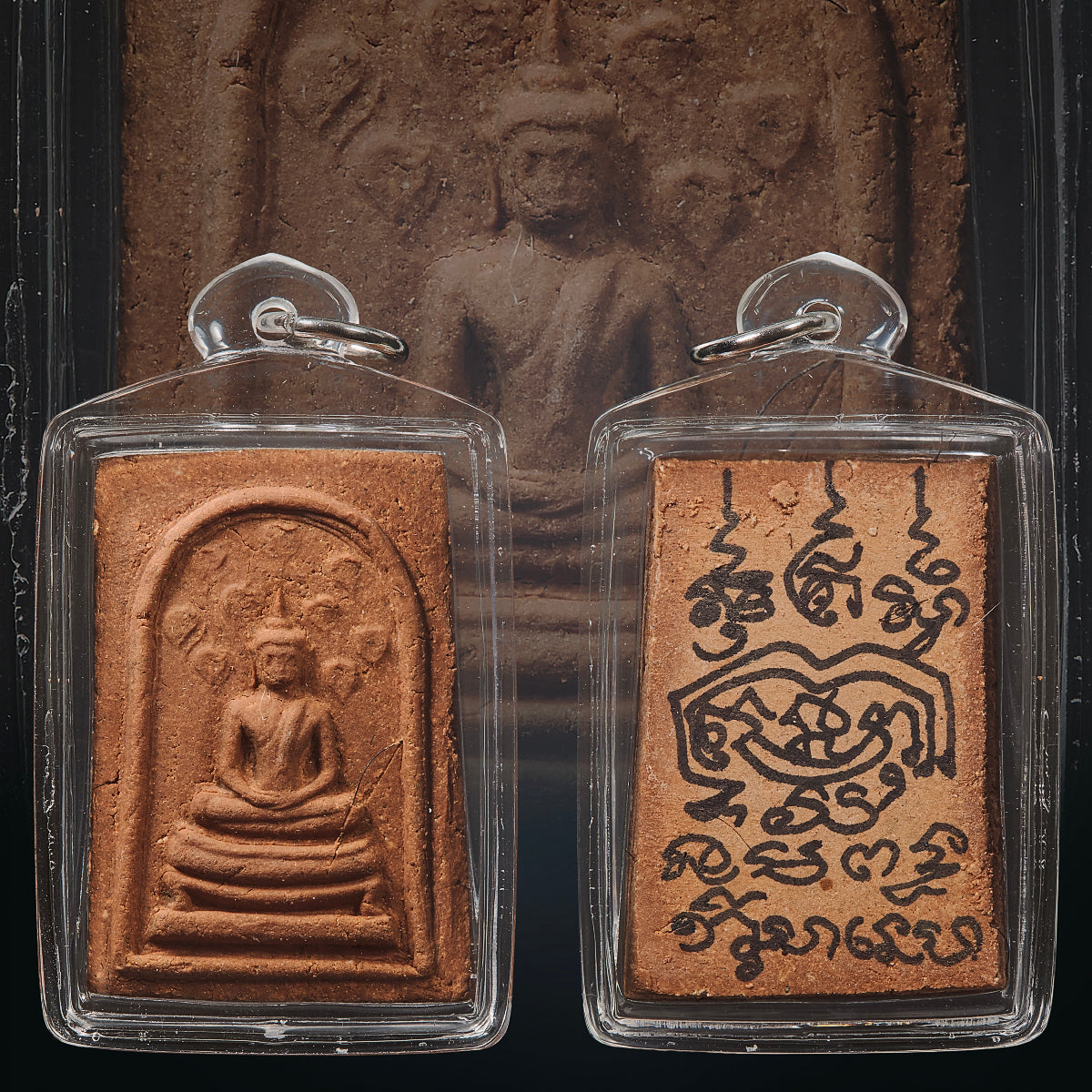
When the amulet was presented to him, LP Anucha personally hand-Yanted the individual piece. This was not simply a standard printed marking already present on every amulet. The inscription was applied directly to the powder surface, meaning that the finished Yant naturally differed between individual examples.
Looking at the reverse today, that distinction remains immediately visible. The lines have the spontaneous character of handwriting rather than a mechanically reproduced design.
For me, this is an important part of the amulet's provenance. It records not only an early period of LP Anucha's amulet making, but also a time when an individual devotee could bring such a piece before him and receive his handwritten Yant directly.
Summary
The Phra Somdej Pro Pok is an early hand-prepared powder amulet of LP Anucha with a particularly strong connection to Wat Pho Ratchaburana itself.
Its sacred material included powder from old roof tiles of the temple's Ubosot, prepared together with the wider sacred mixture and personally pressed by LP Anucha.
The amulets were distributed in connection with donations towards construction of the Wihan Buraphachan, linking the creation with Bucha Kru — gratitude and reverence towards the masters of the lineage.
The front follows the familiar devotional language of Phra Somdej.
The material carries part of the old temple.
The handmade body preserves the character of LP Anucha's earlier work.
The reverse carries his individually drawn Yant.
For collectors, these qualities give the Phra Somdej Pro Pok a character quite different from a later mass-produced commemorative issue.
Historical Background
Phra Somdej occupies one of the most established positions within Thai Buddhist amulet tradition.
The seated Buddha beneath an architectural or sacred arch is deliberately simple. Rather than depending upon elaborate narrative imagery, the form centres attention upon the Buddha and the qualities traditionally associated with Buddhist refuge, merit, composure and Baramee.
LP Anucha's Phra Somdej Pro Pok follows this broader tradition while retaining characteristics particular to his own early sacred-object production.
The accompanying Thai account describes the batch as:
“another opening chapter that may become part of the legend of the Mae Klong river basin.”
It explains that the sacred powder was mixed with material from the Ubosot roof tiles, personally prepared and hand-pressed by Anuchato Bhikkhu — LP Anucha — for presentation to disciples and charitable devotees supporting Buddhism and contributing towards the Wihan Buraphachan.
The original account concludes with an especially telling sentiment: something newly created today may not yet appear particularly valuable, but in the future its value may become impossible to compare.
Within the context of the batch, this should be understood less as a promise of financial appreciation than as an expression of the belief that objects directly connected with an early period of a master's work can acquire increasing historical and devotional significance as time passes.
Origins of the Materials
One of the defining ingredients of this Phra Somdej is the use of old Ubosot roof-tile material.
An Ubosot is not simply another temple building. It is the consecrated ordination hall and occupies a central position within Thai Buddhist monastic life.
Material originating from such a structure therefore carries a direct physical connection with the temple environment.
For this batch, old roof-tile material was reduced into powder and incorporated into the sacred mass from which the amulets were formed.
The importance lies partly in continuity.
A material that had once formed part of the temple architecture was not simply discarded when its original purpose ended. It entered another devotional form and could subsequently be carried by the temple's disciples.
The resulting powder is visibly organic and irregular. Variations in grain, small inclusions and fibres can be observed within individual pieces, while fine hair strands are also visible in some examples.
Such characteristics are consistent with the intentionally handmade nature of these early powder amulets.
Ritual
The preparation of the Phra Somdej Pro Pok followed an unusually personal process.
LP Anucha is described as having personally pounded and prepared the sacred material mixture before forming the individual pieces.
The amulets were then pressed by hand, rather than being produced through an industrial manufacturing process. This inevitably created small differences between pieces: pressure within the mould, density of powder, edges, surface texture and clarity of detail could all vary.
Once the physical form had been completed, another stage could follow — personal Yant inscription.
Upon collection, individual pieces were brought before LP Anucha and he faithfully inscribed them by hand. The reverse offered a broad surface for this work, allowing the Yant to become a major component of the finished artifact.
Within traditional Wicha, the importance of such writing does not rest upon decorative symmetry. The sacred characters belong to ritual formulae transmitted through teachers and practice.
This explains why the inscriptions need not look identical.
The mould establishes the common form of the batch.
The master's hand distinguishes the individual piece.
Blessings and Effects
As a Phra Somdej, the amulet is naturally associated with broad Buddhist blessings rather than one narrowly defined objective.
Its traditional character centres upon Baramee, protection, stability, auspiciousness and support in overcoming obstacles.
Baramee is especially relevant to the Somdej form. For devotees, it may be understood as strengthening personal dignity, composure and the manner in which a person is regarded by others.
The amulet may also be approached for Metta Maha Niyom, encouraging goodwill and favourable relationships with those encountered in everyday life.
For working devotees and business owners, these qualities can extend naturally towards livelihood: smoother relationships, greater stability, useful opportunities and protection of what has already been established.
The Pro Pok character may also be understood in the traditional sense of covering, sheltering or protecting, making the amulet particularly suitable as a general daily piece rather than an object concerned solely with one specialised branch of Wicha.
Modern Application
The Phra Somdej Pro Pok is especially suitable for someone wanting a balanced principal amulet.
It does not require the wearer to be involved in a particular occupation or situation. Its broad character makes it equally relevant to business owners, professionals, travellers, families or those simply seeking a traditional Buddhist amulet for everyday wear.
For someone facing responsibility or leadership, the Somdej association with Baramee and composure is particularly appropriate.
For businesspeople, the combination of Metta, stability and auspicious progress can complement the practical requirements of dealing with customers, employees and business partners.
Yet its strongest appeal may ultimately be devotional.
This is an amulet whose material came partly from the temple itself, whose body was personally prepared and hand-pressed by LP Anucha, and whose individual Yant could subsequently be added directly by him.
It therefore retains a tangible connection with both master and temple.
Physical Details
The Phra Somdej Pro Pok is a rectangular hand-pressed sacred-powder amulet with a warm reddish-brown tone and visibly granular surface. The obverse depicts a seated Buddha upon a tiered base beneath an arched frame, with additional figures or sacred forms appearing around the upper field. Small inclusions, fibres and natural irregularities remain visible within the powder body, including fine hair strands in some examples. The reverse is comparatively plain from the mould and serves as the principal field for LP Anucha's large handwritten Yant, executed directly in dark ink. The example is housed in a clear protective casing.
Recommended Pairing
Because the Phra Somdej already provides a broad foundation of Buddhist protection and Baramee, any pairing can be selected according to the wearer's more specialised needs.
Phra Sivali is appropriate where livelihood, resources and continued material support are the priority.
For occupations dependent heavily upon communication, sales or negotiation, Salika can add a more concentrated emphasis upon persuasive speech and Metta Maha Niyom.
A Khun Paen may complement the Somdej where stronger emphasis upon personal attraction, social interaction and opportunity is desired.
The Phra Somdej Pro Pok itself, however, is sufficiently broad to serve comfortably as the principal amulet in a daily set.
Personal Notes
There is something particularly meaningful about sacred objects made from the fabric of an old temple.
The roof tiles of the Ubosot once sheltered a consecrated Buddhist space. When those materials reached the end of their architectural purpose, part of them entered a different form.
They became sacred powder.
That powder was personally prepared by LP Anucha.
It was pressed by hand into Phra Somdej.
The resulting amulets were then given to disciples and devotees contributing towards a new religious structure — the Wihan Buraphachan, created in honour of the teachers who came before.
There is a quiet continuity in that process.
Material from an older sacred structure helped support the creation of another.
Respect for the Buddha was joined with gratitude towards the teachers.
And an old temple material became something that devotees could carry with them.
My own example adds one final layer to that history.
It was collected during my visit in B.E. 2568, when I waited among the devotees to meet LP Anucha, and the individual piece was personally hand-Yanted by him.
The handwritten reverse therefore matters as much as the moulded front.
The front identifies the tradition.
The reverse records the hand of the master.
-
Free Shipping for Singapore| $15 Worldwide | $100 USA All products