
OOBThaiAmulets
LP Anucha - Wat Pho Ratchaburana
LP Anucha - Wat Pho Ratchaburana
Couldn't load pickup availability
ANU01
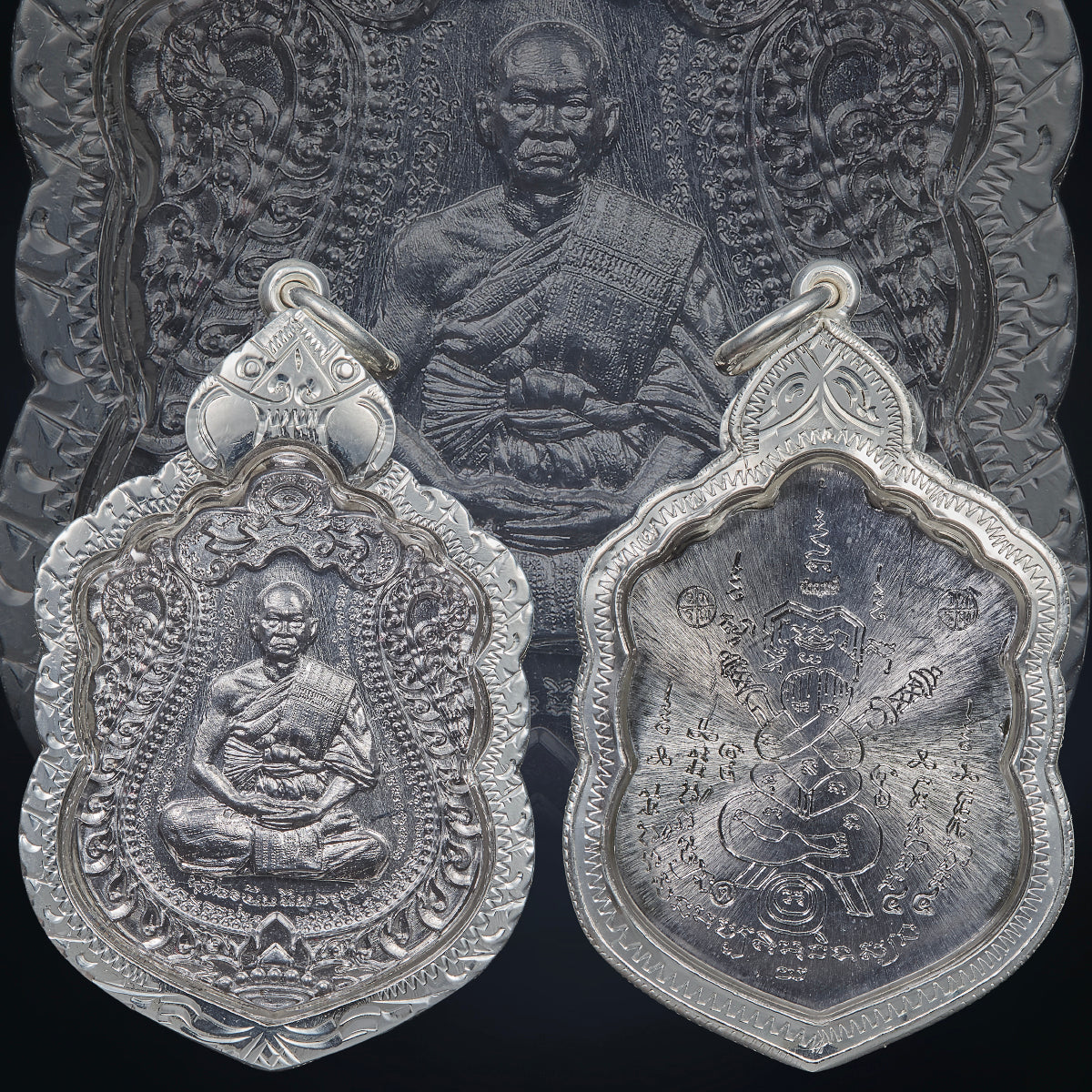
Rian Sema Ayu 60 - Lang Yant Pidta
LP Anucha • Wat Pho Ratchaburana, Ratchaburi
1st Batch • 60th Birthday / 5 Rob Commemorative Issue
B.E. 2568
5cm
Mainstream Artifact
Bio of LP Anucha: click here
Sacred Craftsmanship
The Rian Sema Ayu 60 was created to commemorate an important milestone in the life of LP Anucha of Wat Pho Ratchaburana — his 60th birthday, or 5 Rob.
Both the front and reverse received LP Anucha's personal attention, but the defining feature of this example is the large Yant Pidta drawn by him across the smooth reverse.
Each medal was individually produced and subsequently worked upon by hand, so natural variations in surface, tone, inscription and finishing give every piece its own character.
The photographs are representative only. A piece will be selected at random, and the item supplied may differ slightly from the exact piece shown in the images
Personal Experiences Shared by Luksits
Among close devotees, the Lang Liap pieces have particular appeal because of the direct involvement of LP Anucha.
Rather than receiving only the standard design of the commemorative batch, the devotee could present a smooth-backed piece to the master and receive an individually drawn Yantra. For many Luksits, this personal element carries a different meaning from owning an ordinary production medal.
The Yant chosen could also vary according to the individual piece. Consequently, collectors may encounter examples carrying different configurations associated with protection, Metta, authority, prosperity or other branches of LP Anucha's Wicha.
The present example carries Yant Pidta, giving it a distinctly protective and inwardly stabilising character.
Nevertheless, long-term devotees commonly value LP Anucha's hand-yanted pieces for the sense of protection, steadiness and confidence they associate with carrying something personally worked upon by their teacher.
Summary
The Rian Sema Ayu 60 — Yant Pidta brings together three important elements of LP Anucha's work.
It commemorates his 60th birthday and completion of 5 Rob; it belongs to his first batch; and its smooth reverse became the foundation for a personally inscribed Yant Pidta.
The Pidta aspect changes the character of the medal considerably. Rather than concentrating solely upon commemorating the master, it introduces the traditional symbolism of closing oneself against harmful external influences while preserving what is beneficial within.
Within traditional belief, this gives the piece a broad character encompassing:
- protection and Klaew Klaad;
- defence against harmful intentions and negative spiritual influence;
- preservation of fortune;
- prosperity and favourable opportunity;
- calmness and mental stability;
- Metta Maha Niyom;
- support during difficult or uncertain periods.
It is therefore both a milestone medal and an individually worked Wicha piece.
Historical Background
The significance of 5 Rob deserves particular attention.
Traditional Thai age cycles commonly count twelve years as one Rob. Completing five cycles marks the age of sixty — a major life milestone associated with maturity, accumulated merit and the completion of an important cycle of life.
For respected monks and masters, a 60th-birthday issue consequently carries more significance than an ordinary commemorative release. It records a particular stage in the master's monastic and spiritual journey.
The number five also has considerable symbolic importance within Thai Buddhist Wicha. One important association is Na Mo Phut Tha Ya, the five-syllable sacred formula traditionally connected with the Five Buddhas of the present aeon.
Within different lineages, the formula appears in protective, Metta and auspicious practices.
The Rian Ayu 60 therefore commemorates more than chronological age. For followers of LP Anucha, it records the completion of five twelve-year cycles and the accumulated practice represented by those sixty years.
Origins of the Materials
This example was produced in lead, a material with a long history in Thai sacred-object making.
For a Lang Liap medal, lead also offers an important practical advantage: it provides a receptive surface for individual inscription.
The front carries the detailed moulded portrait composition of LP Anucha within the elaborate Sema form. The reverse, by contrast, was intentionally kept smooth.
This untouched rear field effectively became LP Anucha's personal ritual surface.
Instead of a standard reverse being reproduced identically across every medal, sacred characters could be drawn directly into each individual piece. In this example, the principal composition is Yant Pidta.
The physical material and the handwritten Wicha therefore work together: the mould establishes the commemorative identity, while the master's own hand gives the individual medal its particular ritual character.
Ritual
After production, the Lang Liap medal was not regarded as complete merely because the metal had taken its final form.
LP Anucha personally inscribed sacred characters and Yantra upon these selected pieces before their blessing and consecration.
For this example, the central rear composition was prepared as Yant Pidta.
Phra Pidta — literally associated with the act of closing or covering — is traditionally represented with the hands covering the sensory openings, particularly the eyes. In Buddhist interpretation, this recalls withdrawal from external distraction and the cultivation of inner stillness.
Within Thai Wicha, the symbolism developed an additional protective dimension: closing the paths through which danger, harmful intention and misfortune might enter.
The handwritten Yantra therefore becomes particularly appropriate on the reverse of a medal worn close to the body.
The object faces outward through the image of LP Anucha while the Pidta Wicha rests behind it, symbolically guarding the wearer from the unseen side.
Blessings and Effects
The principal character of this particular Lang Liap example comes from Yant Pidta.
Protection forms its foundation. Traditional belief associates Pidta Wicha with closing away danger, hostile intentions, spiritual disturbances and circumstances capable of bringing unnecessary harm.
Klaew Klaad concerns avoidance — passing through dangerous situations without becoming caught within them. Rather than meeting every obstacle directly, the emphasis is upon circumstances shifting so that trouble does not fully reach the owner.
Protection against harmful spiritual influence is another traditional association. Pidta symbolism is frequently understood as creating a spiritual boundary between the practitioner and unwanted outside forces.
At the same time, Pidta is not purely defensive.
It is also strongly associated with keeping and preserving fortune. Symbolically, what should remain outside is closed away, while what has already entered — wealth, opportunity and merit — is retained.
This gives the medal a natural relationship with Maha Lap and prosperity, particularly for owners concerned not simply with earning money but with maintaining financial stability.
The meditative symbolism of Phra Pidta further contributes associations with calmness, concentration and clarity, qualities useful when decisions must be made under pressure.
Together, the traditional character can be understood as:
close away harm, preserve fortune, maintain composure and allow beneficial opportunities to remain.
Modern Application
The Yant Pidta version is particularly relevant for people whose daily lives expose them to uncertainty, competition or continual interaction with others.
Business owners may appreciate the combination of protection and preservation of fortune. Executives and managers may value its association with calm judgement. Those travelling frequently may connect with its Klaew Klaad aspect, while people working in competitive environments may appreciate the traditional idea of closing away hostility, gossip and harmful intentions.
It is equally suitable as a general daily amulet because its symbolism is broad rather than narrowly specialised.
Where some sacred objects are intended primarily to attract, the Pidta principle is different.
It is concerned with what should be allowed into one's life — and what should remain outside.
Physical Details
This is a 5 cm Rian Sema Ayu 60, first batch, issued for LP Anucha's 60th birthday in B.E. 2568 and made from lead. The front is moulded in an ornate Sema format, with LP Anucha seated centrally within an elaborate traditional frame. The reverse is the Lang Liap, or smooth-back type, providing the open surface upon which LP Anucha personally inscribed the large Yant Pidta and surrounding sacred characters.
The photographed example shows the naturally subdued grey tone of aged lead, with visible hand-worked lines across the reverse. These irregularities are part of the character of a personally Yanted piece rather than the uniform finish expected from machine engraving.
Recommended Pairing
For a balanced daily arrangement, this Yant Pidta medal pairs naturally with Nang Kwak when the priority is business and customer attraction: Nang Kwak calls opportunity towards the owner, while Pidta traditionally helps guard and retain what has been gained.
For livelihood and steady sustenance, Phra Sivali is another complementary choice. For stronger outward Baramee and authority, Phra Somdej provides a more commanding counterpart to the inward protective character of Pidta.
The combination can be understood simply:
Pidta closes away what is harmful, while complementary Metta or prosperity Wicha encourages what is beneficial to enter.
Personal Notes
Among the Rian Sema Ayu 60 variants, the Lang Liap pieces are particularly personal examples because the smooth reverse allowed LP Anucha to work directly upon the individual medal.
The importance is not merely that a Yantra appears on the back. It is that the Yantra was personally drawn rather than reproduced as part of the mould.
This also explains why collectors should not expect every Lang Liap to look alike. One may carry Yant Mongkut, another a Suer-related Yant, while this example carries Yant Pidta. The differences preserve something of the circumstances under which each individual medal passed through LP Anucha's hands.
For this particular piece, the Pidta composition gives the 5 Rob commemorative medal an especially balanced character:
protection without aggression, prosperity with preservation, and strength expressed through calmness rather than confrontation.
-
Free Shipping for Singapore| $15 Worldwide | $100 USA All products