
OOBThaiAmulets
LP Anucha - Wat Pho Ratchaburana
LP Anucha - Wat Pho Ratchaburana
Couldn't load pickup availability
ANU01
Moo Roop
LP Anucha • Wat Pho Ratchaburana, Ratchaburi
1.5 Inches
Mainstream Artifact
-1 Pc Only -
Bio of LP Anucha: click here
Sacred Craftsmanship
The Moo Roop is an unusual sacred charm associated with LP Anucha of Wat Pho Ratchaburana, Ratchaburi. Unlike conventional Thai amulets featuring Buddha images, revered monks or mythological creatures, this particular piece takes the form of a domestic pig, commemorating the first pig raised and cared for at the temple.
Exact Pc in photo will be sent
Each Moo is individually crafted and prepared, with natural variations in surface texture, colour, carving details and form contributing to the individual character of each piece.
Personal Experiences Shared by Luksits
The Temple Pigs and Their Connection to LP Anucha
One of the more interesting aspects of the Moo is the story behind its creation.
Visitors familiar with Wat Pho Ratchaburana may know that pigs have been kept within the temple grounds for several generations.
Unlike livestock raised for commercial purposes, these animals are allowed to roam freely.
They have become accustomed to the presence of monks, devotees and visitors, developing a friendly and approachable temperament.
The first pig eventually passed away, but its descendants continued to remain at the temple.
Today, according to the account associated with the release, the pigs are already in their third or fourth generation.
For devotees, this continuing lineage gives the Moo a significance beyond the usual symbolism of a prosperity charm.
It represents a living connection between the original animal and the present-day temple community.
The Significance of the First Pig
The creation of this charm was not simply an attempt to produce another wealth-related sacred object.
It originated from the desire to commemorate the first pig that had become part of the temple's history.
The fact that LP Anucha rarely produces Kreung Rang makes the decision to create a pig charm especially meaningful.
Rather than choosing a more conventional sacred animal associated with aggressive protection or supernatural authority, he selected a familiar domestic animal that had lived peacefully within the temple.
This reflects a different approach to sacred craftsmanship, one centred on remembrance, companionship and abundance.
Traditional Beliefs Among Pig Charm Devotees
Within Thai folk traditions, domestic pig charms are particularly appealing to merchants and business owners.
The pig's association with plentiful food, comfortable living and reproduction has contributed to its reputation as a symbol of wealth that continues to grow.
Followers of this tradition often interpret prosperity through everyday experiences rather than dramatic financial windfalls.
A business maintaining regular customers, a household having sufficient resources or a merchant experiencing smoother transactions may all be understood as expressions of the abundance symbolised by the pig.
For those born in the Year of the Pig, the charm may also carry additional personal meaning through its connection to their Chinese zodiac animal.
These interpretations reflect traditional beliefs rather than verified supernatural effects.
Summary
The Moo of LP Anucha is a commemorative sacred pig charm created in remembrance of the first domestic pig kept at Wat Pho Ratchaburana.
Its significance comes from the combination of temple history, animal symbolism and traditional Thai prosperity beliefs.
Unlike wild boar amulets associated primarily with strength and aggressive protection, the Moo represents the gentler qualities of the domestic pig.
These include abundance, comfortable living, financial stability and the continuous availability of resources.
The charm is traditionally associated with two important prosperity concepts:
Maha Lap – Great fortune, favourable opportunities and the arrival of wealth.
Maha Pokasap – Abundance of possessions, resources and material prosperity.
The original temple pig has since passed away, but its descendants continue to live within the temple grounds.
The Moo therefore serves as both a prosperity charm and a remembrance of an animal that became part of the temple's history.
Its appeal is further strengthened by the fact that LP Anucha seldom creates Kreung Rang, making this an unusual subject within his sacred-object tradition.
Historical Background
The First Pig of Wat Pho Ratchaburana
The history of this Moo begins with a domestic pig that was raised within the grounds of Wat Pho Ratchaburana.
Over time, the animal became a familiar presence at the temple.
Unlike the wild boars traditionally associated with certain protective Wicha, this was an ordinary domestic pig.
Its gentle nature and peaceful existence among the temple community contributed to the affection associated with its memory.
After the first pig passed away, subsequent generations continued to live within the temple grounds.
The pigs were allowed to move freely rather than being confined as ordinary farm livestock.
Their friendly behaviour became a familiar characteristic of the temple environment.
The continuation of the original pig's lineage is particularly significant.
Although the first animal is no longer alive, its descendants preserve a living connection to the past.
The Moo was created to commemorate this history.
The Domestic Pig in Thai Sacred Traditions
Animals have occupied an important position in Thai sacred-object traditions for centuries.
Different creatures are associated with particular qualities based on their natural behaviour, cultural symbolism and traditional Wicha.
The Seur represents authority, courage and protective strength.
The elephant is associated with endurance, dignity, prosperity and stability.
The wild boar is commonly linked with fearlessness, resilience and resistance against danger.
The domestic pig, however, carries a different symbolic identity.
Its significance centres on abundance.
A well-fed domestic pig traditionally suggests a household with sufficient food and resources.
Its ability to produce numerous offspring has also contributed to its association with fertility, multiplication and the growth of possessions.
These characteristics have made pig imagery especially meaningful in prosperity-oriented folk traditions.
Why the Moo Is Different from Wild Boar Charms
It is important not to confuse the Moo with traditional wild boar amulets.
Although both belong to the same broader animal family, their symbolic purposes are different.
Wild boar charms often emphasise protection, toughness and the ability to confront obstacles directly.
The Moo instead reflects the qualities of a peaceful domestic animal living in an environment where food and shelter are provided.
Its spiritual emphasis is therefore associated with maintaining sufficient resources, attracting favourable opportunities and enjoying a stable livelihood.
This distinction forms an important part of the charm's identity.
Origins of the Materials
The Commemorative Pig Figure
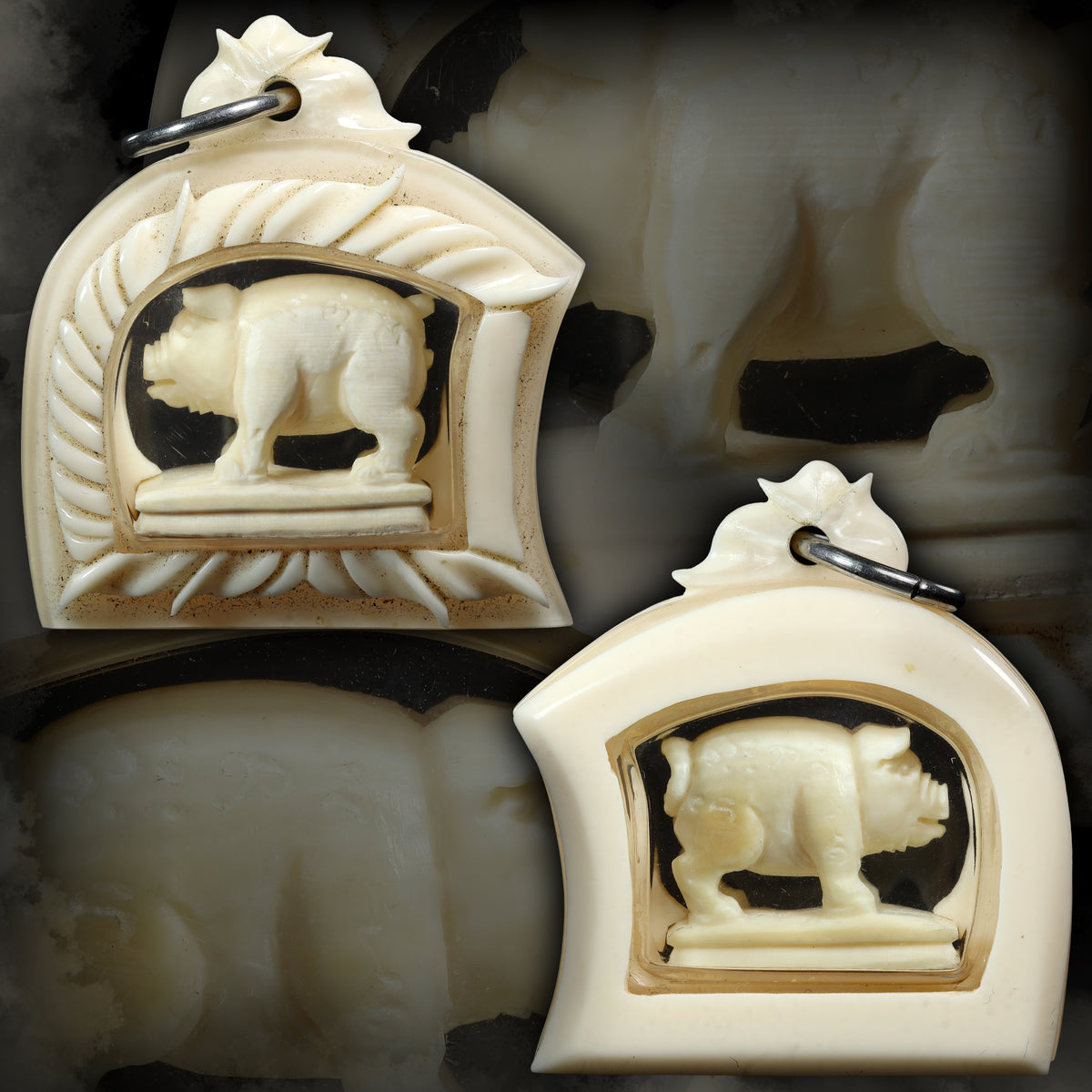
The central component of the Moo is a small three-dimensional representation of a domestic pig.
The illustrated examples display an cream-coloured finish, with the animal standing on a rectangular base.
The pig is shown in a natural standing posture, with a rounded body, short legs and a broad head.
These proportions are consistent with the appearance of a domestic pig rather than a wild boar.
The rounded body is especially meaningful within traditional prosperity symbolism.
A healthy, well-fed pig represents the presence of sufficient food and material resources.
This visual characteristic reinforces the charm's association with Maha Lap and Maha Pokasap.
The precise composition of the carved material has not been independently established from the photographs. The name Moo and the cream-coloured appearance should not, by themselves, be taken as confirmation of the material's origin.
The Spiritual Connection to the Temple Pig
According to the account associated with this release, LP Anucha incorporated the essence of the temple pig into the spiritual preparation of the Moo.
Within traditional Thai sacred practices, the essence or spiritual qualities of an animal may be invoked symbolically through prayer, sacred intention or specialised Wicha.
The purpose is to establish a connection between the sacred object and the qualities represented by the animal.
In this instance, the connection is especially personal because the Moo commemorates a real animal that lived within the temple grounds.
The original pig's peaceful nature and association with the temple community form the foundation of the charm's identity.
Protective Casing
The illustrated Moo examples are enclosed within decorative cream-coloured casings.
The casing protects the carved figure while allowing its three-dimensional form to remain visible.
A metal suspension ring permits the charm to be worn as a pendant or attached to a carrying cord.
The casing also gives the small commemorative figure a presentation consistent with traditional Thai wearable sacred objects.
Ritual
The spiritual preparation of the Moo is associated with LP Anucha's intention to commemorate the first pig kept at Wat Pho Ratchaburana.
According to the account accompanying the charm, LP Anucha invoked or incorporated the essence associated with the temple pig into the blessing of the pieces.
This forms the central distinction between the Moo and an ordinary pig-shaped ornament.
Within traditional Thai Wicha, animal symbolism is often used to represent qualities that practitioners wish to cultivate or attract.
For the domestic pig, these qualities concern abundance, comfortable living and the multiplication of resources.
The Moo is therefore associated with prosperity-oriented blessings rather than the aggressive protective qualities more commonly attributed to wild boar charms.
Maha Lap and Maha Pokasap
The principal spiritual emphasis of the Moo centres on two traditional concepts.
Maha Lap concerns the arrival of great fortune, financial opportunities and favourable circumstances.
Maha Pokasap concerns the accumulation and preservation of wealth, possessions and resources.
Together, these qualities represent the desire not only to receive wealth but also to maintain sufficient resources for a comfortable and stable life.
This distinction is important.
Within traditional belief, prosperity is not necessarily understood as sudden riches.
It may also refer to consistent income, reliable business activity, sufficient food and the ability to provide for one's family without unnecessary hardship.
The Moo embodies this broader understanding of abundance.
The precise Kathas, ritual duration and ceremonial procedures used for this release have not been specified.
Blessings and Effects
1. Maha Lap – Great Fortune and Financial Opportunities
The Moo is traditionally associated with the attraction of favourable financial circumstances.
Practitioners believe that domestic pig symbolism encourages the arrival of opportunities that contribute to a more comfortable livelihood.
For business owners, this may be interpreted as smoother commercial activity, additional customers or improved opportunities for income.
The emphasis is on prosperity that supports everyday living.
2. Maha Pokasap – Wealth Accumulation and Abundance
Maha Pokasap is one of the principal qualities associated with this charm.
The domestic pig's rounded appearance and association with plentiful food symbolise a household that does not lack essential resources.
Within traditional belief, this quality is connected with the gradual accumulation of possessions, savings and financial stability.
It is particularly meaningful for those seeking to build lasting prosperity rather than relying solely on occasional windfalls.
3. Kha Khai Dee – Smooth Business and Commercial Activity
The Moo is traditionally appealing to merchants and individuals involved in buying and selling.
Its association with comfortable living and abundance is interpreted as support for steady business activity.
Practitioners may carry the charm as a symbolic encouragement towards maintaining regular sales, positive customer relationships and sufficient business resources.
4. Metta – Goodwill and Harmonious Relationships
The gentle temperament of the temple pigs contributes to the Moo's association with peaceful interactions.
Unlike wild boar imagery, which may emphasise confrontation and defensive strength, the domestic pig represents a more approachable character.
This makes the charm symbolically suitable for those seeking harmonious relationships and a comfortable social environment.
5. Fertility and Multiplication of Resources
Domestic pigs have long been associated with fertility because of their reproductive characteristics.
Within folk symbolism, this quality extends beyond literal reproduction.
It can represent the multiplication of resources, expansion of a business and the gradual growth of household prosperity.
6. Zodiac Fortune – Year of the Pig
The Moo may hold additional significance for individuals born in the Chinese zodiac Year of the Pig.
In traditional Chinese astrology, the Pig is associated with generosity, sincerity, enjoyment of life and material comfort.
A pig-shaped charm may therefore be regarded as a personal symbol of one's zodiac identity.
Modern Application
The Moo is particularly relevant to individuals who appreciate prosperity symbolism connected with everyday life.
Business Owners and Merchants
The combination of Maha Lap and Maha Pokasap makes the charm suitable for those seeking stable business activity, regular customers and the gradual accumulation of wealth.
Self-Employed Individuals
Those whose income depends on daily transactions may appreciate the Moo's symbolic emphasis on sufficient resources and a comfortable livelihood.
Working Professionals
The charm may serve as a reminder of financial stability, steady career development and the importance of maintaining a balanced working life.
Families and Households
The domestic pig's association with plentiful food and fertility makes it meaningful for households seeking comfort, stability and sufficient resources for family members.
Individuals Born in the Year of the Pig
For those born under the Pig zodiac sign, the charm may carry an additional personal association with their birth animal.
Chinese Zodiac Compatibility
In traditional Chinese zodiac interpretations, the Pig is considered particularly compatible with three animals.
Tiger – The Pig and Tiger form one of the traditional Six Harmony pairings, known as Liu He (六合). This relationship symbolises mutual support, cooperation and complementary strengths.
Rabbit – The Pig and Rabbit belong to the same Three Harmony group, known as San He (三合). Their association is traditionally connected with peaceful relationships, understanding and cooperation.
Goat or Sheep – The Goat completes the Three Harmony combination with the Pig and Rabbit. This grouping is traditionally associated with harmonious relationships, emotional understanding and mutual assistance.
Together, the Pig, Rabbit and Goat form the Wood harmony group in Chinese zodiac traditions.
These relationships are commonly considered when interpreting personal compatibility, including romantic, social and professional relationships.
For collectors who follow Chinese zodiac customs, the Moo may therefore be especially meaningful to individuals born in the Years of the Pig, Tiger, Rabbit or Goat.
Physical Details
The Moo is a small three-dimensional domestic pig charm with an cream-coloured appearance, depicting a rounded pig standing on a rectangular base. The figure displays carved details along the head, body and legs, with a short tail and a broad domestic-pig profile. The illustrated examples are enclosed within decorative cream-coloured protective casings fitted with metal suspension rings. One casing features an elaborate leaf-like ornamental border, while the other has a simpler curved design. The exact dimensions and material composition have not been confirmed. Minor variations in carving, surface texture, colour and casing details are visible between the examples.
Recommended Pairing
The Moo can be paired with other traditional Thai amulets whose attributed qualities complement its emphasis on prosperity, abundance and financial stability.
Phra Sivali – Chok Larp and Abundance
Phra Sivali is traditionally associated with plentiful resources, successful journeys and favourable opportunities.
Pairing Phra Sivali with the Moo creates a symbolic combination centred on the arrival of wealth and the maintenance of sufficient resources.
Personal Notes
What makes this Moo particularly interesting is not simply its association with wealth and abundance, but the circumstances that led to its creation.
LP Anucha seldom produces Kreung Rang, making this commemorative pig charm an unusual departure from the sacred objects more commonly associated with him.
The inspiration came from the first domestic pig kept at Wat Pho Ratchaburana.
This was not a wild boar associated with aggressive protection or physical strength.
It was an ordinary domestic pig that became part of the temple's daily life.
The animal eventually passed away, but its descendants continued to live within the temple grounds.
Today, the temple is said to be home to the third or fourth generation of pigs from the original lineage.
These animals remain free-roaming and friendly, accustomed to the presence of monks and visitors.
There is something particularly meaningful about a sacred object created to remember an animal that lived peacefully within a temple.
Thai sacred traditions frequently draw upon powerful animals such as the Seur, elephant and wild boar.
The Moo represents a different perspective.
Its significance is not based on aggression, dominance or fearlessness.
Instead, it reflects the quieter qualities of abundance, contentment and having sufficient resources for a comfortable life.
The connection with LP Anucha's temple also gives the charm a more personal character.
Rather than being created solely around an established sacred animal symbol, the Moo commemorates an actual animal whose descendants remain part of the temple community.
The association with Maha Lap and Maha Pokasap further strengthens its appeal to collectors who appreciate prosperity-oriented Kreung Rang.
For individuals born in the Year of the Pig, or those who follow traditional Chinese zodiac compatibility, the charm may carry an additional layer of personal significance.
However, its meaning is not limited to zodiac beliefs.
The domestic pig has long represented abundance across different cultures, making its symbolism easily understood even by those unfamiliar with Thai sacred practices.
For me, the most distinctive aspect of this Moo is the story behind it.
It was created not merely as another prosperity charm, but as a remembrance of the first pig that lived at Wat Pho Ratchaburana.
Its descendants continue to roam the temple grounds, preserving a living connection to the animal that inspired the original creation.
The Moo therefore brings together three meaningful elements: the memory of the temple's first pig, LP Anucha's uncommon Kreung Rang craftsmanship, and the traditional belief that the domestic pig represents wealth, abundance and a comfortable livelihood.
For collectors who appreciate sacred objects with an identifiable origin and a personal connection to the issuing master, this is a distinctive piece within LP Anucha's tradition.
-
Free Shipping for Singapore| $15 Worldwide | $60 USA For Items Below $350