
OOBThaiAmulets
LP Anucha - Wat Pho Ratchaburana
LP Anucha - Wat Pho Ratchaburana
Couldn't load pickup availability
ANU01
Rian Sema Ayu 60 - Lang Yant Jing Jok Song Hang
LP Anucha • Wat Pho Ratchaburana, Ratchaburi
1st Batch • 60th Birthday / 5 Rob Commemorative Issue
B.E. 2568
5cm
Mainstream Artifact
Bio of LP Anucha: click here
Sacred Craftsmanship
The Rian Sema Ayu 60 was created to commemorate an important milestone in the life of LP Anucha of Wat Pho Ratchaburana — his 60th birthday, or 5 Rob.
LP Anucha's own hand determined the individual Wicha carried by each piece.
Both the front and reverse received LP Anucha's personal attention, but the defining feature of this example is the large Yant Jing Jok Song Hang drawn by him across the smooth reverse.
Each medal was individually produced and subsequently worked upon by hand, so natural variations in surface, tone, inscription and finishing give every piece its own character.
The photographs are representative only. A piece will be selected at random, and the item supplied may differ slightly from the exact piece shown in the images
Personal Experiences Shared by Luksits
Among LP Anucha's close Luksits, the smooth-back medals are particularly appreciated because they preserve a much more direct connection with the master's personal ritual work.
Rather than choosing only a standard medal with a predetermined reverse, devotees could bring a Lang Liap example to LP Anucha and have him personally work upon it. The resulting Yant therefore became part of the individual identity of that particular medal.
Jing Jok Wicha is especially familiar among merchants and those whose livelihood depends upon attracting people. Traditional accounts surrounding Jing Jok frequently concern customers choosing one shop over another, people becoming more receptive during conversation, or opportunities appearing through unexpected social connections.
Their importance lies in explaining why Jing Jok remains particularly popular among shopkeepers, salespeople and those working in competitive environments.
For this piece, the Song Hang, or two-tailed form, gives the symbolism an additional dimension: rather than attraction alone, it represents opportunity being drawn from more than one direction.
Summary
This Rian Sema Ayu 60 Lang Liap combines the commemorative significance of LP Anucha's 60th birthday and 5 Rob with one of the more recognisable animal-based forms of traditional Thai Wicha — Jing Jok Song Hang.
Jing Jok means gecko, while Song Hang means two tails.
Within Thai animist and occult traditions, Jing Jok is associated with attraction, sensitivity to its surroundings and an unusual ability to survive. The rarer two-tailed form amplifies this symbolism, becoming associated particularly with:
- Maha Lap — wealth and fortunate gains;
- business and customer attraction;
- Metta Maha Niyom — goodwill and popularity;
- Saneh and personal magnetism;
- persuasive communication;
- opportunity and favourable encounters;
- intuition and early warning;
- Klaew Klaad and avoidance of hidden danger.
The result is quite different in character from a purely protective Yant.
Jing Jok attracts, connects and senses.
Historical Background
The term 5 Rob refers to five completed twelve-year cycles. Five Rob therefore represents 60 years, traditionally regarded as an important milestone of maturity and accumulated life experience.
For a monk or master, a 60th-birthday issue may consequently carry particular meaning among disciples. It commemorates not simply age, but the accumulated years of practice, teaching and merit represented by that point in the master's life.
The number five also carries important symbolism within Thai Buddhist Wicha, including its association with Na Mo Phut Tha Ya, the five-syllable sacred formula traditionally connected with the Five Buddhas of the present aeon.
The Jing Jok, however, comes from another layer of Thai sacred culture.
Geckos have lived alongside people in Thai houses, temples and shops for generations. Their sudden calls, ability to remain motionless and then move rapidly, and sensitivity to their surroundings contributed to a body of traditional beliefs concerning omens and warnings.
A Jing Jok calling at a significant moment might traditionally be interpreted according to circumstance as an auspicious sign or a warning to reconsider one's immediate actions.
The animal therefore came to represent more than simple attraction. It embodied awareness — the ability to sense circumstances before acting.
Origins of the Materials
This medal was produced from lead, a material long used for Thai sacred objects, especially pieces intended to receive additional inscription.
The front carries the elaborate moulded design of LP Anucha seated centrally within the Sema-shaped composition.
The reverse is Lang Liap — smooth-backed.
This apparently simple difference is important. Instead of filling the reverse with a predetermined moulded design, the open surface became a field upon which LP Anucha could personally apply whichever branch of Wicha was intended for that individual piece.
On this example, he inscribed the recognisable elongated body and curling twin tails of the Jing Jok Song Hang, together with surrounding sacred characters.
The metal therefore serves two purposes: it forms the commemorative medal itself and provides the physical surface for the master's handwritten Wicha.
Ritual
For the Lang Liap examples, the ritual character extends beyond the general consecration of the Rian Ayu 60 batch.
LP Anucha personally worked upon the individual medal, drawing sacred characters and the central Jing Jok Song Hang directly onto its reverse.
Within traditional practice, the drawn figure is not merely decorative. The animal form establishes the symbolic character of the Wicha, while the accompanying sacred letters and Katha form part of its ritual structure.
The Jing Jok is traditionally approached through qualities already associated with the creature: attraction, awareness, adaptability, survival and responsiveness.
The two tails strengthen the symbolic idea of drawing or sweeping opportunity towards the owner from multiple directions.
Once personally Yanted, the medal formed part of the wider chanting and consecration associated with LP Anucha's sacred objects.
Blessings and Effects
Maha Lap — Wealth Attraction
The most prominent worldly quality associated with Jing Jok Song Hang is Maha Lap, or fortunate gains.
The twin tails are traditionally interpreted as symbolically drawing wealth, customers and opportunity towards the owner.
For this reason, Jing Jok Wicha has long appealed particularly to merchants and those whose income depends upon continual movement of customers and opportunities.
Business and Customer Attraction
Jing Jok is especially appropriate for businesses where customers have many competing choices.
The traditional intention is not simply money appearing without effort, but drawing attention towards the owner — being noticed, remembered and selected.
This makes it relevant to retail, sales, services, commission work and entrepreneurship.
Metta Maha Niyom
The Jing Jok also carries a strong Metta Maha Niyom aspect.
Traditional belief associates it with easier interactions, favourable impressions and greater willingness from others to listen, cooperate or assist.
Saneh and Personal Magnetism
Jing Jok Wicha may also carry a Saneh dimension.
Here the emphasis is upon attraction and presence: becoming more noticeable, approachable and memorable.
It may therefore extend beyond business into social and romantic circumstances.
Premonitory Protection
One of the more interesting aspects of Jing Jok is its traditional association with warnings.
Because geckos were regarded as highly sensitive creatures, their calls and behaviour became connected with the ability to sense something before humans recognised it.
Within Wicha, this developed into an association with intuition and premonitory protection — noticing unusual circumstances, hesitating at the correct moment, or recognising that a person or situation may not be as favourable as it first appears.
Klaew Klaad and Survival
The gecko is also a remarkable survivor.
It moves quickly, hides effectively and can escape danger through extraordinary adaptability. Its ability to shed and regenerate its tail further strengthened associations with survival, recovery and returning after setbacks.
The Jing Jok therefore carries a quieter form of protection:
not necessarily confronting danger, but recognising it early enough to avoid becoming trapped by it.
Modern Application
The Yant Jing Jok Song Hang variation is particularly appropriate for modern occupations where success depends upon visibility and human interaction.
It naturally suits business owners, shopkeepers, salespeople, property agents, insurance agents, online sellers, customer-facing professionals, entertainers and commission-based workers.
It may also appeal to those working in highly competitive markets, where several businesses offer similar products or services and success often depends upon which person customers remember and trust.
The combination of attraction and awareness is particularly useful conceptually.
One side concerns bringing opportunity closer.
The other concerns recognising whether that opportunity is worth pursuing.
Physical Details
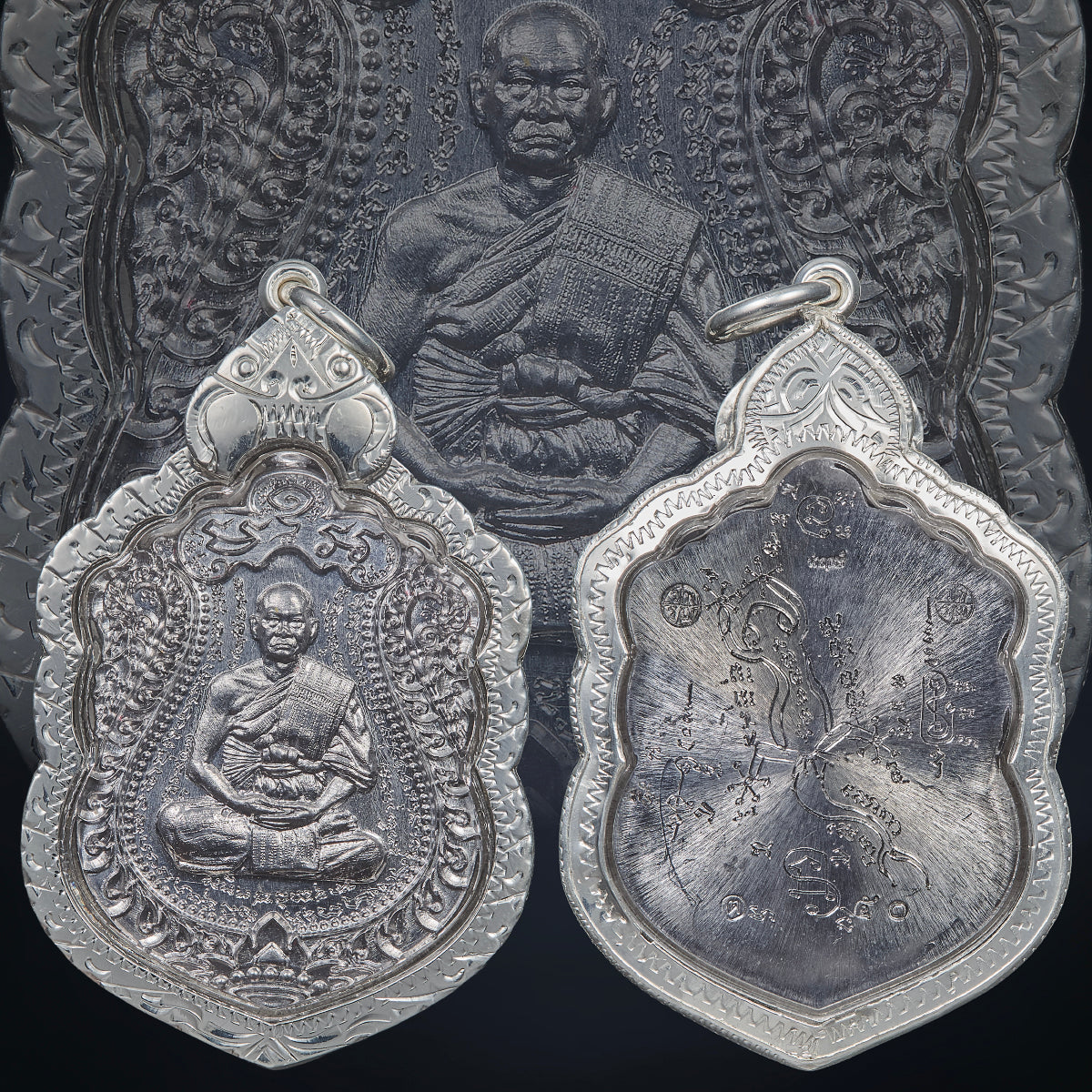
This is a 5 cm Rian Sema Ayu 60, first batch, produced for LP Anucha's 60th birthday in B.E. 2568 and made from lead.
The obverse presents LP Anucha seated centrally within an elaborate Sema-shaped composition surrounded by finely moulded sacred ornamentation and inscriptions.
The reverse is the Lang Liap variation. Across the otherwise smooth lead surface, LP Anucha personally inscribed the distinctive Yant Jing Jok Song Hang. The long-bodied gecko occupies the centre, with its tail dividing into the characteristic twin-tailed configuration, while sacred characters and additional ritual markings surround the principal figure.
The visible hand-worked lines, variations in depth and naturally irregular placement are important characteristics of the piece. They distinguish the master's personal inscription from a machine-produced or moulded reverse.
Recommended Pairing
For commercial use, this Jing Jok Song Hang variation pairs particularly naturally with Nang Kwak. Nang Kwak traditionally calls customers, while Jing Jok strengthens attraction, interaction and the ability to turn attention into opportunity.
For livelihood and continuity of income, Phra Sivali provides another complementary pairing, adding the traditional qualities of sustenance, smooth journeys and access to necessities.
A particularly useful way of understanding the first combination is:
Nang Kwak calls the customer. Jing Jok makes the connection. Maha Lap allows opportunity to grow from it.
Personal Notes
Among the Rian Sema Ayu 60 Lang Liap pieces, the appeal lies in discovering which Wicha LP Anucha personally placed upon the individual medal.
This example is especially distinctive because the Jing Jok Song Hang is immediately recognisable and carries a very different character from the more defensive Yant found on other examples.
Its emphasis is movement rather than stillness.
It concerns customers moving towards the owner, money remaining in circulation, people becoming receptive, opportunities emerging through relationships, and the owner developing sufficient awareness to recognise both favourable openings and hidden difficulties.
The two tails complete the symbolism: two directions of attraction, two paths of opportunity, and the adaptability to find another route when one path becomes blocked.
For the modern owner, its traditional character can be summarised simply:
attract opportunity, strengthen Metta, draw Maha Lap, recognise danger early, and remain adaptable enough to keep moving forward.
-
Free Shipping for Singapore| $15 Worldwide | $60 USA For Items Below $350