
OOBThaiAmulets
LP Anucha - Wat Pho Ratchaburana
LP Anucha - Wat Pho Ratchaburana
Couldn't load pickup availability
ANU01
Loop Tai
LP Anucha • Wat Pho Ratchaburana, Ratchaburi
2 Inches
Mainstream Artifact
Bio of LP Anucha: click here
Sacred Craftsmanship
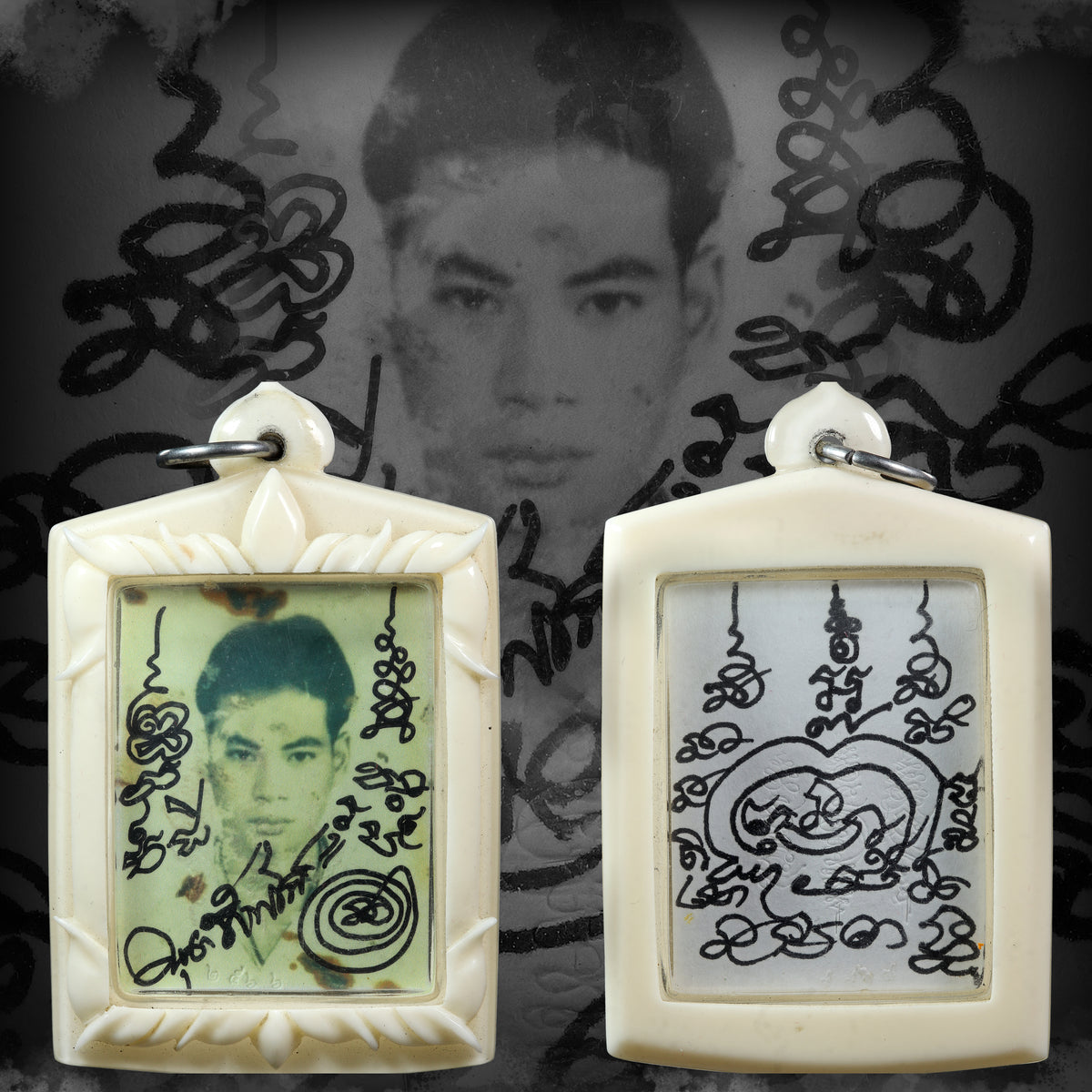
The Loop Tai of LP Anucha of Wat Pho Ratchaburana, Ratchaburi, is a personal photographic amulet featuring a rare and meaningful image of the master during his younger years, before entering the Buddhist monastic order.
The photograph show the actual artifact offered. The piece you receive will be the exact one shown..
Each photographic amulet is individually prepared, with sacred inscriptions personally applied by the master. Natural variations in handwriting, ink placement, photographic appearance and casing details contribute to the individuality of each piece.
Personal Experiences Shared by Luksits
A Personal Encounter with LP Anucha
Among the many photographic amulets associated with Thai monks and spiritual teachers, pieces bearing personally handwritten Yant often carry a deeper significance for collectors who have had the opportunity to meet the master.
This particular Loop Tai holds such a connection.
I was personally present when LP Anucha inscribed the Yant onto the photograph.
Watching the master personally apply the sacred characters was an experience that gave the piece a meaning beyond its physical appearance.
Rather than receiving an amulet that had already been prepared and distributed, I witnessed the additional inscriptions being written directly by LP Anucha.
For collectors familiar with traditional Thai sacred practices, this distinction is important.
A handwritten Yant is regarded as a personal blessing from the master, reflecting his concentration, knowledge and intention at the time of inscription.
The experience also provided a direct connection to LP Anucha himself, something that cannot be fully represented through photographs or written descriptions alone.
The Significance of Early Photographs
It is common among Thai devotees and experienced collectors to preserve photographs of revered masters from different periods of their lives.
While images taken after ordination are generally more familiar, photographs from a master's younger years are often particularly meaningful.
They offer an opportunity to appreciate the person behind the monastic identity.
For some followers, such photographs serve as reminders that respected monks and spiritual teachers also experienced ordinary life before entering the religious path.
An early photograph may therefore carry a different kind of sentimental value from a conventional portrait taken during a master's later years.
In the case of LP Anucha, this photograph captures his appearance during his Kalawat period, providing a visual connection to his life before ordination.
When accompanied by handwritten Yant personally applied by the master, the photograph becomes both a historical keepsake and a sacred object within the traditional understanding of his followers.
Experiences Associated with Handwritten Photographic Amulets
Among Thai practitioners, photographic amulets bearing personal inscriptions are commonly kept for protection, reassurance and spiritual connection.
Some devotees describe carrying a photograph of their teacher as a source of confidence during difficult circumstances.
Others keep such images in their homes, vehicles or workplaces as reminders of the master's teachings and blessings.
For many collectors, the greatest significance lies in the relationship between the devotee, the master and the circumstances under which the photograph was blessed.
Summary
The Loop Tai – Early Years Portrait of LP Anucha is a photographic amulet distinguished by its unusual subject and personally handwritten sacred inscriptions.
Unlike the more familiar images of LP Anucha wearing monastic robes, this particular photograph depicts him during his younger years, before ordination.
This gives the piece a historical and personal character that differs from conventional portrait amulets.
Its principal features include:
- Kalawat Period Portrait: An early photograph of LP Anucha taken before he entered the Buddhist monastic order.
- Personally Handwritten Yant: Sacred inscriptions applied directly by LP Anucha to both sides of the photographic amulet.
- Direct Personal Connection: The additional inscriptions were written while I was personally present with the master.
- Traditional Devotional Significance: Photographic amulets are commonly kept as representations of a revered master's blessings, teachings and spiritual presence.
- Protective Casing: An ivory-coloured decorative casing designed to preserve the photograph and its handwritten inscriptions.
Historical Background
LP Anucha – Wat Pho Ratchaburana
LP Anucha is associated with Wat Pho Ratchaburana in Ratchaburi Province, Thailand.
Within Thai Buddhist culture, the personal histories of respected monks often form an important part of how devotees understand their teachers.
Although a monk's religious life begins formally with ordination, his experiences before entering the Sangha remain part of his personal history.
This earlier period is commonly referred to as Kalawat, meaning the life of a layperson.
Photographs from this stage of a master's life are especially interesting because they preserve an appearance that may be unfamiliar to later generations of followers.
In many cases, devotees primarily encounter images of their teachers wearing monastic robes, seated in meditation or participating in religious ceremonies.
Earlier photographs reveal a different chapter of the same person's life.
For collectors, such images can provide historical context and a more complete appreciation of the master's personal journey.
The Tradition of Loop Tai Amulets
The use of photographic portraits as devotional objects became increasingly common as photography developed and became more accessible throughout Thailand.
Before photographic images were widely available, devotees often relied on painted portraits, drawings, cast images or other representations of revered teachers.
Photography introduced a more direct means of preserving a master's likeness.
Over time, photographs of respected monks began to be kept in homes, carried in wallets and placed within protective amulet casings.
Some photographs were subsequently blessed or personally inscribed with sacred Yant.
These additional markings transformed the photograph from a simple portrait into an object with a specific devotional purpose.
Among collectors, photographs bearing original handwritten inscriptions are often regarded with particular interest because they demonstrate the master's personal involvement.
The value of such pieces is therefore not necessarily determined by elaborate materials or complicated construction.
Origins of the Materials
The Early Photograph
The central element of this amulet is a photographic portrait of LP Anucha during his younger years.
The image shows him before ordination, dressed as a layperson rather than in the robes normally associated with Buddhist monks.
The photograph has a slightly aged appearance, with muted colouring and visible tonal variations.
These characteristics contribute to the historical atmosphere of the piece.
For collectors, the importance of the image lies primarily in its subject.
It preserves a representation of LP Anucha from an earlier period of his life, making it different from the conventional photographic amulets commonly encountered among devotees.
Handwritten Sacred Inscriptions
Both sides of the amulet display handwritten Yant.
On the front, sacred characters surround LP Anucha's portrait, with additional writing extending across the lower portion of the photograph.
A prominent circular inscription is positioned near the bottom.
The reverse features a more extensive arrangement of sacred characters, including a central design enclosed by curved lines and surrounded by additional markings.
These inscriptions were personally applied by LP Anucha.
Within traditional Thai sacred practices, handwritten Yant are associated with the master's knowledge of Wicha, concentration and intention.
Ritual
The most significant aspect of this particular Loop Tai is the personal application of sacred Yant by LP Anucha.
Unlike mass-produced photographic amulets bearing printed inscriptions, this example received additional handwritten markings directly from the master.
I was present during this process.
The act of writing sacred characters onto a photograph is an established practice within Thai amulet traditions.
Depending on the master's lineage and particular Wicha, the inscriptions may be associated with protection, Metta Maha Niyom, spiritual reassurance or other traditional blessings.
The process requires the master to apply sacred writing to the chosen object, often while maintaining concentration and reciting appropriate prayers or Kathas.
In this case, the visible inscriptions cover substantial portions of both the front and reverse.
The front markings surround the younger portrait of LP Anucha, while the reverse carries a more elaborate sacred arrangement.
From a collector's perspective, the importance of these markings lies not only in their symbolic meaning but also in the fact that they were written personally by LP Anucha.
This creates a direct connection between the master and the individual photographic amulet.
It is this personal involvement that distinguishes the piece from an ordinary photograph of a revered monk.
Blessings and Effects
Photographic amulets personally inscribed by respected masters are traditionally associated with several spiritual qualities.
1. Baramee – Connection to the Master's Spiritual Authority
One of the principal reasons devotees carry photographic images of revered teachers is to maintain a symbolic connection with their Baramee.
In Thai Buddhist understanding, Baramee refers to cultivated spiritual qualities and virtues.
A personally blessed photograph may serve as a reminder of the master's teachings, moral discipline and religious example.
2. Metta Maha Niyom – Goodwill and Favourable Relationships
Handwritten Yant are often associated with blessings intended to encourage goodwill and favourable interactions.
Within traditional belief, Metta Maha Niyom is connected with kindness, popularity and acceptance.
Devotees may carry such an amulet when seeking harmonious relationships with colleagues, customers, family members and others encountered in daily life.
3. Kong Krapan and Klaew Klaad – Protection
Photographic amulets bearing sacred inscriptions are also traditionally kept for protection.
Kong Krapan concerns resilience and resistance to physical harm, while Klaew Klaad refers to escaping or avoiding danger.
These qualities are commonly associated with protective Thai amulets, although the exact purpose of LP Anucha's individual inscriptions would depend on the Wicha he applied.
4. Spiritual Reassurance and Confidence
For many devotees, carrying an image of a respected teacher provides a sense of reassurance.
The photograph may encourage the wearer to remain composed, exercise patience and approach difficult situations with greater confidence.
This aspect is particularly meaningful when the image was personally blessed by the master.
5. Remembrance of the Master's Teachings
Beyond traditional protective beliefs, the photograph serves as a reminder of the spiritual path represented by LP Anucha.
Its unusual portrayal of him during his Kalawat period reinforces the idea that spiritual development is a journey shaped by experience, discipline and personal transformation.
Modern Application
The Loop Tai of LP Anucha can be appreciated both as a personal devotional object and as a collectible photographic amulet.
Daily Personal Carry
Its compact size makes it suitable for wearing around the neck or keeping in a personal carrying pouch.
For devotees, carrying the image provides a symbolic connection to LP Anucha and his blessings.
Workplace and Professional Life
Individuals who appreciate Metta Maha Niyom traditions may keep the photograph as a reminder to maintain patience, goodwill and positive relationships in their working environment.
Travelling and Personal Protection
Photographic amulets are commonly carried during journeys as devotional objects associated with reassurance and traditional protective blessings.
Home or Personal Altar
Collectors who prefer not to wear the amulet may place it on a personal altar or in a dedicated display area.
Its early portrait makes it particularly suitable for those who appreciate photographs documenting different stages of a master's life.
Collection of Personally Inscribed Amulets
For serious collectors, the principal appeal lies in the handwritten Yant and the circumstances surrounding their application.
Pieces with a direct personal connection to the master often occupy a distinctive position within a collection.
Physical Details
This Loop Tai of LP Anucha measures approximately 2 inches and features an early photographic portrait of the master during his Kalawat period. The front displays his youthful likeness, surrounded by personally handwritten sacred Yant, including a circular inscription near the lower portion. The reverse carries an extensive arrangement of handwritten sacred characters and a central curved Yantra design. The photograph is protected within an ivory-coloured decorative casing with raised ornamental details and a metal suspension loop. Natural signs of ageing, photographic discolouration and variations in the handwritten ink contribute to the individual character of the piece.
Recommended Pairing
The Loop Tai of LP Anucha may be paired with other traditional Thai amulets whose spiritual associations complement its devotional and protective significance.
Phra Somdej – Buddhist Merit and Stability
Phra Somdej is traditionally associated with protection, spiritual stability, merit and personal well-being.
Pairing a Phra Somdej with the Loop Tai creates a combination centred on Buddhist devotion and remembrance of respected teachers.
For collectors who appreciate sacred objects from the same master, this pairing creates a complementary combination of prosperity symbolism and personal blessing.
Personal Notes
This particular Loop Tai holds a different significance from the conventional portrait amulets of LP Anucha.
The photograph itself is already unusual because it depicts the master during his younger years, before he entered the Buddhist monastic order.
Most devotees are familiar with photographs of their teachers wearing robes, seated in meditation or conducting religious ceremonies.
Images from their earlier lives are less commonly encountered and offer an interesting glimpse into the person before his religious identity became established.
However, what makes this piece especially meaningful to me is the fact that I was personally present when LP Anucha wrote the sacred Yant onto it.
The inscriptions were not something I had to rely on another person's account to understand.
I witnessed the master personally applying them.
For collectors who have spent years appreciating Thai sacred objects, such experiences carry a significance that cannot always be measured through rarity, materials or market value.
There is a difference between collecting an amulet because of its reputation and keeping a piece connected to a personal encounter with the master.
This Loop Tai belongs to the latter category.
Another aspect worth appreciating is the traditional practice of preserving early photographs of revered masters.
Among Thai devotees, it is not unusual to encounter photographs showing respected monks during their younger years, including periods before ordination.
These images are often treasured because they preserve a part of the master's personal history that later followers may never have witnessed.
In this example, the combination of the early Kalawat portrait and LP Anucha's handwritten inscriptions brings together two different periods of his life.
The photograph represents his younger years, while the sacred writing reflects his later role as a monk and spiritual teacher.
It is this connection between the master's past and present, together with the personal experience of witnessing the inscriptions being written, that makes the Loop Tai a particularly meaningful piece to preserve.
-
Free Shipping for Singapore| $15 Worldwide | $60 USA For Items Below $350