
OOBThaiAmulets
LP Anucha - Wat Pho Ratchaburana
LP Anucha - Wat Pho Ratchaburana
Couldn't load pickup availability
ANU01
Rian Ayu 60 - Lang Yant Na Kongkrapan
LP Anucha • Wat Pho Ratchaburana, Ratchaburi
1st batch (60th birthday)
Test mould
B.E 2568
1.5 Inches
Mainstream Artifact
Bio of LP Anucha: click here
Sacred Craftsmanship
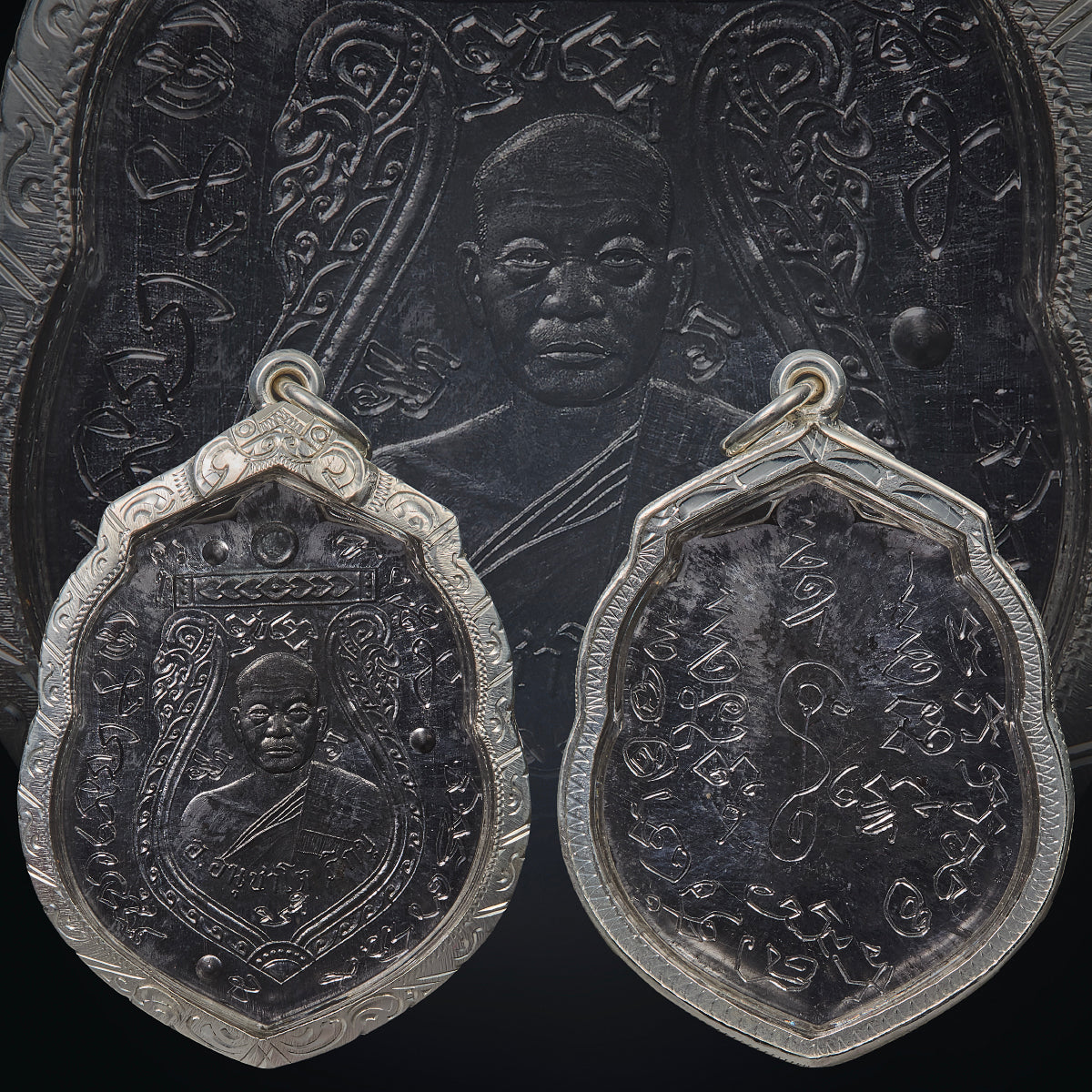
The Rian Ayu 60 marks an important point in the sacred-object lineage of LP Anucha Anuchato of Wat Pho Ratchaburana, Ratchaburi. Created to commemorate his 60th birthday, or 5 Rob, it also represents the first batch of Rian issued under LP Anucha.
It is a test-mould piece cast in lead, produced during the preparation and evaluation of the Rian before the regular issue.
LP Anucha personally hand-Yanted on this individual example on both the front and reverse, composition centred upon Yant Na Kongkrapan.
Each piece is therefore individually prepared and hand worked; natural variations in casting, surface, patina and the master's handwritten Yant make every example unique.
The photographs are representative only. A piece will be selected at random, and the item supplied may differ slightly from the exact piece shown in the images.
Personal Experiences Shared by Luksits
Among LP Anucha's long-term Luksits are numerous business owners, traders and established local families whose relationships with respected masters extend across generations.
During visits to Wat Pho Ratchaburana, I have met followers who explained that their fathers had previously been devoted to older masters such as LP Deang of Wat Khao Bandai-It, while they themselves gradually came to follow LP Anucha.
One businessman working within Thailand's beauty industry spoke particularly strongly about this continuity. His father had collected LP Deang, while he later began carrying LP Anucha's sacred objects. As his own business expanded, he came to regard LP Anucha's blessings as an important spiritual companion alongside diligent work and careful judgement.
Other entrepreneurs have spoken of smoother negotiations, stronger customer relationships, greater confidence in difficult decisions and a gradual improvement in financial stability.
With personally hand-Yanted pieces, however, Luksits often speak of an additional sense of closeness to the master. The attraction is understandable: rather than carrying only a medal bearing LP Anucha's portrait, the owner carries an object upon which the master personally sat and inscribed his sacred formulae.
For those who specifically sought Kongkrapan and protective Wicha, a Lang Liap piece carrying Yant Na Kongkrapan would naturally have held particular appeal.
Summary
This Rian combines several characteristics that distinguish it from an ordinary first-batch Ayu 60.
It commemorates LP Anucha's 60th year and its first Rian batch.
It is made from lead as a test-mould piece.
It is Lang Liap, with the reverse left smooth rather than carrying the standard moulded reverse.
Both surfaces were personally hand-Yanted by LP Anucha.
Most importantly, the reverse was specifically worked with Yant Na Kongkrapan, giving this individual medal a much stronger emphasis upon protection, endurance and resistance to harm than the broader character normally associated with the standard Ayu 60.
For the collector, it represents not merely another metal variation, but an individually worked piece connecting the developmental stage of LP Anucha's first Rian with his personal protective Wicha.
Historical Background
The Ayu 60 issue commemorates the completion of five twelve-year cycles, traditionally expressed in Thailand as 5 Rob.
A Rob represents one complete twelve-year zodiac cycle. Five cycles therefore equal sixty years, an important milestone traditionally associated with maturity, accumulated experience and the completion of a major period of life.
Within Thai Buddhist Wicha, the number five also carries sacred associations. One of the best-known is the five-syllable formula Na Mo Phut Tha Ya, traditionally connected with the Five Buddhas of the present aeon.
LP Anucha was born on 23 August 1964 in Nakhon Pathom Province. His early development was closely associated with LP Sanga of Wat Nong Muang, through whom he was introduced to meditation, sacred inscription and traditional Buddhist Wicha.
He first entered the monkhood in B.E. 2527 (1984) at Wat Nong Pho. Following a period in lay life, he returned to the monkhood at Wat Pho Ratchaburana on 10 August B.E. 2552 (2009).
His later studies combined formal Buddhist education with traditional Wicha. Between B.E. 2556 and 2558 (2013–2015), he completed the Nak Tham sequence while continuing the ritual knowledge transmitted through his teachers.
Additional branches of his studies are associated with masters including LP Non of Wat Khao Phran Thup, LP Boonkham of Wat Chaiyaphum and LP Od of Wat Bang Muang.
Protective Wicha, sacred Yant inscription, Metta Maha Niyom, prosperity practices and the Na Ma Pa Ta Wicha concerning the Four Great Elements are among the traditions particularly associated with his practice.
Origins of the Materials
This particular Rian is made from lead, rather than the other versions of the Ayu 60.
Its significance therefore lies in a different direction.
The lead was used for a test mould, placing the piece within the preparatory stage of the issue. Such pieces allowed the moulded portrait, borders, lettering and relief to be examined before the wider production process.
Lead naturally gives the medal a heavier and visually more subdued character. Over time, the surface can develop dark grey, charcoal and almost black tones, particularly within recessed areas.
For this Lang Liap example, the material also provided an extensive reverse field for LP Anucha's personal inscription.
The front therefore records the work of the mould.
The reverse records the work of the master.
That distinction is central to understanding the character of this particular piece.
Ritual
After the front had been formed, the smooth reverse remained open for individual ritual work.
LP Anucha personally added sacred characters to the portrait side before working much more extensively across the reverse.
At the centre of the reverse is Yant Na Kongkrapan.
Within traditional Thai Wicha, Kongkrapan concerns resistance and endurance against physical danger. Depending upon the lineage and particular formula used, it may be associated with protection against weapons, violent circumstances, accidents and situations where bodily safety is threatened.
The principle is slightly different from Klaew Klaad.
Klaew Klaad concerns avoiding or escaping danger.
Kongkrapan concerns endurance when danger cannot be avoided.
The two are therefore frequently regarded as complementary protective branches.
The additional sacred characters surrounding the central Na Kongkrapan composition further reflect the individually prepared character of this medal. Because the reverse was not machine engraved or moulded, LP Anucha was free to arrange the inscriptions according to the particular Wicha being applied.
This is precisely such pieces can differ so noticeably from one another.
Blessings and Effects
The presence of Yant Na Kongkrapan gives this example a more distinctly protective orientation than the standard Ayu 60.
Its principal traditional association is Kongkrapan, understood as strengthening resistance against physical danger and helping the wearer remain protected when exposed to threatening circumstances.
This is complemented by Klaew Klaad, concerned with avoiding accidents, harmful situations and unnecessary confrontation before they develop further.
The wider Ayu 60 consecration adds Baramee, supporting personal standing, confidence and respect, together with the broader protective qualities associated with LP Anucha's Wicha.
Metta and prosperity remain relevant within the character of the original Rian, particularly for businesspeople and those whose livelihood depends upon relationships with others. Yet on this individual piece, these should be understood as supporting qualities rather than its defining emphasis.
Its central character is better summarised as:
Klaew Klaad — avoid the danger.
Kongkrapan — withstand what cannot be avoided.
Baramee — remain composed and respected under pressure.
Modern Application
The protective emphasis of this particular Rian makes it especially appropriate for those whose daily lives involve frequent travel, unpredictable environments or significant responsibility.
Drivers and those spending long periods on the road may approach it for traditional Klaew Klaad and protection.
Business owners who regularly travel, handle valuables or work late hours may appreciate the combination of protection with the broader prosperity and Baramee qualities of LP Anucha's lineage.
It is equally relevant to people working in physically demanding occupations or environments where situational awareness and personal safety are important.
For the collector, however, its appeal extends beyond function.
A lead test mould, Lang Liap reverse, individual hand-Yant work and a clearly identifiable protective Yant together create a much more personal object than a standard production medal.
Physical Details
The Rian Ayu 60 measures approximately 1.5 inches and this particular example is made from lead as a test-mould piece.
The obverse is moulded and features LP Anucha's portrait in monastic robes within the familiar ornamental frame of the first Ayu 60 issue. Numerous additional sacred characters have been individually inscribed around the portrait and surrounding field.
The reverse is empty land eft smooth rather than carrying the normal moulded reverse design.
Across this open surface LP Anucha personally engraved the sacred characters and Yant Na Kongkrapan, creating a visibly freehand composition that differs fundamentally from a machine-produced Yant.
The lead has developed a deep charcoal to blackened appearance, with lighter grey highlights appearing across raised and worked areas. Small surface irregularities and inscription marks contribute to the working character expected of a test-mould piece.
It is housed in a fitted silver-coloured protective casing, allowing both the moulded portrait and hand-worked reverse to remain visible.
Recommended Pairing
For a stronger emphasis upon avoidance of danger, a Klaew Klaad Takrut would complement the Na Kongkrapan reverse particularly well: one tradition concerns escaping danger, while the other concerns endurance and resistance.
Phra Pidta offers another natural pairing for those seeking a quieter form of spiritual shielding, particularly against harmful influences, hostility and unseen negativity.
For livelihood and resources, Phra Sivali can balance the strongly protective nature of this particular Rian with blessings traditionally associated with sustenance and opportunity.
Personal Notes
The character of this piece is best understood through its reverse.
A normal production medal receives its reverse from the mould.
This one received its reverse from LP Anucha's hand.
The blank Lang Liap field allowed him to choose the Wicha, position the sacred characters and build the composition directly upon the metal. In this example, he chose Na Kongkrapan, turning what began as a lead test mould into an individually prepared protective Rian.
That gives the object three separate layers of history.
The test mould records the creation of the first Rian.
The Lang Liap reverse records its unfinished state.
The hand-Yanted Na Kongkrapan records LP Anucha completing that individual piece through Wicha.
For a collector of LP Anucha, this is where the appeal lies.
It is not simply one medal from the first batch.
It is a piece from the making of the first batch, subsequently completed by the master's own hand.
-
Free Shipping for Singapore| $15 Worldwide | $60 USA For Items Below $350