
OOBThaiAmulets
LP Anucha - Wat Pho Ratchaburana
LP Anucha - Wat Pho Ratchaburana
Couldn't load pickup availability
ANU01
Rian Phutson Bucha Kru
LP Anucha • Wat Pho Ratchaburana, Ratchaburi
Bucha Kru / Kathina Merit-Making Batch
B.E. 2567
1.5 Inches
Mainstream Artifact
Bio of LP Anucha: click here
Sacred Craftsmanship
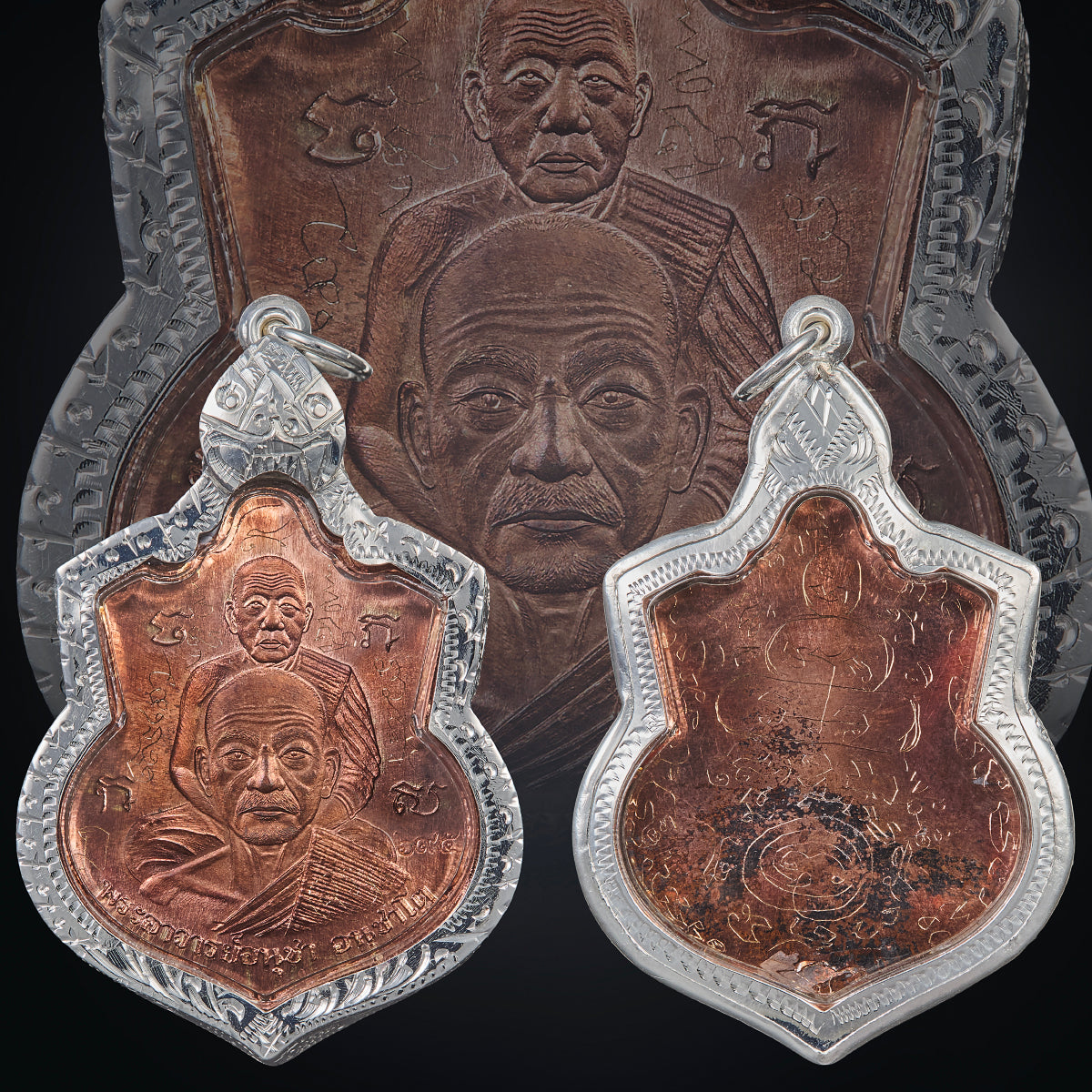
The Rian Phutson Bucha Kru is a particularly personal lineage medal of LP Anucha of Wat Pho Ratchaburana, created not simply as a portrait amulet, but as an expression of gratitude towards his principal teacher, LP Sanga of Wat Nong Muang.
Because the Yant were applied by hand, differences in placement, scale, line and sacred characters naturally occur between individual examples. Rather than being imperfections, these variations distinguish one personally inscribed Rian from another.
The photographs are representative only. A piece will be selected at random, and the item supplied may differ slightly from the exact piece shown in the images.
Personal Experiences Shared by Luksits
Among followers of LP Anucha, his sacred objects are commonly approached as practical amulets for everyday life rather than pieces concerned with only one specialised blessing.
Luksits particularly associate his work with Metta Maha Niyom, protection, business prosperity and Chok Larp. Business owners and working devotees often speak of these qualities in terms of smoother dealings with others, greater support from customers, improved opportunities and greater confidence when navigating difficult periods.
What gives the Phutson Bucha Kru a somewhat different character is the presence of the teacher-disciple lineage.
For devotees who place importance upon teachers, mentors and the people who helped establish their path, the medal can carry a more personal meaning. It serves as a reminder that achievement is rarely created by one person alone.
The figure of LP Sanga behind LP Anucha reinforces precisely this principle: remember the person who taught you even after you have progressed beyond the position of a student.
Summary
The Rian Phutson Bucha Kru B.E. 2567 is fundamentally an amulet of lineage and gratitude.
Its overlapping portrait arrangement places LP Sanga of Wat Nong Muang behind LP Anucha, visually recording the relationship between Kru and disciple.
Its purpose was equally meaningful. The batch was created to honour LP Sanga while helping raise funds for the annual Kathina merit-making ceremony.
The copper body provides the physical foundation.
The Phutson portrait records the lineage.
The Kathina purpose establishes the merit.
LP Anucha's handwritten Yant add the master's personal ritual work.
Together, these qualities distinguish the piece from an ordinary portrait medal. It is both a sacred object and a compact record of Bucha Kru — remembrance of the teacher from whom one's knowledge originated.
Historical Background
LP Anucha's spiritual development is closely connected with LP Sanga of Wat Nong Muang, one of the important teachers associated with his early study of traditional Buddhist practice and Wicha.
The Phutson composition therefore has particular relevance.
Rather than depicting LP Anucha independently, the medal deliberately acknowledges the lineage that stands behind his own practice. LP Sanga occupies the upper and rear position while LP Anucha appears prominently in front, presenting the relationship between transmission and continuation.
This concept of Bucha Kru is deeply rooted in Thai sacred traditions. Knowledge is not viewed simply as something acquired intellectually. The teacher who transmits a method, Katha, Yant or discipline becomes part of the lineage through which that knowledge continues.
Respecting the Kru is consequently more than ceremonial politeness. It acknowledges the source of one's learning and reminds the practitioner that knowledge carries responsibilities towards those who preserved and transmitted it.
The Kathina connection gives the B.E. 2567 issue an additional Buddhist dimension. Kathina is an important annual period of merit-making associated with offerings to the monastic community following the rains retreat. Creating the Rian to support this occasion links the commemoration of LP Sanga with tangible support for the temple.
Origins of the Materials
This particular Rian is produced in copper, a traditional material widely used in Thai medal making.
Copper is especially suitable for a piece of this nature because its surface accepts both moulded relief and subsequent hand inscription clearly. The warm reddish-brown metal also develops individual changes in tone and patina through age, handling and environmental exposure.
In this example, the original mould establishes the principal Phutson portrait and commemorative design. LP Anucha's handwritten inscriptions were then added separately to the medal.
This distinction is important to collectors.
The portrait belongs to the formal production of the batch; the handwritten Yant belong to the individual ritual treatment of the particular piece.
Ritual
The most distinctive ritual feature is that LP Anucha personally hand-yanted the medal on both sides.
The front already contains the formal Phutson imagery of LP Anucha and LP Sanga, yet additional sacred characters were written into the available spaces surrounding the portraits. The reverse received considerably more extensive inscription, turning what would otherwise be the back of a commemorative medal into a field for LP Anucha's personal Yant work.
In traditional practice, a hand-written Yant is not treated merely as ornamentation. Its significance lies in the combination of sacred characters, the Wicha behind their arrangement, the Katha associated with the inscription and the concentration of the master performing the work.
Consecration therefore brings together several layers: Bucha Kru towards LP Sanga, merit connected with Kathina, the formal sacred medal and LP Anucha's individual handwritten Yant.
The result is an object in which lineage and personal ritual work are physically inseparable.
Blessings and Effects
Within the tradition surrounding LP Anucha's amulets, the Rian Phutson Bucha Kru is associated with a broad range of blessings rather than one narrowly defined purpose.
Metta Maha Niyom concerns goodwill, acceptance and favourable relationships with those encountered in daily life. For people working with customers, colleagues, employers or business partners, this aspect is traditionally sought for smoother human relations and greater willingness from others to assist.
Business prosperity and Chok Larp concern opportunity, livelihood and favourable circumstances. Rather than being understood only as sudden wealth, these qualities may be approached as support for maintaining income, recognising opportunities and keeping one's affairs moving.
Protection forms another important part of the traditional interpretation, particularly for everyday travel, work and circumstances in which the wearer wishes for spiritual safeguarding.
There is also a less tangible quality particular to this Rian: Baramee through lineage. The presence of the Kru represents discipline, accumulated knowledge and the authority that comes from standing within an established tradition rather than acting without foundation.
Its character may therefore be understood as:
Bucha Kru for gratitude and lineage.
Metta for goodwill and human relationships.
Chok Larp for favourable opportunities.
Prosperity for livelihood and business.
Protection for the wearer's path.
Modern Application
The Rian Phutson Bucha Kru is particularly meaningful for people whose progress depends upon both personal ability and relationships with others.
Business owners may approach it for customer relations, prosperity and stability. Salespeople and professionals may value its Metta qualities. Managers and those responsible for others may appreciate the themes of Baramee, guidance and remembering the teachers who helped establish their knowledge.
It is also especially appropriate for people who themselves occupy both roles — student and teacher.
A person may still learn from senior figures while simultaneously becoming responsible for younger colleagues, apprentices, children or students. The Phutson composition becomes relevant here because it depicts knowledge as something passed from one generation to the next.
Physical Details
The Rian Phutson Bucha Kru measures approximately 1.5 inches and is made from copper. The obverse uses the distinctive Phutson composition, with the portrait of LP Sanga positioned behind LP Anucha, surrounded by commemorative inscriptions and additional handwritten sacred characters. The reverse provides a broad copper field extensively hand-yanted by LP Anucha. Natural variations in copper tone, patina, surface marks and the positioning of the handwritten Yant are characteristic of individually worked examples. The medal shown is protected within a fitted silver-coloured casing.
Recommended Pairing
The Rian is sufficiently broad to serve as a principal daily amulet by itself.
For those placing greater emphasis upon livelihood and continued resources, Phra Sivali forms a natural pairing. For professions heavily dependent upon communication, negotiation and customer relationships, Salika can complement the Metta Maha Niyom dimension.
A Lersi may be particularly meaningful when the wearer wishes to emphasise the Bucha Kru aspect, since Lersi traditions are closely associated with teachers, transmitted knowledge, discipline and Wicha.
The pairing should nevertheless remain secondary to the central meaning of this Rian: respect for the lineage itself.
Personal Notes
There is something particularly fitting about a master producing an amulet bearing his own image while deliberately placing his teacher behind him.
LP Anucha could have created a medal centred entirely upon himself. Instead, the Phutson design records the person who stood earlier in the lineage.
That changes the meaning considerably.
The medal does not simply say, “this is LP Anucha.”
It says, “this is LP Anucha, and this is the Kru behind him.”
Its connection with the Kathina ceremony strengthens that message further. Gratitude towards one's teacher is transformed into merit supporting the temple, while LP Anucha's handwritten Yant turn each individually worked example into something more personal than the standard moulded issue.
The portrait remembers the Kru.
The Kathina creates merit.
The handwritten Yant carries the master's personal touch.
For that reason, the Rian Phutson Bucha Kru B.E. 2567 is best understood not merely as a portrait Rian, but as a physical expression of lineage, gratitude and continuation.
-
Free Shipping for Singapore| $15 Worldwide | $60 USA For Items Below $350