
OOBThaiAmulets
LP Anucha - Wat Pho Ratchaburana
LP Anucha - Wat Pho Ratchaburana
Couldn't load pickup availability
ANU01
Locket LP Anucha — Early Period
LP Anucha • Wat Pho Ratchaburana, Ratchaburi
1.5 Inches
Mainstream Artifact
Bio of LP Anucha: click here
Sacred Craftsmanship
This Locket of LP Anucha belongs to an earlier period of his sacred-object making at Wat Pho Ratchaburana, Ratchaburi, before the later expansion of his better-known medal and commemorative issues.
Each artifact was individually assembled from carefully prepared sacred materials, so natural variations in texture, colour, embedded particles, fibres, sacred markings and overall form make every piece unique.
The photographs are representative only. A piece will be selected at random, and the item supplied may differ slightly from the exact piece shown in the images.
Personal Experiences Shared by Luksits
Earlier pieces such as this are particularly interesting because they reflect the period before LP Anucha's sacred-object lineage became represented by a larger range of formal Rian and commemorative releases.
Among established followers, LP Anucha's sacred objects are commonly approached as practical everyday amulets rather than pieces concerned with only one specialised branch of Wicha.
Businesspeople and devotees have spoken of carrying his amulets for Metta Maha Niyom, protection, favourable opportunities and stability in livelihood. The experiences described are often comparatively grounded: easier interaction with people, assistance appearing at useful moments, smoother business dealings and greater confidence when facing difficult circumstances.
The older material composition of this locket is also meaningful to devotees who value continuity. Instead of relying solely upon newly prepared powder, the piece incorporates substances originating from temples, Buddha images, ceremonies, scriptures and older religious artifacts.
Within traditional understanding, these materials already possess histories of worship, chanting, offerings and religious use before becoming part of the locket.
Summary
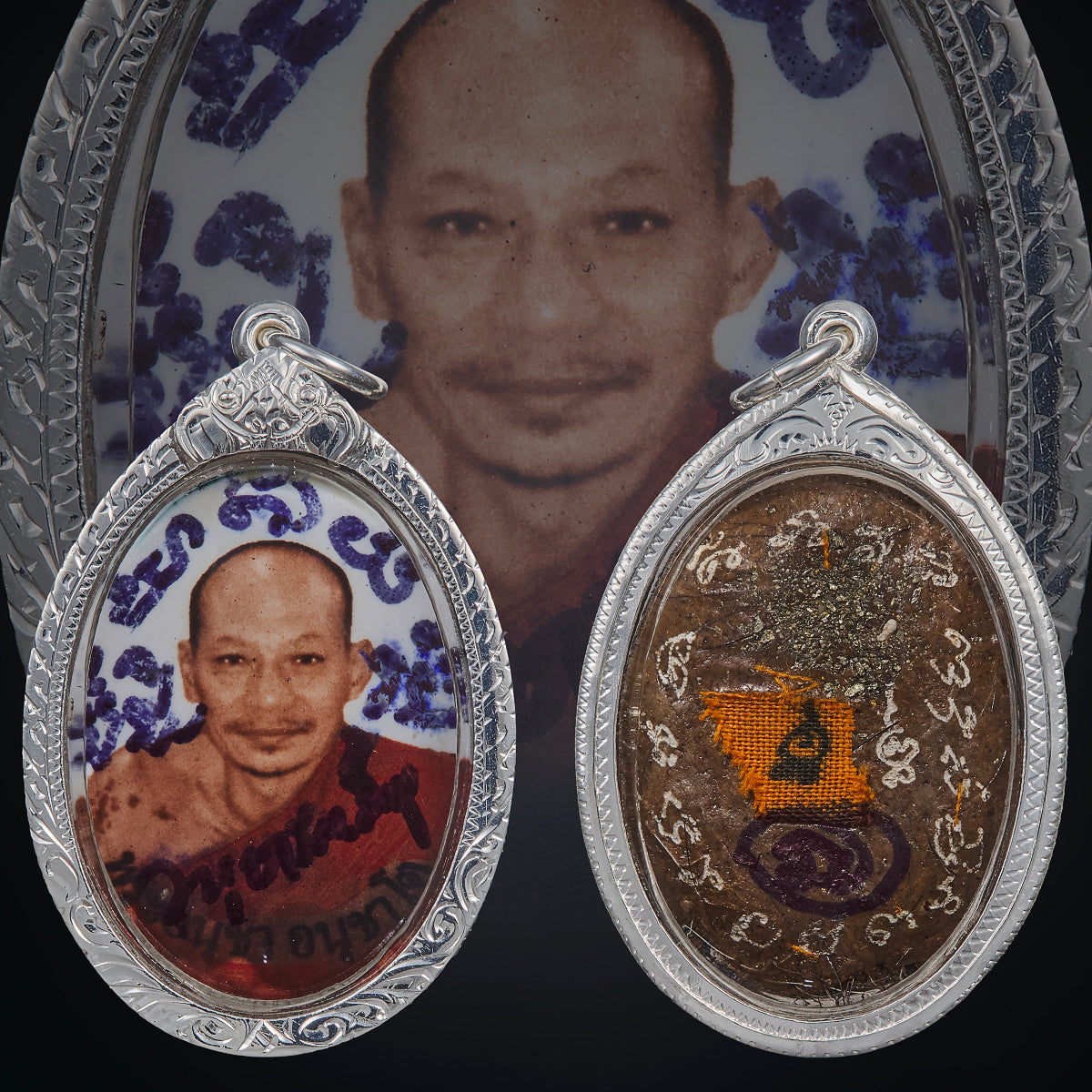
This early Locket of LP Anucha is distinguished less by elaborate outward decoration than by the material construction concealed behind its portrait.
Its sacred mass brings together old temple bricks, gold leaf from principal Buddha images, incense ash, relic-associated material, traditional Yant powders, old palm-leaf scripture fragments and other religious substances.
Visible hairs can also be observed within the material.
The front provides the direct devotional connection with LP Anucha.
The reverse preserves the physical sacred materials.
The sacred markings introduce the Wicha element.
Together, they create an artifact characteristic of an earlier, more individually prepared period of LP Anucha's sacred-object making.
Historical Background
Before photographic lockets became widely treated as collectable portrait pieces, the traditional Thai sacred locket could serve a considerably deeper purpose.
The photograph established a direct devotional association with a monk or master, but the space behind it allowed the maker to incorporate sacred powders, relic substances, blessed cloth, Takruts, Yant and other ritual materials.
In such constructions, the photograph and sacred mass perform different roles.
The image identifies the lineage.
The materials carry its physical history.
This distinction is especially relevant to an earlier locket such as the present example. LP Anucha's portrait dominates the obverse, while the reverse preserves a heterogeneous mixture assembled from older religious sources.
It also reflects a broader principle found throughout Thai amulet making: sacred materials need not end when the original object reaches the end of its practical life.
Fragments of old temple structures, worn religious materials, old scriptures, incense residue and gold leaf removed or collected from sacred images can be incorporated into new objects. In doing so, physical material from an earlier generation of Buddhist practice is carried forward into another.
Origins of the Materials
The material mixture is one of the defining features of this locket.
Powdered ancient temple bricks connect the sacred mass physically with older Buddhist structures and religious spaces. Material from an old temple is valued not simply for its age, but for the years of chanting, worship and merit-making associated with the place from which it came.
Gold leaf collected from principal Buddha images introduces material that had previously been offered directly in acts of Buddhist devotion.
Sacred incense ash from long-standing altars represents another accumulated ritual substance. Incense offered repeatedly before Buddha images and sacred shrines becomes associated with years of prayer and devotional activity.
The mixture also contains fragments of relic materials associated with respected monks, connecting the locket with the wider monastic tradition rather than LP Anucha alone.
Traditional Yant powders prepared during temple ceremonies provide the specifically ritual component of the mixture.
Particularly interesting are fragments from old palm-leaf scriptures. Palm-leaf manuscripts belong to an older physical tradition of preserving Buddhist scripture, teachings and sacred knowledge before modern printed books became commonplace. Incorporating fragments of such material symbolically connects written Dhamma and older religious knowledge with the sacred mass.
Finally, visible hairs can be observed within the material itself. Together with the other fibres and heterogeneous inclusions, they emphasise the individually prepared nature of the compound.
Rather than producing a visually perfect powder, the intention was to preserve the identity and accumulated associations of the materials brought together within it.
Ritual
The making of such a locket can be understood as a process of gathering, combining, inscribing and consecrating.
First came the collection of sacred substances.
Materials originating from temples, Buddha images, altars, respected monks, old scriptures and previous ceremonies were reduced or prepared so that they could be combined into a workable sacred mass.
Traditional Yant powders were then incorporated, adding materials prepared specifically through Wicha and ritual practice.
The reverse became the principal repository for this mixture.
In the present example, the sacred mass remains visibly heterogeneous. Fibres, particles and hairs can be observed rather than being completely pulverised away. A saffron-coloured cloth fragment is incorporated into the centre, while sacred characters surround the composition.
The portrait side was likewise marked with sacred characters around LP Anucha's image.
This creates a complementary construction:
the portrait establishes the master;
the old materials establish continuity;
the Yant establishes the Wicha;
and consecration unites them.
Blessings and Effects
The locket is best understood as a broad daily sacred object rather than an amulet created solely for one narrowly defined purpose.
Within the tradition surrounding LP Anucha, one of the principal qualities associated with his work is Metta Maha Niyom — goodwill, favourable reception, kindness from others and smoother interpersonal relationships.
This makes such an amulet particularly relevant to people whose livelihood depends upon human interaction: business owners, salespeople, managers, traders and those regularly dealing with customers or people in authority.
Traditional protective qualities are equally important. The wearer may approach the locket for Klaew Klaad, general protection and assistance in avoiding harmful situations or unnecessary obstacles.
The sacred materials connected with older temples, Buddha images and respected monks further give the piece a broad character of Baramee and auspicious support.
For livelihood, its traditional interpretation extends towards opportunity, good fortune and gradual prosperity rather than simply sudden wealth.
Its overall character may therefore be understood as:
Metta for favourable relationships.
Baramee for personal standing.
Protection for the path ahead.
Chok Larp for opportunity.
Prosperity for continued progress.
Modern Application
This is the type of amulet that can comfortably function as a principal everyday piece.
For a business owner, the combination of Metta, protection and auspicious materials provides a balanced traditional purpose without concentrating exclusively upon wealth.
For those working in sales or customer-facing professions, its Metta Maha Niyom aspect is particularly relevant to communication, goodwill and maintaining relationships.
It is also appropriate for devotees who feel a personal connection with LP Anucha and prefer an artifact carrying his actual portrait.
For the collector, however, the appeal is somewhat different.
Later issues may display increasingly elaborate designs and more formal production. Earlier lockets such as this preserve the material culture of LP Anucha's early sacred-object making — mixed old substances, individually worked surfaces, handwritten sacred characters and visible inclusions that reveal how the object was physically assembled.
Physical Details
The locket measures approximately 1.5 inches and follows a traditional oval portrait form. The obverse displays an early photographic image of LP Anucha in monastic robes, surrounded by prominent purple sacred markings. The reverse contains a dark brown heterogeneous sacred-material mass in which particles, fibres and visible hairs can be observed. A small saffron-coloured cloth section is embedded towards the centre, with further ritual material beneath and sacred characters applied around the perimeter. The locket is presently protected within a fitted decorative casing.
Recommended Pairing
A Phra Somdej provides a natural pairing where the emphasis is upon Buddhist Baramee, stability and broad protection.
Phra Sivali can complement the locket where livelihood, resources and continued financial support are the principal concerns.
For someone working extensively through communication, negotiation or sales, Salika provides a more specialised emphasis upon speech and Metta Maha Niyom.
The locket itself, however, already combines several traditions and materials and is sufficiently broad to function comfortably as a standalone sacred object.
Personal Notes
The attraction of this locket lies in what can still be seen within it.
A modern sacred object can be beautifully finished while concealing almost every trace of how it was made. This earlier locket does almost the opposite.
Its material remains visibly heterogeneous.
There are old religious substances, fibres and particles within the sacred mass. There are fragments connected with temple worship and older Buddhist objects. There are pieces of old palm-leaf scripture. There are visible hairs. There is cloth and there are individually applied sacred markings.
These details give the piece a distinctly handmade character.
More importantly, they illustrate an older principle of Thai sacred craftsmanship: materials that have already participated in religious life can be gathered and given another sacred form rather than simply discarded.
Temple brick becomes powder.
Gold leaf once offered to a Buddha image enters a new sacred object.
Incense offered at an altar becomes part of its material body.
Old scripture contributes to another generation of devotional practice.
The portrait connects the wearer to LP Anucha.
The Yant connects the piece to Wicha.
The old materials connect the present to what came before.
That continuity is what gives this earlier LP Anucha locket its particular character.
-
Free Shipping for Singapore| $15 Worldwide | $60 USA For Items Below $350