
OOBThaiAmulets
LP Anucha - Wat Pho Ratchaburana
LP Anucha - Wat Pho Ratchaburana
Couldn't load pickup availability
ANU01
Roop Tai
LP Anucha • Wat Pho Ratchaburana, Ratchaburi
4cm
Mainstream Artifact
Bio of LP Anucha: click here
Sacred Craftsmanship
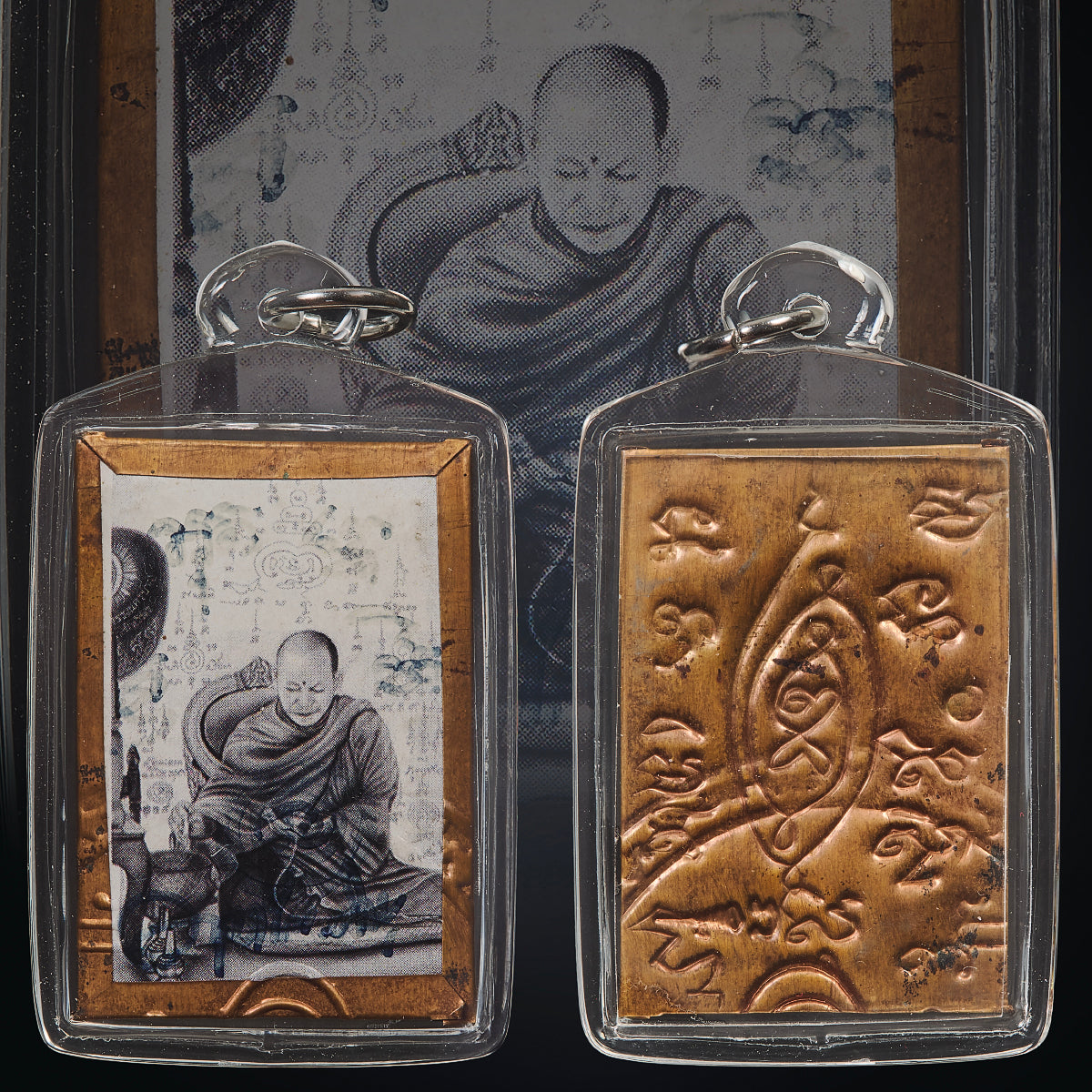
This Roop Tai of LP Anucha belongs to a particularly personal category of sacred objects associated with LP Anucha of Wat Pho Ratchaburana, Ratchaburi. Rather than being a standard factory-produced medal or moulded powder amulet, the piece combines the master's photographic image with a sheet of copper personally inscribed with sacred Yant.
Each artifact was individually assembled from carefully prepared sacred materials, so natural variations in texture, colour, embedded particles, fibres, sacred markings and overall form make every piece unique.
The photographs are representative only. A piece will be selected at random, and the item supplied may differ slightly from the exact piece shown in the images.
Personal Experiences Shared by Luksits
Among followers of LP Anucha, personally inscribed pieces occupy a somewhat different position from standard temple releases.
Devotees visiting him may request blessings according to the circumstances they are facing. One person may be concerned with business and customer relations, another with protection, while another may simply seek a general blessing for smoother circumstances in daily life.
For this reason, the Yant found upon one Roop Tai may differ noticeably from another.
This individuality is part of their appeal. Rather than viewing every piece as an identical production, followers regard the handwritten inscriptions as evidence of the direct interaction between the master, the sacred object and the devotee for whom it was prepared.
The qualities most commonly associated with such pieces are Metta, protection, support in one's work and general auspiciousness.
Summary
The Roop Tai of LP Anucha is a compact devotional object built around three closely connected elements:
the image of the master, the handwritten Yant, and the copper sheet carrying the Wiccha.
Its construction is straightforward in appearance but highly personal in execution.
LP Anucha's photograph forms the devotional centre. He personally adds sacred inscriptions to the photograph, while a separate copper sheet is hand-Yanted and folded behind it to form the backing.
Because the inscriptions may be prepared according to the needs of individual devotees, these Roop Tai naturally display considerable variation.
It is this direct handwork that gives the piece its particular character.
It is not simply an image of LP Anucha.
It is an image that has been personally worked upon and blessed by LP Anucha himself.
Historical Background
The use of a revered monk's photograph as a sacred object has long existed alongside the more familiar Thai traditions of Rian, powder amulets and cast images.
Photography introduced another way for devotees to maintain a direct visual connection with a respected master. Such images could be carried, placed upon an altar or incorporated into more elaborate sacred constructions.
A photograph alone, however, is different from a photograph that has subsequently been inscribed and ritually prepared by the monk represented upon it.
In the case of this Roop Tai, LP Anucha adds the traditional language of Yant and Wiccha to his own portrait.
The object therefore joins two traditions.
The photograph preserves the physical likeness of the master.
The handwritten Yant carries the ritual intention.
This approach is especially appropriate within LP Anucha's practice, where sacred inscription forms an important part of his work. His Yant are not treated simply as decorative writing; their arrangement is connected with particular ritual purposes and blessings.
Origins of the Materials
The principal physical materials are deliberately uncomplicated: LP Anucha's photographic image and a prepared copper sheet.
Copper has long been practical for sacred inscription because it can be written, engraved, pressed, folded and incorporated into a compact object without losing the physical marks made upon it.
In this piece, however, the significance of the copper does not rest upon the metal alone.
Its importance comes from what was subsequently done to it.
The sheet was personally hand-Yanted by LP Anucha, turning an ordinary piece of metal into the ritual backing of the Roop Tai. Once folded behind his photograph, the portrait and the inscribed copper effectively become one object.
This construction also preserves the marks of individual preparation. Variations in handwriting, line pressure, positioning and Yant arrangement are therefore expected rather than regarded as imperfections.
Ritual
The preparation centres upon direct inscription.
LP Anucha first writes the appropriate sacred Yant upon the copper sheet. Depending upon the purpose of the piece, the inscriptions may emphasise different branches of Wiccha.
The completed sheet is then folded and placed behind his photograph.
LP Anucha additionally writes sacred characters directly upon the photograph itself. The result is therefore a two-sided ritual construction: the visible portrait carries his handwritten blessing, while the concealed or rear-facing copper carries the more extensive Yant work.
This method gives the Roop Tai an unusually personal character.
Instead of relying entirely upon a standard mould or mechanically reproduced design, part of the sacred composition exists only because LP Anucha physically wrote it onto that individual piece.
For devotees, the process is therefore as important as the finished appearance.
Blessings and Effects
The exact emphasis can differ according to the Yant placed upon an individual example, but these Roop Tai are commonly associated with several broad qualities within LP Anucha's tradition.
Metta Maha Niyom concerns goodwill, approachability, favourable relationships and receiving kindness or assistance from others.
Protection and Klaew Klaad concern avoidance of harmful circumstances, safer passage and general spiritual protection.
Baramee relates to personal standing, confidence and the ability to command appropriate respect.
For those engaged in business or occupations requiring regular interaction with others, Metta may also be approached for smoother negotiations, customer relationships and cooperation.
Because individual examples may carry different Yant, however, it is better to understand each Roop Tai according to its actual inscriptions rather than assume that every piece was prepared for precisely the same purpose.
Modern Application
The Roop Tai is particularly suitable for someone who values directly prepared sacred objects.
It is compact enough for daily carrying, while the portrait maintains a clear devotional connection with LP Anucha.
For business owners, managers and salespeople, a piece prepared with Metta-oriented Yant may complement circumstances where relationships, communication and goodwill are important.
For those primarily concerned with protection, an example carrying protective Yant can instead be approached in that direction.
There is also a simpler devotional interpretation.
A follower may carry the Roop Tai not because of one specialised effect, but as a reminder of the master, his teachings and the importance of maintaining mindfulness and good conduct in everyday life.
Physical Details
The Roop Tai measures approximately 4cm and is housed in a clear protective casing. The front presents a photographic portrait of LP Anucha with visible handwritten sacred markings. Behind the photograph is a folded copper sheet personally hand-Yanted by LP Anucha. The reverse exposes the copper surface and its individually executed sacred characters, giving the piece a distinctly handmade appearance. Differences between examples are natural because the Yant were individually written rather than mechanically reproduced.
Recommended Pairing
Because the Roop Tai can already incorporate both Metta and protective Wiccha, it can comfortably be carried by itself.
Where greater emphasis upon livelihood and continued resources is desired, Phra Sivali provides a traditional complementary direction.
A Phra Somdej may be paired with it where the wearer prefers a stronger Buddhist devotional emphasis centred upon Baramee, stability and general auspicious support.
For someone whose occupation depends heavily upon speaking, negotiation or customer relations, Salika may provide a more specialised emphasis upon communication and Metta Maha Niyom.
The Roop Tai nevertheless remains the personal centre of such a combination because it carries the image and direct handwritten work of LP Anucha himself.
Personal Notes
There is something particularly revealing about these simpler pieces from a collector's perspective.
Their importance does not depend upon precious metal, elaborate casting or complicated ornamentation.
The value lies in direct contact with the master's hand.
A photograph could be reproduced many times.
A copper sheet could be cut many times.
But once LP Anucha personally writes the Yant upon both the photograph and its copper backing, that particular Roop Tai acquires an individuality that cannot be duplicated exactly.
The handwriting changes.
The arrangement changes.
The Yant may change according to the devotee.
For this reason, two Roop Tai that appear similar at first glance may in fact represent two different moments of preparation and two different ritual intentions.
The photograph establishes the connection.
The copper carries the inscription.
The handwritten Yant makes the piece personal.
That combination is the defining character of this Roop Tai of LP Anucha, Wat Pho Ratchaburana.
-
Free Shipping for Singapore| $15 Worldwide | $60 USA For Items Below $350