
OOBThaiAmulets
LP Anucha - Wat Pho Ratchaburana
LP Anucha - Wat Pho Ratchaburana
Couldn't load pickup availability
ANU01
Rian Phutson Bucha Kru
LP Anucha • Wat Pho Ratchaburana, Ratchaburi
Bucha Kru / Kathina Merit-Making batch
B.E. 2567
1.5 Inches
Mainstream Artifact
Bio of LP Anucha: click here
Sacred Craftsmanship
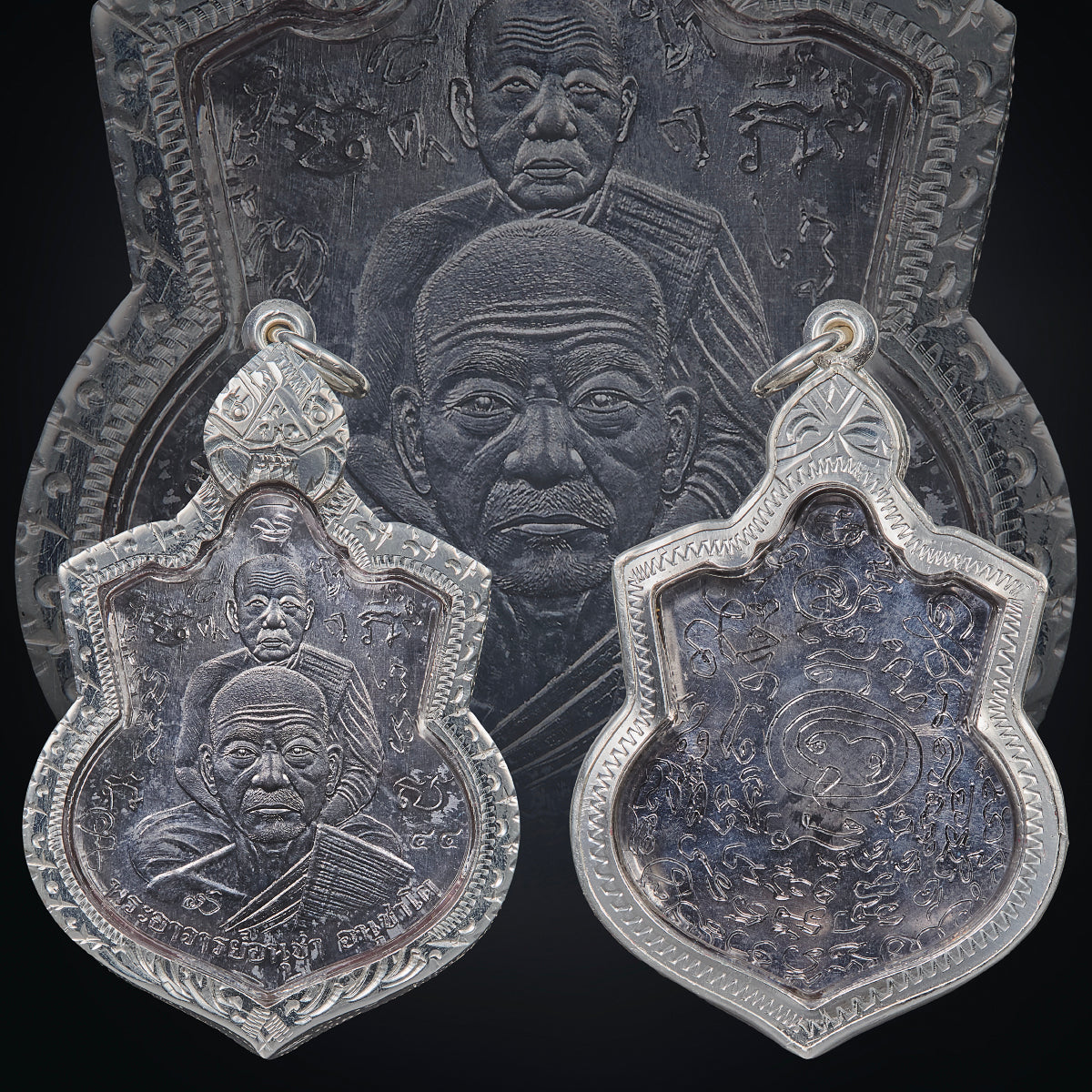
The Rian Phutson Bucha Kru is one of the more personally meaningful early medals associated with LP Anucha of Wat Pho Ratchaburana. Rather than being created simply as a portrait medal of LP Anucha, its composition was designed specifically to acknowledge the master-disciple lineage that shaped his own practice.
Each artifact was individually produced from prepared material and personally worked by hand. Natural differences in the lead surface, patina, moulding and placement of the sacred inscriptions make every hand-yanted example unique.
The photographs are representative only. A piece will be selected at random, and the item supplied may differ slightly from the exact piece shown in the images
Personal Experiences Shared by Luksits
Among followers of LP Anucha, one recurring theme is the relationship between spiritual practice and ordinary working life.
A noticeable number of devotees connected with Wat Pho Ratchaburana are business owners, entrepreneurs and people carrying considerable family or professional responsibilities.
Some followers describe their connection as extending across generations. Their parents may have followed an earlier respected master, while they themselves later developed a relationship with LP Anucha.
One businessman involved in Thailand's beauty industry described precisely this type of continuity. His father had been devoted to an older generation of respected masters, while he subsequently became a follower and collector of LP Anucha. During the period in which his own business expanded, he regarded LP Anucha's sacred objects as an important spiritual support alongside his own effort and judgement.
Other devotees have spoken about smoother negotiations, stronger customer relationships, greater confidence during difficult periods and an increased sense that opportunities appeared at useful moments.
The experiences tend to be described as steady progress rather than sudden fortune.
In the case of the Rian Phutson Bucha Kru, there is another dimension. Because the medal centres upon gratitude towards one's teacher, devotees may also approach it as a reminder that success is rarely achieved entirely alone. Knowledge comes from teachers; opportunities often come through others; and progress carries with it an obligation to remember those who helped establish the path.
Summary
The Rian Phutson Bucha Kru B.E. 2567 was created with a clear purpose: to honour LP Sanga of Wat Nong Muang, LP Anucha's core lineage teacher, while raising funds for the temple's annual Kathina merit-making ceremony.
Its Phutson composition expresses that relationship visually.
LP Sanga stands behind.
LP Anucha sits before him.
Teacher and disciple remain within one Rian.
This particular example is made from Nur Takua and originates from the test-mould stage. Its collector interest is strengthened further by LP Anucha's extensive personal involvement: both the front and reverse were individually hand-yanted by him.
It is therefore simultaneously a lineage medal, a Bucha Kru object, a Kathina merit-making issue and an individually inscribed example of LP Anucha's Wicha.
Historical Background
LP Anucha's development cannot be separated from the teachers through whom he received his knowledge, and LP Sanga of Wat Nong Muang occupies an important position within that history.
LP Anucha was born on 23 August 1964 in Nakhon Pathom Province. His relationship with temple life began early, and his association with LP Sanga became an important foundation for his later practice.
Through this lineage he was introduced not only to Buddhist teachings, but also to meditation, sacred Yant, ritual preparation and traditional Wicha.
LP Anucha first entered the monkhood in B.E. 2527 (1984) at Wat Nong Pho. After returning to lay life for a period, he maintained his connection with Buddhist practice and traditional knowledge.
On 10 August B.E. 2552 (2009), he returned to the monkhood at Wat Pho Ratchaburana.
His subsequent development combined formal Buddhist education with continued study of Wicha. Between B.E. 2556 and 2558 (2013–2015), he completed the Nak Tham sequence while continuing to develop the ritual knowledge transmitted through his teachers.
Other branches of his studies are associated with masters including LP Non of Wat Khao Phran Thup, LP Boonkham of Wat Chaiyaphum and LP Od of Wat Bang Muang, but LP Sanga remained fundamental to his core lineage.
The decision to create a medal specifically placing LP Sanga together with LP Anucha should therefore be understood within this tradition of Kru — the teacher.
Bucha Kru is not merely remembrance. It expresses gratitude towards the person through whom knowledge was received and acknowledges that the disciple's later practice rests upon foundations established by those before him.
Origins of the Materials
This particular example is made from Nur Takua — lead.
Lead has a long history within Thai sacred-object production, particularly for Takrut, cast images, trial pieces and objects intended to receive sacred inscription.
Its physical qualities are especially appropriate for a hand-worked piece. Lead is comparatively soft, allowing sacred characters to be scratched, engraved or drawn deeply into its surface without the resistance encountered in harder metals.
This becomes particularly relevant here because the Rian was not left in its ordinary production state.
LP Anucha used the available surfaces extensively, personally adding sacred characters across both sides.
As a test-mould example, the piece also belongs to a different stage of manufacture from an ordinary finished production medal. Such pieces are associated with checking the mould, relief and overall form before or around the preparation of the principal production run.
For collectors, that production context combines naturally with the individuality of the handwritten Yant.
The lead is therefore more than simply the material from which the medal was made. It became the surface upon which LP Anucha physically recorded his own ritual hand.
Ritual
The Rian Phutson Bucha Kru was created within the devotional context of Bucha Kru and Kathina merit-making.
Its purpose was to honour LP Sanga while helping raise funds connected with the temple's annual Kathina ceremony. The making and distribution of the sacred object therefore participated in a wider act of merit rather than existing solely as an object for private collection.
The moulded imagery established the lineage relationship first.
LP Sanga occupies the upper and rear position, while LP Anucha appears prominently before him. The composition visually places the teacher behind the disciple.
LP Anucha then personally worked upon the medals.
On this example, sacred characters were applied extensively across the front and reverse. The inscriptions surround the portraits rather than being confined to a single small signature or token Yant.
The reverse becomes particularly important because its broad surface provides space for the central sacred diagram together with numerous surrounding characters.
Within traditional Wicha, such inscription is understood as a deliberate ritual act. Yant are associated with Katha, sacred formulae and particular intentions; their value does not lie simply in their appearance.
The final consecration therefore brought together Kru, Yant, Katha, meditation, merit and lineage within the same object.
Blessings and Effects
The Rian Phutson Bucha Kru is associated with the broad qualities for which followers seek LP Anucha's sacred objects, while its Bucha Kru character adds an emphasis upon guidance, Baramee and continuity of knowledge.
Metta Maha Niyom is traditionally associated with goodwill, acceptance and favourable relationships. For those involved in business, management or occupations dependent upon other people, this quality is approached for smoother interaction with customers, colleagues and those in positions of authority.
Business prosperity and Chok Larp concern favourable opportunity, livelihood and continued financial movement. In the context of LP Anucha's followers, prosperity is often understood less as sudden riches and more as the ability to maintain momentum, recognise opportunities and gradually strengthen one's position.
Protection and Klaew Klaad concern avoiding harmful situations and passing through difficulties safely.
Baramee concerns personal standing, respect and the strength of character required to carry responsibility.
The Bucha Kru aspect adds another interpretation: support in learning, judgement and following the correct path. The teacher stands behind the disciple, symbolically reminding the wearer that knowledge should be carried forward with discipline and gratitude.
Modern Application
The character of this Rian makes it especially appropriate for people whose progress depends upon knowledge, judgement and relationships with others.
A business owner may approach it for Metta, prosperity and the wisdom to make sound decisions.
A manager or executive may value its associations with Baramee, authority and responsibility.
Teachers, students, craftsmen and practitioners of specialised professions may find particular meaning in its Bucha Kru theme, since their own progress similarly depends upon knowledge transmitted from teacher to student.
It is also appropriate for someone beginning a new stage of professional life.
The imagery offers a simple reminder: one may move forward independently, but the knowledge carried forward often came from someone who taught the path first.
Physical Details
The Rian Phutson Bucha Kru is a B.E. 2567 first-batch test-mould example made from Nur Takua (lead). The obverse uses a stacked Phutson composition, with the larger portrait of LP Anucha occupying the foreground and LP Sanga of Wat Nong Muang positioned directly behind him. Both figures are surrounded by individually inscribed sacred characters.
The reverse presents a broad lead field carrying a central circular Yant surrounded by dense handwritten sacred script. The silver-grey lead displays the characteristic subdued lustre and surface variation of the material, while the personally applied inscriptions vary naturally in depth, direction and spacing. The medal is protected within a fitted silver-toned casing while leaving the original hand-worked surfaces clearly visible.
Recommended Pairing
Because the Rian already combines Kru Baramee, Metta, prosperity and protection, it can comfortably function as a principal standalone amulet.
A Lersi may be an especially meaningful pairing for someone who approaches the Rian primarily through its Bucha Kru dimension. Both traditions place importance upon knowledge, teachers, disciplined practice and the transmission of Wicha.
Personal Notes
What makes this Rian particularly interesting is that its meaning does not begin with the wearer.
It begins with LP Anucha remembering his own teacher.
The medal was created to honour LP Sanga, and its Phutson composition makes the hierarchy immediately visible. The teacher remains behind the disciple — not hidden, but permanently present.
The fact that the issue also supported the temple's Kathina merit-making ceremony strengthens this idea. Gratitude towards one's teacher was converted into an act of merit benefiting the temple community.
Then there is this individual example.
It is Nur Takua.
It is a test mould.
And LP Anucha personally covered both front and back with handwritten Yant.
Those details give the piece a character quite different from an ordinary production medal. The mould establishes the historical design, but LP Anucha's handwritten work establishes the individuality of the actual object.
Perhaps the simplest way to understand the Rian is through its composition:
The disciple appears in front because his work continues.
The master remains behind because the lineage came first.
That is the essence of Bucha Kru — remembering the source of one's knowledge, respecting those who opened the path, and carrying their teachings forward into another generation.
-
Free Shipping for Singapore| $15 Worldwide | $60 USA For Items Below $350