
OOBThaiAmulets
LP Anucha - Wat Pho Ratchaburana
LP Anucha - Wat Pho Ratchaburana
Couldn't load pickup availability
ANU01
Rian Sema Ayu 60 - Uncut
LP Anucha • Wat Pho Ratchaburana, Ratchaburi
1st Batch • 60th Birthday / 5 Rob Commemorative Issue
B.E. 2568
2 Inches
Mainstream Artifact
Bio of LP Anucha: click here
Sacred Craftsmanship
The Rian Sema Ayu 60 was created to commemorate an important milestone in the life of LP Anucha of Wat Pho Ratchaburana — his 60th birthday, or 5 Rob.
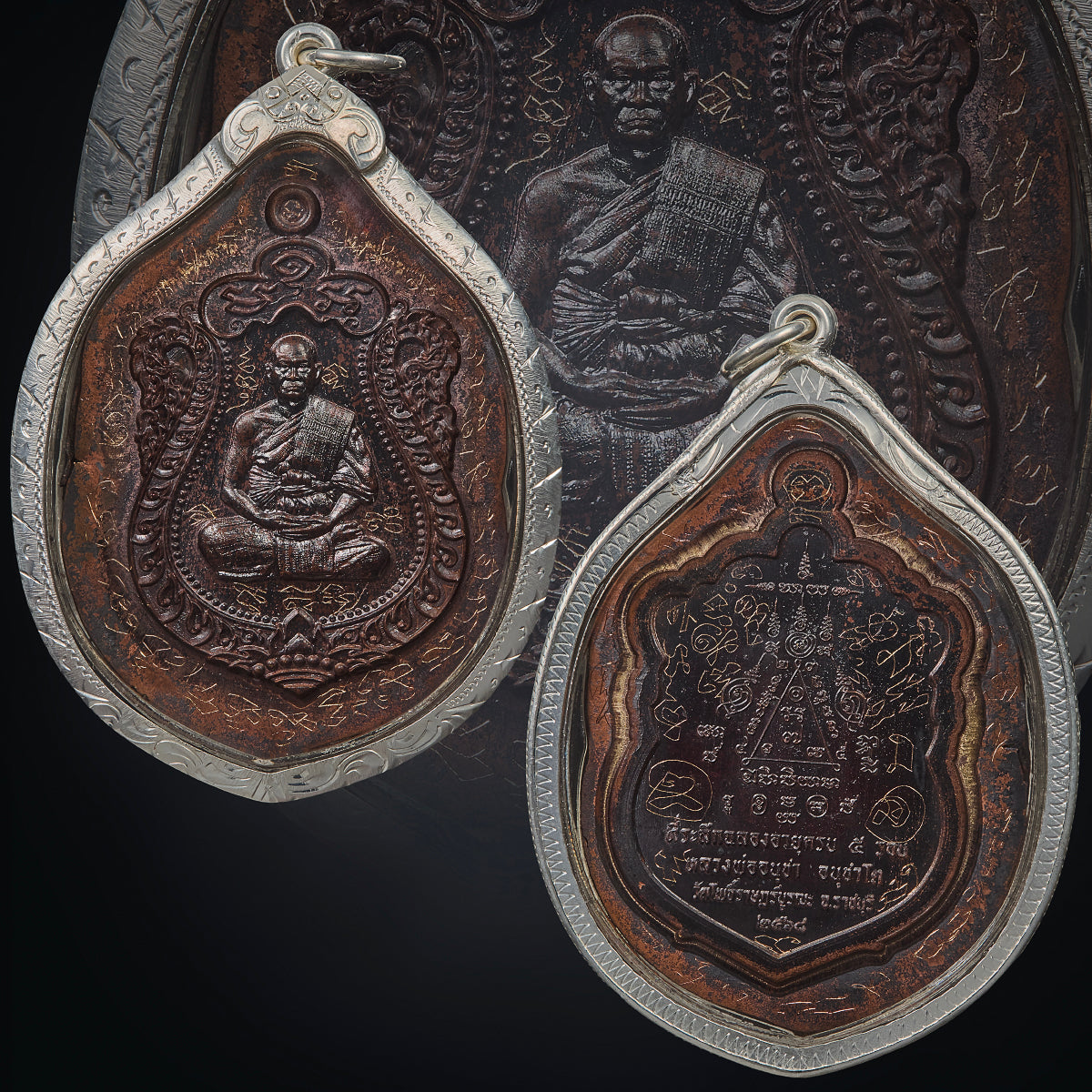
This rian is on its own uncut production form, and was personally hand-yanted by LP Anucha across both the front and reverse.
Each artifact is individually prepared from sacred material and personally worked by hand, so natural variations in surface, patina, inscription and form make every piece unique.
The photographs are representative only. A piece will be selected at random, and the item supplied may differ slightly from the exact piece shown in the images
Personal Experiences Shared by Luksits
One of the more noticeable characteristics of LP Anucha's following is the number of established businesspeople and long-term local devotees who maintain their connection with him over many years.
During visits to Wat Pho Ratchaburana, followers have spoken of relationships with sacred-object traditions extending across generations. Some came from families that had previously revered older masters, including LP Deang of Wat Khao Bandai-It, before the younger generation developed its own relationship with LP Anucha.
One businessman involved in Thailand's beauty industry described such a progression. His father had collected and revered LP Deang, while he himself later became a follower of LP Anucha. As his business expanded, he came to regard LP Anucha's sacred objects as an important spiritual companion to his own work, judgement and effort.
Other devotees have similarly spoken about smoother customer relationships, greater confidence when handling difficult negotiations, improved stability and opportunities appearing at useful moments.
What stands out in these accounts is that the emphasis is seldom upon sudden riches.
The language used is more often that of continuity and gradual improvement — retaining customers, overcoming difficult periods, making better decisions and seeing one's position become stronger over time.
A fully hand-yanted example such as this naturally holds a more personal character for such followers. The medal does not simply carry LP Anucha's portrait; the sacred characters were physically drawn onto the piece by the master himself.
Summary
The Rian Sema Ayu 60 commemorates two important beginnings and milestones at the same time.
It celebrates LP Anucha reaching 60 years of age — 5 Rob — while belonging to his first batch of Rian.
This particular example is further separated from the standard issue by its copper composition, uncut form and extensive personal hand-yanting across both sides.
The portrait establishes the connection with the master.
The 5 Rob issue records an important point in his life.
The formal Yant provides the ritual foundation of the medal.
The handwritten inscriptions make the individual piece personal.
For collectors of LP Anucha, it is therefore not simply another material variation of the Rian Sema Ayu 60. It represents a more individually worked form of the first-batch issue, preserving both the production field and the master's direct ritual inscription.
Historical Background
LP Anucha Anuchato was born on 23 August 1964 in Nakhon Pathom Province.
His relationship with temple life began at a relatively young age, with LP Sanga of Wat Nong Muang becoming an important influence upon his early development. Through this association, he was introduced to Buddhist practice together with traditional sacred inscription, meditation and Wicha.
He first entered the monkhood in B.E. 2527 (1984) at Wat Nong Pho. After subsequently returning to lay life for a period, he maintained his interest in Buddhist practice and traditional ritual knowledge.
On 10 August B.E. 2552 (2009), he returned permanently to the monkhood at Wat Pho Ratchaburana.
His later development combined formal Buddhist education with continued study of traditional Wicha. Between B.E. 2556 and 2558 (2013–2015), he completed the Nak Tham sequence while continuing to develop the knowledge transmitted through his teachers.
His principal lineage is associated with LP Sanga of Wat Nong Muang, with further branches of study associated with masters including LP Non of Wat Khao Phran Thup, LP Boonkham of Wat Chaiyaphum and LP Od of Wat Bang Muang.
Among the practices associated with LP Anucha are sacred Yant inscription, protective Wicha, Metta Maha Niyom, prosperity and business blessings, and the Na Ma Pa Ta Wicha concerning the Four Great Elements.
The Rian Sema Ayu 60 therefore emerged from an established practice in which the physical sacred object and the handwritten Yant are closely connected.
Origins of the Materials
This particular Rian is made from copper, a metal with a long history in Thai medal and sacred-object production.
Copper is practical for detailed medal work because it accepts moulded relief clearly while providing a surface upon which further sacred characters can be inscribed by hand. Over time, it also develops its own characteristic oxidation and patina, allowing individual medals to acquire increasingly distinct appearances.
In this example, the copper is especially relevant because the medal remains uncut.
The normal production process would eventually remove the surrounding excess field to establish the final outline. Here, that surrounding material has been retained, preserving a larger and less conventional form.
LP Anucha subsequently used these available surfaces for additional sacred inscription.
The material therefore records several stages of the object's creation: the original copper blank, the moulded Sema medal, the retained uncut field and finally the individually applied handwritten Yant.
Ritual
The ritual character of this example rests particularly upon LP Anucha's direct personal involvement.
The medal began with the formal imagery of the Rian Sema Ayu 60: LP Anucha seated in meditation upon the obverse, surrounded by the ornate Sema composition, with the principal sacred diagram and commemorative inscriptions occupying the reverse.
LP Anucha then personally added sacred characters across the piece.
These were not simply decorative marks intended to make the medal visually elaborate. Within traditional Yant practice, sacred characters are associated with particular Katha, ritual formulae and intentions. Their inscription forms part of the preparation of the object.
The photographs show this particularly clearly.
On the front, handwritten characters extend around the portrait and into the broad surrounding field. On the reverse, they surround and supplement the formal central Yant, creating a dense field of sacred writing.
The medal was then incorporated into the wider blessing and consecration associated with the Ayu 60 / 5 Rob issue.
For devotees, the distinction is meaningful: the formal medal belongs to the commemorative batch, while the additional handwritten work establishes the individuality of this particular piece.
Blessings and Effects
The Rian Sema Ayu 60 is approached as a broad all-purpose sacred medal, combining the traditional qualities of LP Anucha's Wicha with the auspicious symbolism of the 60-year milestone.
In the Thai calendrical understanding used for such commemorations, one Rob represents a twelve-year zodiac cycle. Five complete cycles therefore equal 60 years.
Reaching 5 Rob carries the symbolism of completion, accumulated experience and the beginning of another cycle of life. In the context of a respected monk's commemorative sacred objects, devotees may regard this as particularly auspicious.
The number five also has strong associations within Thai Buddhist sacred practice, including Na Mo Phut Tha Ya, the five-syllable formula traditionally associated with the Five Buddhas.
Within the lineage interpretation of this issue, its principal qualities may be understood through several complementary areas:
- Kong Grapan Chatree — protection and resilience.
- Klaew Klaad — avoiding danger and passing safely through difficult circumstances.
- Metta Maha Niyom — goodwill, acceptance and favourable relationships.
- Baramee — personal standing, authority and respect.
- Chok Larp and prosperity — opportunity, livelihood and continued financial movement.
- Stability — protecting what has already been built rather than pursuing prosperity without foundation.
Modern Application
The broad character of the Rian Sema Ayu 60 makes it suitable as a principal daily amulet rather than one reserved for a narrowly defined purpose.
For a business owner, the combination of Metta, Baramee and prosperity is relevant to customers, negotiations, staff relationships and long-term commercial stability.
For executives, managers and professionals, the emphasis upon authority, judgement and protection fits environments in which decisions carry significant responsibility.
For those whose income depends upon sales, commissions or interpersonal relationships, Metta Maha Niyom complements the prosperity aspect by focusing upon the human relationships through which opportunities often arise.
The protective side of the medal also makes it suitable for ordinary daily travel and work.
At the same time, an uncut and extensively hand-yanted first-batch example has an obvious collector dimension. It can be appreciated not merely for what devotees believe it does, but for what it records about LP Anucha's early medal lineage.
Physical Details
This Rian Sema Ayu 60 measures approximately 5 cm and is made from copper. It is an uncut example, retaining the broad outer production field around the normal Sema-shaped medal.
The obverse presents LP Anucha seated cross-legged in meditation, framed by deep ornamental relief. The original copper has developed rich reddish-brown and darker tones, giving considerable contrast to the raised portrait and decorative details. Fine handwritten Yant characters personally applied by LP Anucha can be seen throughout the available surface, including the retained outer field.
The reverse carries the formal sacred design of the Ayu 60 issue, centred upon a triangular Yant arrangement and sacred characters. Around this established design are further individually handwritten inscriptions, again applied personally by LP Anucha.
The piece is housed in a fitted protective casing with the broad uncut copper border remaining clearly visible. Surface variation, patina and irregularities in the handwritten characters are natural characteristics of an individually worked example rather than defects.
Recommended Pairing
Because this Rian already combines protection, Metta, Baramee and prosperity, it does not require another amulet to make it complete. It can comfortably function as the principal piece in a daily set.
For a wearer whose primary concern is livelihood and continued support, Phra Sivali provides a natural complement through the traditional association with resources, sustenance and favourable journeys.
For sales, negotiations or professions where speech is especially important, Salika can place greater emphasis upon persuasive communication and Metta Maha Niyom.
Where the wearer wants a stronger emphasis upon seniority, leadership and personal standing, an established Maha Amnaj piece may complement the Baramee aspect of the Rian.
The Rian itself remains the foundation: a broad first-batch medal intended to accompany everyday life rather than a narrowly specialised situation.
Personal Notes
There are several layers to this particular example that should not be confused with one another.
First, it is the Rian Sema Ayu 60, created for LP Anucha's 60th birthday.
Second, it belongs to his first batch of Rian.
Third, it is made from copper.
Fourth, it remains uncut, preserving material that would normally disappear during finishing.
And finally — perhaps most importantly for this individual piece — LP Anucha personally filled both sides with handwritten Yant.
That final characteristic changes the nature of the object.
A standard commemorative medal can be reproduced in numbers from the same mould. A handwritten inscription cannot. The moment LP Anucha placed his own sacred characters upon the copper, that individual medal began to separate itself from the others in the batch.
The mould gives the medal its identity.
The uncut copper preserves its original form.
The 5 Rob occasion gives it its historical moment.
LP Anucha's own hand gives this particular piece its individuality.
For a collector following the early development of LP Anucha's sacred objects, this is precisely where its appeal lies: not simply in rarity for rarity's sake, but in the unusually direct connection between master, Wicha and object.
-
Free Shipping for Singapore| $15 Worldwide | $60 USA For Items Below $350