
OOBThaiAmulets
LP Anucha Wat Pho Ratchaburana
LP Anucha Wat Pho Ratchaburana
Couldn't load pickup availability
ANU01
Rian Sema Ayu 60
LP Anucha • Wat Pho Ratchaburana, Ratchaburi
1st Batch • 60th Birthday / 5 Rob Commemorative Issue
B.E. 2568
5cm
Mainstream Artifact
Bio of LP Anucha: click here
Sacred Craftsmanship
The Rian Sema Ayu 60 was created to commemorate the 60th birthday of LP Anucha Anuchato of Wat Pho Ratchaburana, marking the completion of 5 Rob and forming part of his important first-batch medal lineage.
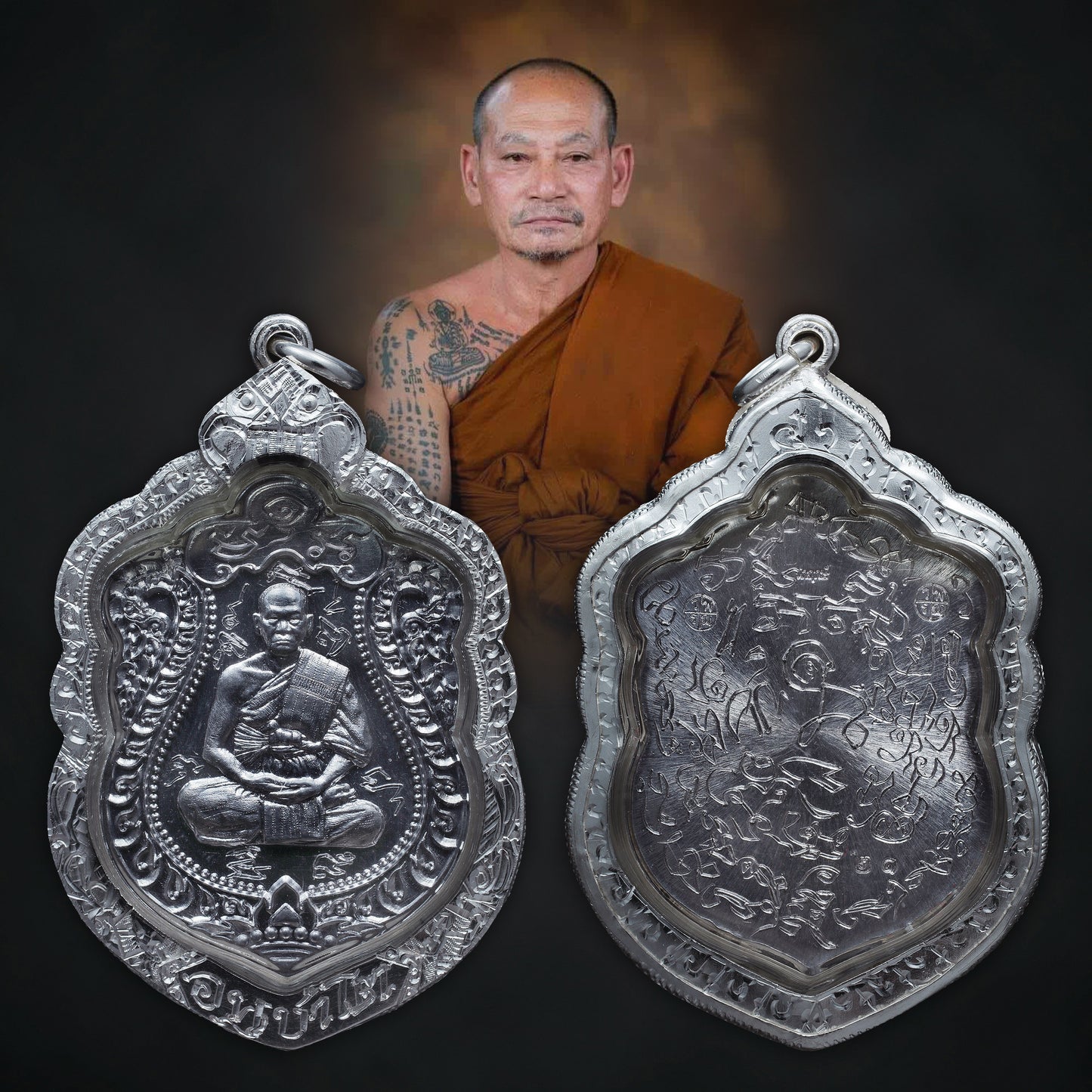
This particular example is distinguished from the standard production medal by its lead construction, Lang Liap smooth reverse and extensive personal hand-Yant work by LP Anucha.
Each medal was individually produced and subsequently worked by hand, so natural differences in the lead surface, patina, inscription depth, character placement and finishing make every hand-Yanted example unique.
The photographs are representative only. A piece will be selected at random, and the item supplied may differ slightly from the exact piece shown in the images.
Personal Experiences Shared by Luksits
Among LP Anucha's established Luksits, personally inscribed medals tend to be viewed differently from ordinary production examples.
The distinction is not simply rarity.
A hand-Yanted medal required the master to take the finished object into his own hands and spend time writing directly upon its surfaces. For close followers, those handwritten lines provide a particularly tangible connection with LP Anucha and his Wicha.
During visits to Wat Pho Ratchaburana, I have encountered followers whose association with this tradition extends across generations. Some explained that their fathers had previously followed respected masters such as LP Deang of Wat Khao Bandai-It, while they themselves later formed their own relationship with LP Anucha.
One businessman involved in Thailand's beauty industry spoke of this continuity particularly strongly. His father had collected and revered LP Deang, while he later began carrying sacred objects blessed by LP Anucha. As his business expanded, he came to regard the master's blessings as a spiritual companion to his own effort and judgement.
Other businesspeople have similarly spoken of improved customer relationships, smoother negotiations, greater confidence when making important decisions and periods of financial uncertainty becoming easier to manage.
Their accounts generally concern steady progress rather than sudden riches — customers returning, opportunities appearing at useful moments and businesses gradually becoming more secure.
For those who already have faith in LP Anucha, a fully hand-Yanted medal such as this carries an additional personal dimension: the sacred writing itself was placed upon the piece by the master.
Summary
The Rian Sema Ayu 60 belongs to LP Anucha's important first-batch 60th-birthday issue, commemorating the completion of five twelve-year cycles of life.
This particular example combines three especially desirable characteristics:
Lead construction.
Lang Liap smooth reverse.
LP Anucha's personal hand-Yant work across both front and back.
The moulded obverse provides the formal identity of the commemorative issue. The smooth reverse provided LP Anucha with a blank field for individual Wicha.
He also inscribed the front.
The resulting medal therefore combines formal temple craftsmanship with direct personal ritual work.
For the collector, it remains recognisably a Rian Sema Ayu 60. For the devotee, however, its individual handwritten inscriptions give it a character that cannot be reproduced simply by striking another medal from the same mould.
Historical Background
Within the Thai calendrical tradition, a Rob represents a complete twelve-year zodiac cycle. Five Rob therefore equal 60 years, making the completion of the fifth cycle an important milestone in a person's life.
The 60th year traditionally carries associations with maturity, accumulated experience and the completion of a major cycle before entering the next stage of life.
Within Buddhist Wicha, the number five also possesses important symbolic associations. One of the most familiar is Na Mo Phut Tha Ya, the five-syllable heart formula associated in traditional practice with the Five Buddhas of the present aeon.
For this reason, a 5 Rob commemorative issue may be approached by devotees as more than a simple birthday souvenir. It marks the accumulated years of a master and the merit surrounding an important life milestone.
LP Anucha was born on 23 August 1964 in Nakhon Pathom Province. His early spiritual development was closely associated with LP Sanga of Wat Nong Muang, through whom he was introduced to meditation, sacred inscription and traditional Buddhist Wicha.
He first entered the monkhood in B.E. 2527 (1984) at Wat Nong Pho. After spending a period in lay life, he returned permanently to the monkhood at Wat Pho Ratchaburana on 10 August B.E. 2552 (2009).
His later development combined formal Buddhist education with traditional Wicha. Between B.E. 2556 and 2558 (2013–2015), he completed the Nak Tham sequence while continuing his ritual studies.
Additional branches of learning are associated with masters including LP Non of Wat Khao Phran Thup, LP Boonkham of Wat Chaiyaphum and LP Od of Wat Bang Muang.
Sacred Yant inscription remains particularly relevant to this example. Here, the tradition is not represented merely by a reproduced symbol: LP Anucha's own inscriptions remain physically visible upon the medal.
Origins of the Materials
This example was produced from lead, a traditional metal well suited to sacred-object production and subsequent hand inscription.
Its relatively soft surface provides an effective field for the deliberate cutting and writing of Yant, allowing individual characters to remain clearly visible upon the medal.
For this particular piece, however, the most important material characteristic is the relationship between the metal and the Lang Liap reverse.
The reverse was not filled by a factory-moulded sacred diagram. It remained smooth, leaving the metal itself available for LP Anucha's personal work.
He subsequently transformed this plain surface into a densely inscribed ritual field.
The front was similarly personalised. Sacred characters were added around the moulded portrait and decorative elements wherever suitable space remained.
The lead therefore performs two functions.
It forms the physical body of the Rian, while simultaneously serving as the writing surface upon which LP Anucha recorded his individual Wicha.
Ritual
The central ritual feature of this particular Rian is straightforward but significant:
LP Anucha personally hand-Yanted both the front and the back.
The process transforms the medal beyond its original moulded form.
On the obverse, the formal portrait and decorative Sema composition were already established by the mould. LP Anucha then worked around that composition, adding sacred characters by hand.
The reverse offered much greater freedom.
Because it is Lang Liap, there was no moulded reverse design determining where the inscriptions had to sit. LP Anucha could instead arrange the sacred writing directly across the open field.
This explains why individual Lang Liap examples can look markedly different from one another.
The handwritten Yant were not simply decorative reproductions. Within traditional Wicha, the inscription of sacred characters forms part of the ritual act itself, connecting physical writing with concentration, Katha and the intention of the practitioner.
The distinction may be expressed simply:
The mould establishes the batch.
The hand-Yant establishes the individual piece.
Blessings and Effects
The Rian Sema Ayu 60 is traditionally approached as a broad, balanced daily amulet, while the extensive personal Yant give this particular example a stronger individual Wicha character.
Protection forms an important foundation. Devotees may approach LP Anucha's work for Klaew Klaad, seeking avoidance of accidents, danger and unfavourable circumstances, together with broader protective qualities for everyday life.
Metta Maha Niyom concerns goodwill and favourable human relationships. For those in business, sales or management, this is traditionally associated with smoother communication, customer confidence and receiving cooperation rather than unnecessary opposition.
Baramee concerns personal standing and the ability to carry oneself with authority. It is particularly relevant for people responsible for staff, negotiations or important decisions.
Prosperity forms another part of the tradition, although among established Luksits it is often understood as sustainable advancement rather than instant wealth — maintaining income, preserving opportunities, overcoming difficult periods and gradually strengthening one's position.
The 5 Rob symbolism adds the qualities of maturity, completion and continuity.
Taken together, the medal is traditionally associated with:
- Protection and Klaew Klaad
- Metta Maha Niyom
- Baramee and personal authority
- Prosperity and business stability
- Opportunity and favourable circumstances
- Mental steadiness during difficult periods
Modern Application
This is particularly suitable for those who prefer one broad principal amulet rather than carrying several highly specialised pieces.
For business owners, its combination of Metta, Baramee, protection and prosperity suits the practical realities of managing customers, employees, negotiations and financial responsibility.
For executives and managers, the emphasis upon steadiness and personal authority complements leadership and decision-making.
Salespeople and commission-based professionals may appreciate the Metta aspect, where trust and communication directly influence livelihood.
Frequent travellers may approach the protective and Klaew Klaad traditions.
For the dedicated collector of LP Anucha, however, the attraction is somewhat different. The standard Rian records an official issue; a personally hand-Yanted Lang Liap example additionally records the master's individual intervention after the medal had been produced.
Physical Details
The Rian Sema Ayu 60 measures approximately 5 cm and is produced from lead.
The obverse depicts LP Anucha seated cross-legged in meditation, framed by an elaborate Sema-shaped composition with deeply moulded ornamental work surrounding the portrait. Individual hand-inscribed sacred characters can be seen across the field around the master.
The reverse is Lang Liap, deliberately lacking the standard moulded reverse composition. Its broad smooth field is instead covered extensively with LP Anucha's personal hand-Yanted characters and sacred forms.
The handwriting varies noticeably in size, orientation and depth across the surface — precisely the irregularity expected of individually applied sacred writing rather than machine reproduction.
The medal has a dark grey lead tone with brighter highlights across raised areas and freshly exposed inscription lines.
It is protected within an ornate silver-coloured casing, which follows the Sema outline while allowing both the portrait and the extensively hand-worked reverse to remain fully visible.
Recommended Pairing
For those seeking a more strongly Buddhist devotional balance, Phra Somdej pairs naturally with the Rian's protective and Baramee qualities.
For livelihood and continuity of resources, Phra Sivali adds a traditional emphasis upon sustenance, favourable journeys and the availability of necessities.
For sales, negotiations and occupations dependent heavily upon communication, Salika can place greater emphasis upon persuasive speech and Metta Maha Niyom.
Nevertheless, the Rian Sema Ayu 60 is broad enough in traditional purpose to be carried comfortably on its own.
Personal Notes
There is a meaningful difference between owning a medal blessed by a master and owning a medal personally written upon by that master.
Both belong to the same lineage, but they preserve different kinds of connection.
The ordinary production Rian records the official design and consecration of the batch.
This Lang Liap example records something more individual.
LP Anucha took the medal into his own hands and worked across both surfaces personally. The portrait side was already crowded with moulded ornament, yet he still found spaces for additional sacred characters. The smooth reverse gave him a much broader field, and he filled it extensively with his own writing.
No two such pieces need to be exactly alike.
That individuality is precisely their attraction.
The Rian commemorates 60 years of LP Anucha's life. The 5 Rob symbolism represents five completed cycles. The first-batch status records an early chapter of his medal lineage.
But on this particular example, there is another layer:
The mould identifies the Rian.
The 5 Rob records the milestone.
The handwritten Yant records LP Anucha himself.
-
Free Shipping for Singapore| $15 Worldwide | $60 USA For Items Below $350