
OOBThaiAmulets
Wat Prasat - B.E 2506
Wat Prasat - B.E 2506
Couldn't load pickup availability
MS06
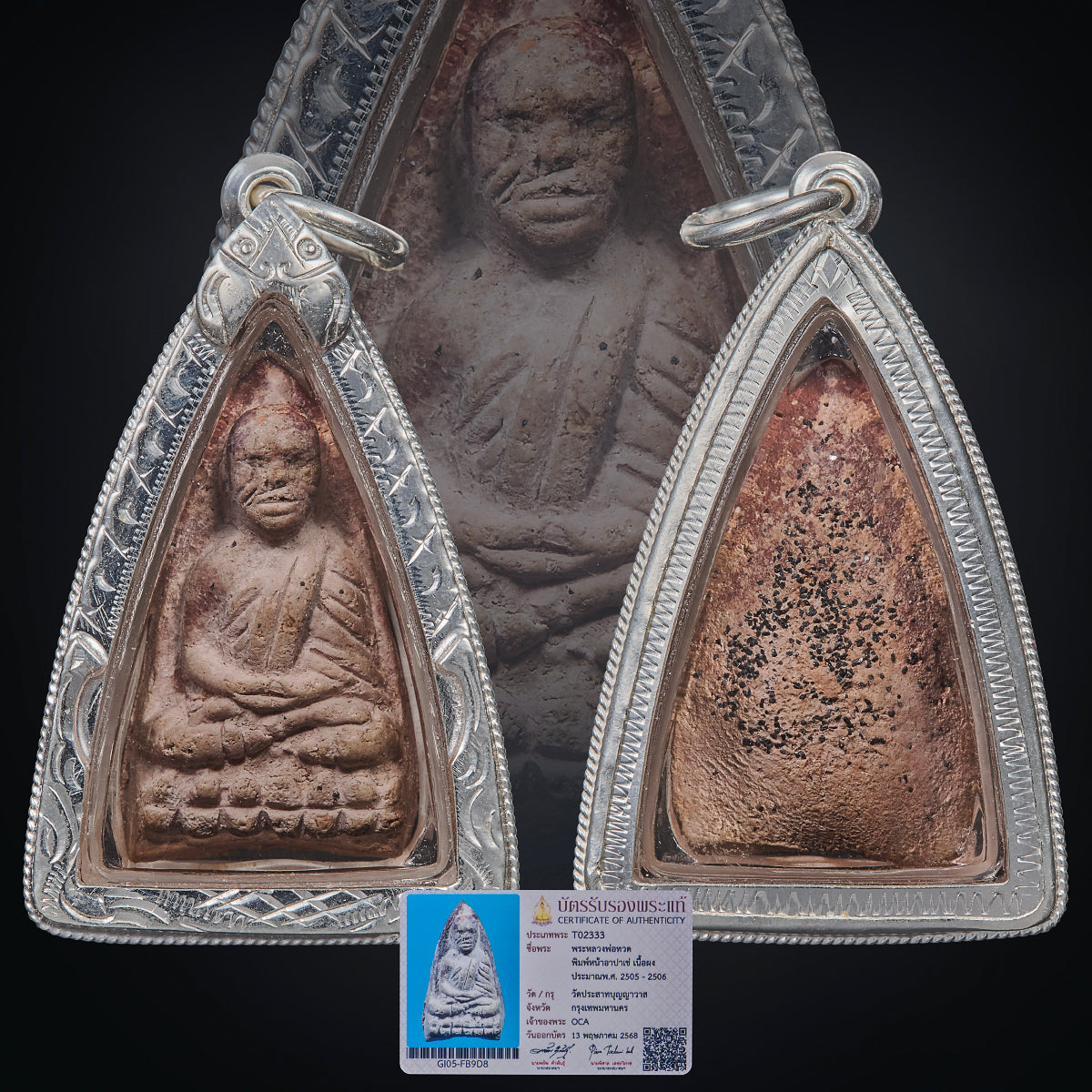
LP Thuat Pim Apache
Wat Prasat Bunyawas · Bangkok
B.E. 2505–2506 (1962–1963)
1.5 Inches
Mainstream Artifact
Samakom Certification Card (GI05-FB9D8)
Sacred Craftsmanship
Each artifact was individually pressed from hand-prepared material. Differences in colour, inclusions, mould pressure, surface texture and natural ageing therefore make every surviving example unique.
Personal Experiences Shared by Luksits
Among collectors of the Wat Prasat generation, LP Thuat pieces have long been particularly associated with Klaew Klad, safe travel and protection from unexpected danger.
Owners often share experiences involving situations that could have developed badly but somehow changed course — a journey delayed at the right moment, an instinct to slow down while driving, an unexpected decision to change route, or an accident whose consequences proved considerably less severe than expected.
For some devotees, the experience is not dramatic. It may simply be an unusual feeling to stop, wait or reconsider something before proceeding.
The Wat Prasat lineage adds another dimension. Users frequently speak of smoother dealings with people, support appearing during difficult periods and livelihood gradually becoming more stable.
For this reason, many collectors regard the Apache as an excellent everyday LP Thuat: small enough to wear comfortably, yet connected with one of the most substantial collective consecrations of its generation.
Summary
The LP Thuat Pim Lek “Apache” is a compact sacred-powder amulet associated with Wat Prasat Bunyawas in Bangkok, generally dated to approximately B.E. 2505–2506.
Its importance comes from the meeting of two respected traditions.
The first is LP Thuat, one of Thailand's most enduring devotional figures for protection, safe travel and escape from danger.
The second is Wat Prasat, whose major amulet-making project became renowned for gathering an extraordinary range of old sacred substances and bringing together respected monks from different lineages for collective consecration.
Although physically small, the Apache carries the distinctive character of this larger project: old sacred materials, multi-lineage blessing and broad traditional protection.
Historical Background
Wat Prasat Bunyawas became the centre of an ambitious sacred-object project during the early B.E. 2500s.
The undertaking was associated with temple restoration, religious construction and merit-making, with amulets distributed to supporters and devotees contributing towards the temple.
What distinguished Wat Prasat was its unusually broad approach.
Instead of relying exclusively upon one master's powders or one ritual lineage, materials were gathered from numerous established temples, older amulets and respected teachers throughout Thailand.
The same principle was reflected in the consecration ceremonies. Monks and meditation masters from different regions and traditions were invited to participate, creating a project remembered for its unusually collective character.
LP Thuat was particularly appropriate for such a series. By this period, his devotional image had become firmly established throughout Thailand, especially through the influential southern tradition associated with Wat Chang Hai.
Origins of the Materials
The sacred-powder composition is one of the principal reasons Wat Prasat amulets remain so highly regarded.
Traditional records concerning the project describe the collection of broken old amulets, sacred powders, herbs, soils, minerals and ritual substances from temples and respected masters throughout the country.
Particularly important are accounts of fragments from old Phra Somdej Wat Bang Khun Phrom, including material associated with the opening of the Wat Mai Amataros Kru in B.E. 2500.
Other traditional accounts describe powders connected with respected masters and temples, remnants from earlier major Buddhist amulet projects, sacred herbs and older religious material that could be ground and incorporated into the new mixture.
For LP Thuat forms, materials connected with the southern LP Thuat tradition were also considered especially appropriate.
The resulting powder is therefore visually complex.
On surviving examples one may observe black speckling, pale particles, differently coloured fragments and variations in density, reflecting the heterogeneous material rather than a single uniform powder recipe.
Ritual
The Wat Prasat project became famous for the scale of its Phutthaphisek ceremonies.
The consecration was not confined to one brief blessing. Different stages of the project involved chanting, meditation and adhitthana jit by numerous respected monks.
Surviving accounts differ over the precise number of participants, particularly because different records refer to different stages of the wider project. What remains consistent is that a very large gathering of senior monks and recognised masters took part.
Names traditionally associated with the wider Wat Prasat ceremonies include respected figures from several major lineages, among them LP Ngern of Wat Don Yai Hom, LP Toh of Wat Pradoochimplee, LP Mui of Wat Don Rai, LP Pae of Wat Pikulthong, LP Tae of Wat Sam Ngam, LP Tob of Wat Chon Daen and LP Noi of Wat Dhammasala, together with many others.
The ceremonies became so extensive that Sai Sin was reportedly extended through and beyond the principal ritual area, maintaining the ceremonial connection between participating monks and the sacred objects being blessed.
For collectors, this large-scale collective consecration remains one of the defining characteristics of Wat Prasat.
Blessings and Effects
The LP Thuat Apache is traditionally associated most strongly with protection and safe passage.
Klaew Klad concerns avoiding accidents, dangerous circumstances and unexpected misfortune.
Safe Travel is perhaps the quality most closely associated with LP Thuat himself, making these amulets particularly popular with drivers and frequent travellers.
Kong Kraphan concerns resilience and traditional protection when confronted by physical danger.
Metta Maha Niyom reflects the wider Wat Prasat blessing tradition of favourable relationships, goodwill and support from others.
Serm Duang refers to strengthening one's overall direction and helping difficult circumstances gradually move towards greater stability.
The amulet is also traditionally associated with livelihood and opportunity, particularly where the wearer seeks smoother progress in work and everyday affairs.
Modern Application
This remains one of the most practical types of old LP Thuat amulet for modern daily wear.
People who drive frequently, travel between countries or spend considerable time on the road may particularly appreciate the longstanding safe-travel symbolism of LP Thuat.
Those working in construction, logistics, engineering, transport or other environments involving physical risk may likewise connect strongly with its protective character.
For office workers and businesspeople, the Wat Prasat Metta aspect adds a softer quality — smoother relationships with customers, colleagues and those in positions to provide assistance.
Its traditional principle remains straightforward:
travel with awareness, avoid unnecessary danger, maintain good relationships and return safely.
Physical Details
This example is the small LP Thuat Pim Na Apache in sacred powder, generally dated to approximately B.E. 2505–2506.
The front depicts LP Thuat seated cross-legged upon a tiered base. His relatively large, strongly defined face gives the tiny image its distinctive character and is the source of the collector nickname “Apache.”
The powder body has matured into a warm reddish-brown tone, with numerous small dark particles and other natural inclusions visible throughout.
The reverse is plain and retains the original pressed surface, allowing the material itself to remain clearly visible.
Recommended Pairing
The Apache can comfortably serve as a principal protection and travel amulet on its own.
A Phra Somdej also forms a particularly traditional Buddhist pairing for those who prefer a restrained mainstream arrangement.
Personal Notes
What makes this small Apache especially appealing is the amount of history compressed into such a modest object.
LP Thuat supplies the immediately recognisable tradition of protection and safe travel. Wat Prasat contributes something different — the extraordinary accumulation of old sacred materials and the collective Baramee of numerous respected masters.
Its material tells that story visibly.
The coarse powder, black speckling, small inclusions and uneven ageing are not distractions from the piece; they are part of what makes Wat Prasat amulets so interesting to study.
More than sixty years after its creation, the LP Thuat Pim Lek “Apache” of Wat Prasat remains an accessible way to connect with one of the important collective amulet projects of the B.E. 2500 era — a compact artifact carrying the combined traditions of LP Thuat, old sacred powders and the great Wat Prasat consecration.
-
Free Shipping for Singapore| $15 Worldwide | $100 USA All products