
OOBThaiAmulets
Wat Plub 2458
Wat Plub 2458
Couldn't load pickup availability
MS06
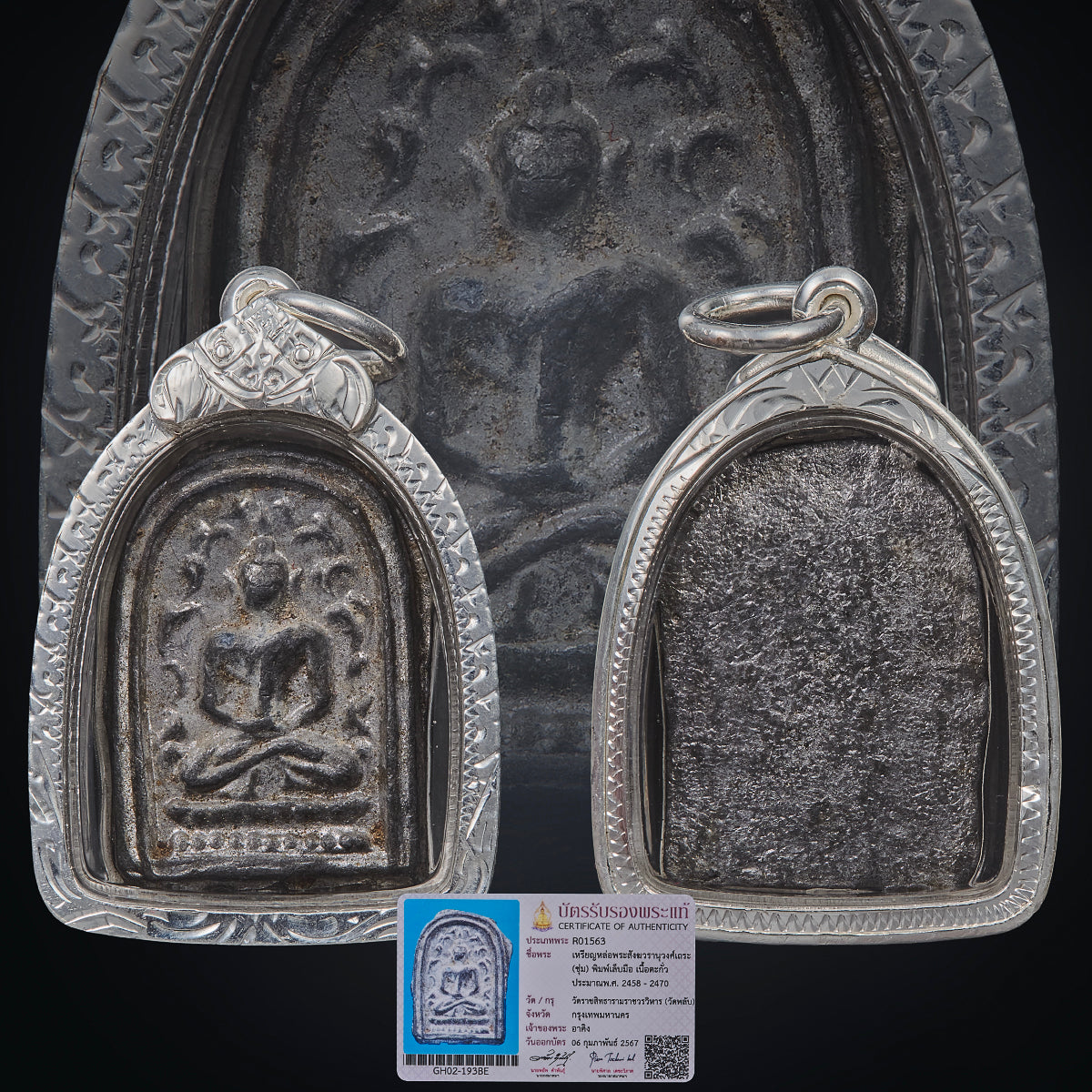
Wat Plub Pim Leb Mue
Chao Khun Sangwara (Chum) · Wat Plub · Bangkok
B.E. 2458–2470
1 Inch
Mainstream Artifact
Samakom Certification Card (GH02-193BE)
Sacred Craftsmanship
Each piece was individually cast and finished using traditional methods. Differences in surface texture, casting depth, outline and natural oxidation are therefore expected, giving every surviving artifact its own individual character.
Personal Experiences Shared by Luksits
Among older generations of Bangkok and Thonburi collectors, sacred objects associated with Chao Khun Sangwara have long been respected particularly for Klaew Klad, Kong Kraphan, Maha Ut and protection from fire.
Accounts passed down through collectors describe devotees keeping his amulets close when travelling, working in uncertain environments or facing situations where physical protection was a concern.
His reputation became sufficiently established that senior collectors traditionally regarded his sacred objects as important protective pieces from the old Thonburi schools.
Yet their significance extends beyond accounts of protection. For many collectors, wearing an artifact of Chao Khun Sangwara represents a direct connection with a respected Vipassana teacher whose influence continued through several important Bangkok masters of the following generation.
Summary
The Phra Phim Leb Mue of Chao Khun Sangwara (Chum) is an early twentieth-century cast Buddha amulet traditionally dated to approximately B.E. 2458–2470, corresponding with his period as abbot of Wat Plub.
Small in size and comparatively simple in appearance, it belongs to an important period of Bangkok–Thonburi amulet history when sacred objects were produced primarily as objects of devotion and protection for temple followers.
Chao Khun Sangwara was remembered not merely as an amulet maker, but as a senior meditation master associated with the virtues of the Four Brahma Viharas — loving-kindness, compassion, sympathetic joy and equanimity.
His position within the spiritual history of Thonburi gives these modest lead casts a significance considerably greater than their physical size.
Historical Background
Wat Ratchasittharam Ratchaworawihan, commonly known as Wat Plub, is an old royal monastery in Bangkok Yai on the Thonburi side of Bangkok.
The temple possesses an important history extending through the Thonburi and early Rattanakosin periods. Its first abbot was the celebrated Somdet Phra Sangharaja Suk, commonly remembered as Suk Kai Thuean, whose name remains closely connected with the temple's early spiritual heritage.
Another major figure was Phra Sangworanuwong Thera (Chum Tissaro), commonly known among collectors as Chao Khun Sangwara (Chum).
Born in B.E. 2396 (1853), he became the 16th abbot of Wat Plub, serving approximately from B.E. 2458 until his passing in B.E. 2470 (1927).
He became particularly respected for his knowledge of Vipassana meditation, disciplined monastic practice and traditional Buddhist sacred sciences. Laypeople travelled to Wat Plub to hear his teachings and practise meditation under his guidance.
His standing was also reflected in a remarkable royal distinction. Chao Khun Sangwara is remembered as the last monk to receive the prestigious woven elephant-ivory ecclesiastical fan, or Phat Nga San, following the earlier recipient Chao Khun Thao of Wat Nang. The tradition was not continued after him.
His influence also extended into the next generation of Bangkok and Thonburi masters. Traditional accounts identify him as a teacher connected with important monks including LP Nak of Wat Rakhang, LP Pring of Wat Bang Pakok and LP Toh of Wat Pradoochimplee.
Origins of the Materials
The Phim Leb Mue was traditionally produced primarily from Chin Takuwa, an old lead-based alloy. Some collector descriptions refer to examples as:
Nuea Chin Takuwa Tham Ch
The term describes the distinctive aged character seen on old lead-alloy surfaces, which may develop layers of grey, dark charcoal, brown and occasionally lighter mineralised deposits.
Unlike modern precision casting, these pieces retain the irregularities expected from early hand-production. Casting pits, uneven edges, differing image definition and variations in thickness form part of the character of surviving examples.
The illustrated piece shows precisely this old-fashioned character, with a deeply aged surface and softened Buddha image resulting from its casting and subsequent passage through roughly a century of history.
Ritual
During Chao Khun Sangwara's period at Wat Plub, a number of sacred objects were produced under his tradition, including Takrut Sam Kasat, Nam Tao Kan Fai, cast Buddha images, Phim Leb Mue, Phim Sum Kor, five-sided Buddha molds, two-sided casts, Pidta and other sacred objects.
The Phim Leb Mue was conceived as a small and practical devotional object that could easily accompany its owner.
Chao Khun Sangwara was also associated with sacred inscriptions and protective kata. One traditional verse preserved in connection with him is:
“Phra Sonama Yakkho Mettantaparivasako Asunihate Hotato Jayamangkala.”
Tradition associates this protective practice with defence against fire, lightning, harmful spiritual influences and other forms of danger.
Blessings and Effects
The traditional reputation of Chao Khun Sangwara's sacred objects centres particularly upon:
- Klaew Klad — avoidance of accidents and danger.
- Kong Kraphan — physical protection and resilience.
- Maha Ut — traditional protection associated particularly with weapons.
- Kan Fai — protection against fire.
- Metta Mahaniyom — goodwill, support and favourable treatment from others.
- Protection from harmful influences — traditionally including misfortune and hostile spiritual forces.
His reputation for protection against fire became especially well known through the celebrated Nam Tao Kan Fai, or fire-protection gourd amulets.
Modern Application
Although created approximately a century ago, the underlying qualities associated with the Phim Leb Mue remain readily applicable to modern life.
It may be worn as a general protective amulet for travel, work, business and everyday safety, while the Metta aspect is traditionally valued for harmonious dealings with colleagues, customers and people in positions of authority.
For practitioners, however, its deeper value lies in remembrance of the master's teachings. Chao Khun Sangwara was fundamentally a meditation teacher, and the artifact can therefore serve as a reminder of mindfulness, compassion, restraint and equanimity alongside its traditional protective reputation.
Physical Details
The front depicts a seated Buddha within a compact arched frame, rendered in the restrained and somewhat abstract manner characteristic of small early cast amulets.
The reverse of this example is plain, displaying the naturally irregular surface of the old lead alloy.
The metal has developed substantial dark-grey and charcoal patination, with areas of lighter oxidation and age-related surface variation. The piece is presently preserved within a protective silver casing.
The accompanying authentication card identifies the artifact as a Phra Phim Leb Mue of Phra Sangworanuwong Thera (Chum), Wat Ratchasittharam, attributed to approximately B.E. 2458–2470.
Recommended Pairing
Because this artifact already represents a broad protective lineage, it pairs naturally with a traditional Phra Somdej, Phra Pidta or another meditation-oriented Buddha amulet.
A pairing with an old Bangkok or Thonburi lineage can be particularly meaningful, especially where there is a historical relationship between the masters involved.
Personal Notes
There is a particular appeal in artifacts of this generation that cannot be measured simply by rarity or market value.
Modern amulets may sometimes command considerably higher prices, but an old piece such as this carries something different: a tangible connection to the life, merit and teaching lineage of one of old Thonburi's respected meditation masters.
Chao Khun Sangwara stood within a generation that helped transmit knowledge to figures later remembered as legendary masters themselves, including LP Nak, LP Pring and LP Toh. A surviving Phim Leb Mue therefore represents more than an early lead amulet. It is a small physical remnant of that historical chain of transmission.
For the serious collector, this is one of the enduring attractions of old amulets. Their importance has already passed through generations of devotees and collectors. Their surfaces carry the evidence of age, while their names remain anchored to teachers whose legacies have survived for nearly a century.
The Phra Phim Leb Mue of Chao Khun Sangwara (Chum), Wat Plub is a particularly understated example of this tradition — small, simple and deeply historical.
-
Free Shipping for Singapore| $15 Worldwide | $100 USA All products