
OOBThaiAmulets
Wat Ngern Khlong Toey
Wat Ngern Khlong Toey
Couldn't load pickup availability
MS06
Phra Kru Wat Ngern · Pim Sum Ko
Wat Ngern · Khlong Toei · Bangkok
B.E. 2430–2435
3cm height
Mainstream Artifact
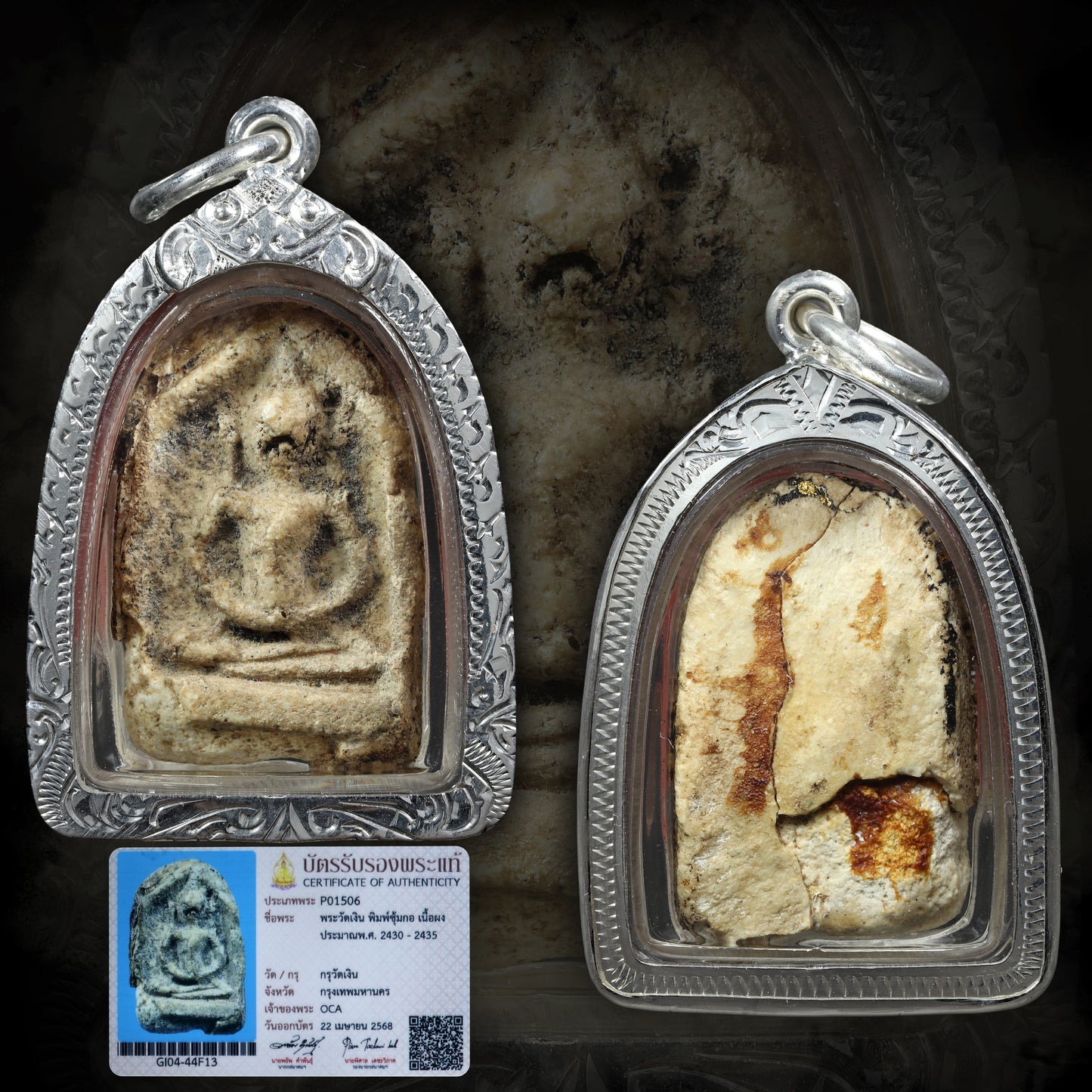
Samakom Certification Card (GI04-44F13)
Sacred Craftsmanship
Each artifact was individually pressed from hand-prepared material, resulting in natural differences in colour, surface texture, impression depth and ageing. These variations form an important part of the character of genuine old Wat Ngern pieces.
Personal Experiences Shared by Luksits
Among older Bangkok collectors, Phra Kru Wat Ngern developed a particularly favourable reputation for improving livelihood and helping ordinary people gradually establish greater financial stability.
The association is reinforced by the temple name itself. Ngern means “money”, and an old saying among collectors holds that those who regularly carry a Wat Ngern amulet will seldom be completely without money in hand.
Older merchants around Khlong Toei were especially fond of these amulets. Accounts passed through the collecting community describe traders carrying them for business, financial opportunity, customer support and protection while travelling or working.
One frequently repeated account concerns a vehicle carrying vegetable merchants in the Khlong Toei area that overturned badly. Several occupants were seriously injured, while a merchant said to have been wearing a Wat Ngern amulet escaped with comparatively minor bruising. Such stories contributed to the amulet's longstanding reputation for Klaew Klad alongside wealth-related blessings.
There are also long-standing accounts of owners beginning from modest circumstances and gradually improving their livelihood after adopting Wat Ngern amulets. Because of such experiences, some collectors came to describe the lineage informally as having a “rags to riches” character — not simply sudden wealth, but gradual improvement in opportunity, stability and circumstances.
Summary
The Phra Kru Wat Ngern Phim Sum Ko is one of the classic powder amulets associated with the former Wat Ngern of Khlong Toei, Bangkok.
Traditionally dated to approximately B.E. 2430–2435, these pieces are associated with the late nineteenth-century Bangkok tradition of producing large quantities of sacred Buddha images for enshrinement within temple chedis.
The front depicts a seated Buddha beneath the characteristic Sum Ko arched frame, while the reverse is generally plain.
Its importance today lies not only in age, but in the remarkable history of Wat Ngern itself. The original temple eventually disappeared during the redevelopment of the Khlong Toei riverside for Bangkok's modern port, leaving its kru amulets as some of the most tangible surviving objects connected with the lost monastery.
Historical Background
The origins of Wat Ngern are closely associated with the Mon community of early Bangkok.
Mon communities maintained a long relationship with Siam, with substantial migrations occurring during different periods of conflict in Burma. Under the early Chakri kings, many Mon families were permitted to establish settlements around Bangkok, Pak Kret, Pathum Thani, Ratchaburi, Kanchanaburi and Phra Pradaeng.
One particularly important Mon settlement developed around Phra Pradaeng and Bang Ko Bua, where traditional language, customs, craftsmanship and religious practices continued for generations.
According to temple tradition, more than a century before Wat Ngern disappeared, a prosperous Mon couple living around Bang Ko Bua had accumulated substantial wealth but had no children.
As they grew older, they decided that rather than allowing their estate to disappear without purpose, they would dedicate part of their wealth to Buddhism.
They crossed the river and acquired land in a peaceful agricultural area where they established a monastery.
The temple became known as Wat Ngern.
Following Mon religious custom, after constructing the temple and establishing the consecrated monastic boundary, a large Mon-style chedi was also erected.
Sacred Buddha images were then made and placed inside the chedi as an offering intended to preserve and extend the life of Buddhism for future generations.
This became the origin of what collectors now call Phra Kru Wat Ngern Khlong Toei.
Origins of the Materials
Wat Ngern amulets were predominantly made from a relatively simple but characteristic mixture.
The principal ingredients are traditionally described as Phong Wises, or sacred powder, mixed with shell-lime powder.
Some accounts also mention Tang-Iw and other binding substances used to produce a workable paste. Certain collectors have proposed that boiled plant or seed material may also have been used as a natural binder, helping create the dense yet relatively soft texture associated with old examples.
One of the most recognisable features is the pale mineral crust that developed during prolonged enclosure within the chedi.
This deposit is traditionally called:
Khrap Fong Tao Hu
The appearance can range from thin creamy deposits to heavier chalky layers. Similar ageing phenomena are also discussed by collectors studying other old Bangkok powder kru, making the surface character an important area of connoisseurship.
The illustrated example retains substantial natural white, cream and darkened kru deposits, particularly around the recessed Buddha image and reverse surface.
Ritual
The amulets were not originally conceived as ordinary commercial releases.
According to the traditional account, they were created primarily for enshrinement inside the temple chedi, following the old Buddhist practice of depositing sacred images within religious monuments as an act of merit and a means of preserving the Buddha's teachings symbolically into the future.
Large numbers of different molds were made.
Known Wat Ngern types include Phra Sangkatchai, Phra Khong, Phra Leb Mue, Phra Na Ruesi, Phra Sangkati, Phra Pidta and numerous Sum Ko variants, among others.
The Sum Ko family itself includes both high-base and low-base forms together with differences in arm formation and Buddha modelling.
This diversity suggests that production occurred on a considerable scale rather than as a single small commemorative batch.
Blessings and Effects
Traditionally, Phra Kru Wat Ngern is associated with several complementary qualities.
Metta Mahaniyom is connected with goodwill, support, favourable relationships and easier interaction with customers, colleagues and people in positions of authority.
The lineage is also strongly connected with Choke Lap and wealth-related opportunity, reinforced culturally by the auspicious name Ngern.
For merchants and people dependent upon daily trade, the amulet became associated with steady circulation of money, continued opportunity and fewer interruptions to livelihood.
Its protective reputation centres upon Klaew Klad, avoidance of danger, together with broader personal safety during travel and work.
As with other traditional sacred objects, these qualities should be understood within the devotional beliefs and experiences passed through generations of owners rather than as guaranteed material outcomes.
Modern Application
For a modern owner, Wat Ngern remains particularly relevant to business, sales, employment and financial stability.
It may be carried by people whose livelihood depends upon attracting customers, maintaining relationships, receiving repeat business or finding opportunities through personal connections.
The protective aspect also makes it suitable as an everyday amulet for commuting, travelling or working in environments where accidents remain a concern.
Its attraction for collectors is equally historical.
Wat Ngern no longer survives in its original setting, so each genuine kru piece represents a surviving physical connection with an important but largely vanished chapter of Bangkok's riverside history.
Physical Details
This example is the Phim Sum Ko, displaying a seated Buddha within a rounded arched niche.
The front retains heavy natural kru ageing, with cream-white mineral deposits, darker embedded staining and areas where the original powder surface remains visible beneath the accumulated patina.
The reverse is largely plain and shows substantial age-related surface variation, including cracking, exposed inner material and darker brown deposits.
Such irregularities are characteristic of a fragile powder artifact that remained within an enclosed chedi environment for decades before discovery.
The accompanying authentication card identifies the piece as Phra Wat Ngern, Phim Sum Ko, attributed to approximately B.E. 2430–2435.
Recommended Pairing
Phra Kru Wat Ngern pairs naturally with a traditional Phra Somdej where the intention is to combine old Bangkok powder traditions with Metta, Baramee and general protection.
For stronger wealth emphasis, it may also be paired with Phra Sangkatchai or Phra Sivali.
A collector wishing to preserve historical continuity may instead pair it with another nineteenth- or early twentieth-century Bangkok kru artifact, particularly one associated with the old Chao Phraya temple communities.
Personal Notes
What makes Wat Ngern especially appealing is not simply its age.
The original temple disappeared as Bangkok modernised. Its buildings were dismantled, its land absorbed into the development of the port area, and its religious community continued elsewhere under changing circumstances.
The amulets survived.
They preserve a connection with the Mon founders who dedicated their wealth to Buddhism, the old riverside community that surrounded the monastery, and the generations of ordinary Bangkok residents who later carried these pieces in everyday life.
Modern releases can sometimes become expensive very quickly, yet price alone does not create historical depth. Wat Ngern requires no modern story to give it importance. Its significance developed slowly through more than a century of temple history, kru discovery, collector recognition and accumulated devotional experience.
The old idea that “those who keep Wat Ngern will have Ngern with them” remains one of the simplest ways collectors express the character of the lineage.
For me, that combination of history, affordability, old Bangkok craftsmanship and generations of lived reputation is precisely what makes Phra Kru Wat Ngern worth preserving.
-
Free Shipping for Singapore| $15 Worldwide | $100 USA All products