
OOBThaiAmulets
Wat Ling Khob
Wat Ling Khob
Couldn't load pickup availability
MS06
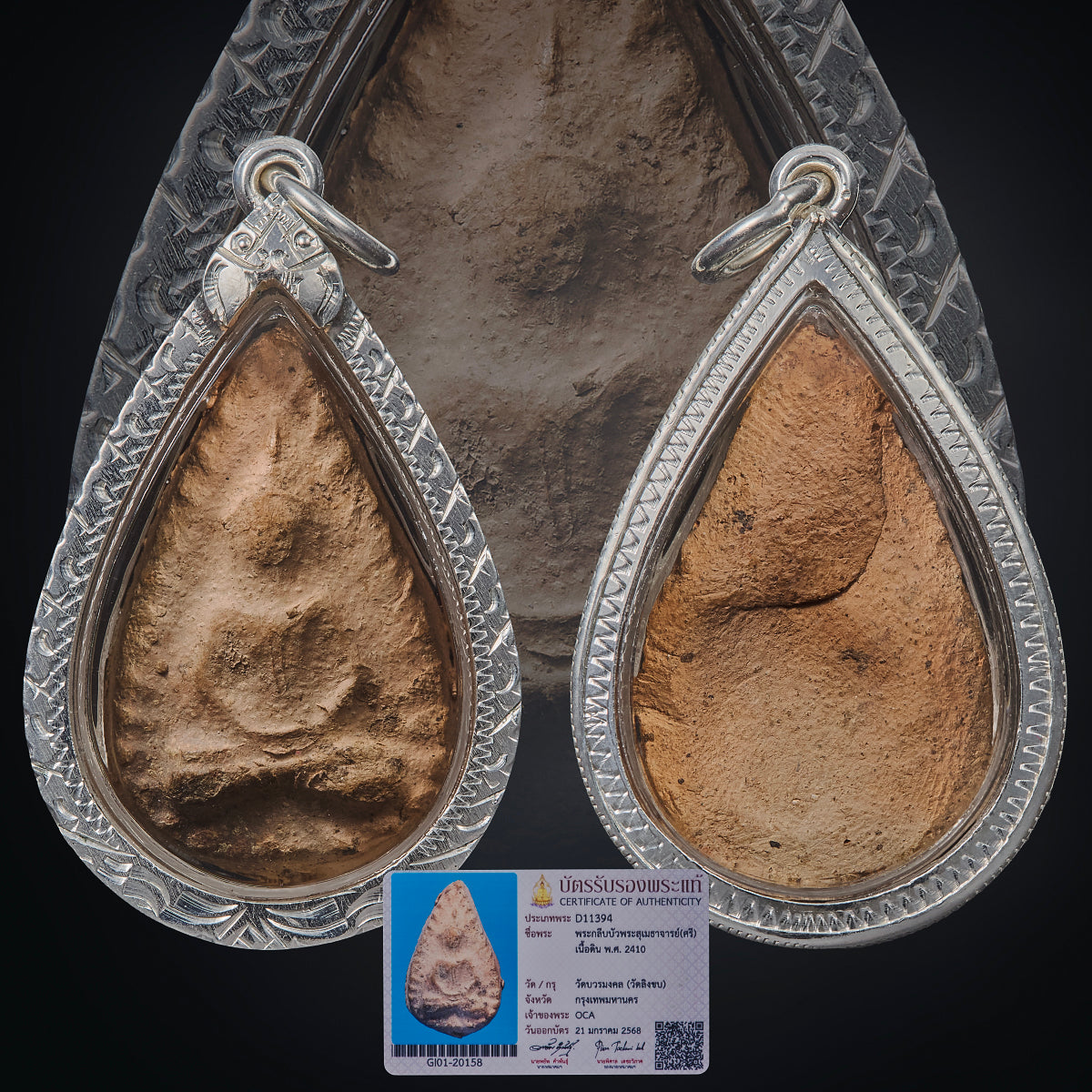
Phra Kleeb Bua
Wat Ling Khob · Wat Bowon Mongkhon · Thonburi
B.E. 2410 (1867)
1.5 Inches
Mainstream Artifact
Samakom Certification Card (GI01-20158)
Sacred Craftsmanship
Each piece was individually pressed and fired from prepared clay. Differences in firing, clay composition, mould pressure and more than a century of ageing naturally produce variations in colour, surface texture and definition, making every surviving example unique.
Personal Experiences Shared by Luksits
Phra Kleeb Bua from Wat Ling Khob has been known among older generations of Thai collectors for its traditional reputation in Metta Maha Niyom and protection.
Owners have particularly valued it as an uncomplicated Buddha amulet suitable for everyday wear. Traditional accounts associate the Kru with smoother dealings with other people, receiving goodwill and assistance, and protection when travelling or working away from home.
Another longstanding belief associated with the amulet concerns protection against Khun Sai and harmful occult influences, together with protection from poisonous creatures.
Its combination of considerable age, Mon temple heritage and traditional protective reputation has allowed Phra Kleeb Bua Wat Ling Khob to remain a recognised old Thonburi Kru despite its historically substantial discovery quantity.
Summary
Phra Kleeb Bua Wat Ling Khob is an important old terracotta Kru associated with what is today Wat Bowon Mongkhon in Thonburi.
The amulets are traditionally dated to B.E. 2410 (1867), when Phra Sumethachan (Sri), then serving the temple, undertook extensive restoration works and constructed a chedi.
Buddha images, sacred objects, valuables and these terracotta Phra Kleeb Bua were reportedly placed within the chedi as an act of Buddhist merit and for the continuation of the religion.
The Kru remained sealed for almost a century before being opened in B.E. 2509 (1966).
Today the amulet is appreciated for three principal reasons: its early Rattanakosin age, Mon Buddhist heritage and traditional reputation for Metta and protection.
Historical Background
The temple commonly called Wat Ling Khob by local residents is officially known as Wat Bowon Mongkhon, situated beside the Chao Phraya River in the Thonburi area.
Its history is closely connected with the Mon community.
During the reign of King Rama II, groups of Mon people migrated into Siam and were permitted to settle in several areas, including the surroundings of Wat Ling Khob.
The temple was subsequently elevated to the status of a royal monastery by Prince Maha Senanurak, the Front Palace during the reign of Rama II, and received the name Wat Bowon Mongkhon.
For many years it retained a distinctly Mon identity, with senior Mon ecclesiastical figures serving as abbots.
By B.E. 2462 (1919), however, the temple had deteriorated considerably and the number of Mon monks residing there had declined. Its administration was subsequently reorganised under the Dhammayut tradition, which continues into the modern period.
Origins of the Materials
The Phra Kleeb Bua were created from fired sacred clay, following one of the oldest material traditions in Thai Buddhist amulet production.
According to the traditional account, their creation occurred during the major restoration undertaken by Phra Sumethachan (Sri) in B.E. 2410.
During these works, a chedi was constructed within the temple grounds. Buddha images, amulets and other objects of religious or material significance were deposited inside.
The Phra Kleeb Bua formed part of this deposit.
Their purpose was therefore closely connected with the traditional practice of placing Buddha images within a sacred monument as an offering to preserve and perpetuate Buddhism for future generations.
Ritual
The original account records that several respected masters of the period participated in the consecration of the amulets.
Most notably, tradition maintains that Somdej Phra Phutthachan (Toh) of Wat Rakang also participated in their blessing.
This association has long contributed to the interest surrounding the Kru. As with many nineteenth-century amulets, however, such details belong to the received temple and collector tradition and should be understood within that historical context rather than treated as surviving modern ceremony documentation.
Following consecration, the Phra Kleeb Bua were enshrined within the temple chedi and remained there for generations.
Blessings and Effects
Traditional belief surrounding Phra Kleeb Bua Wat Ling Khob places particular emphasis upon:
- Metta Maha Niyom — goodwill, popularity and favourable treatment from others.
- Protection — general safeguarding during everyday life and travel.
- Khun Sai protection — traditionally believed to resist harmful occult influences and hostile spiritual workings.
- Protection from poisonous creatures — an old reputation associated with snakes, scorpions and other venomous animals.
The amulet is consequently regarded as a balanced old Buddhist Kru rather than one devoted exclusively to a single blessing.
Modern Application
For modern wearers, Phra Kleeb Bua remains particularly suitable as an everyday Buddha amulet.
Its Metta reputation makes it appropriate for people whose work depends upon communication, customers, colleagues or maintaining harmonious relationships.
Its protective reputation also makes it traditionally suitable for those who travel frequently or spend significant time outdoors.
Beyond these traditional beliefs, its historical importance is equally compelling. The amulet connects its owner with nineteenth-century Thonburi, the Mon Buddhist community and the old practice of creating and enshrining terracotta Buddha images within temple chedis.
Physical Details
The amulet is formed from fired terracotta in the distinctive pointed Kleeb Bua, or lotus-petal, shape.
The front depicts a seated Buddha in shallow relief upon a simple base. The reverse is plain, retaining the natural texture of the clay and manufacture.
Material: Terracotta
Creation: B.E. 2410 (1867)
Kru opened: B.E. 2509 (1966)
Recommended Pairing
Phra Kleeb Bua can be worn independently as a traditional Buddhist protective amulet.
For those seeking a stronger emphasis upon Metta and interpersonal relations, it pairs naturally with Phra Somdej or another established Metta-oriented Buddhist amulet.
For travel and general protection, it may also be paired with a recognised Klaew Klad or Kong Krapan amulet, while allowing the Phra Kleeb Bua to remain the principal Buddha image in the set.
Personal Notes
An especially interesting part of the history of this Kru is its opening in March B.E. 2509 (1966).
The chedi was initially disturbed by people secretly digging into the Kru and removing a considerable number of amulets. Wat Ling Khob subsequently opened the chamber officially on 25 March B.E. 2509.
Because a substantial quantity of Phra Kleeb Bua emerged, the amulet was once relatively affordable. Over the decades, however, well-preserved examples have become increasingly appreciated by collectors.
Created in B.E. 2410, the Phra Kleeb Bua is now more than 150 years old. Its significance lies not simply in age or rarity, but in the history preserved within a small piece of fired clay — connecting the old Mon community of Thonburi, Wat Ling Khob and the nineteenth-century tradition of creating Buddha images to be sealed within a sacred chedi for future generations.
-
Free Shipping for Singapore| $15 Worldwide | $100 USA All products