
OOBThaiAmulets
Somdej Bang Khun Phrom 2517
Somdej Bang Khun Phrom 2517
Couldn't load pickup availability
MS06
Phra Somdej Bang Khun Phrom — Pim Yai 5 Jud
Wat Mai Amataros · Bangkok
B.E. 2517 (1974)
101st Anniversary Commemorative Edition
1.5 Inches
Mainstream Artifact
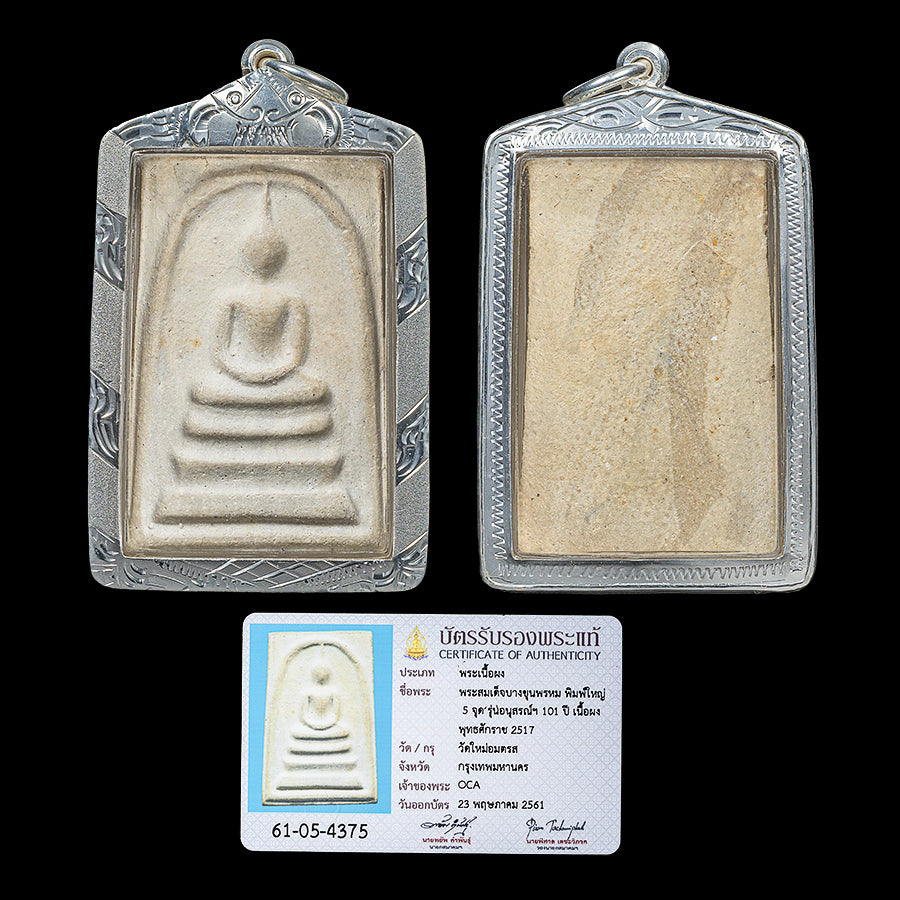
Samakom Certification Card (61-05-4375)
Individual Craftsmanship
Pim Yai 5 Jud - Top Pim in its series.
Each artifact was individually pressed from prepared sacred powder. Differences in pressure, moisture, powder distribution and finishing naturally created variations in colour, texture, thickness and definition, giving each surviving piece its own character.
Personal Experiences Shared by Luksits
Phra Somdej has traditionally been regarded as one of the most balanced forms of Thai Buddhist amulet.
Collectors and devotees often describe the experience of wearing Somdej not through one dramatic effect, but through a gradual sense that circumstances become easier to manage.
In business, some speak of negotiations proceeding more smoothly, customers returning, contracts becoming easier to conclude or assistance appearing from senior and influential people.
In working life, the emphasis is often upon Baramee and Metta — being respected without having to force authority, receiving greater trust from colleagues and superiors, and finding that one's words carry more weight.
Others keep Phra Somdej principally for protection and stability, particularly during periods of uncertainty.
This broad character is one reason Phra Somdej remains so widely worn: rather than being centred upon a single purpose, it traditionally encompasses Metta, Baramee, protection, prosperity and general auspiciousness.
Summary
The Bang Khun Phrom B.E. 2517 series was created by Wat Mai Amataros to commemorate 101 years since the passing of Somdej Phra Buddhachan To Phromrangsi, whose name is inseparably connected with the great Phra Somdej tradition.
The project also carried a practical merit-making purpose, with proceeds associated with the construction of the Wat Mai Amataros municipal school.
A major consecration was held in B.E. 2517, bringing together respected masters of that generation. Accounts of the ceremony commonly include LP Toh of Wat Pradoochimplee, LP Pae of Wat Phikun Thong, LP Nueang of Wat Chulamanee, LP Thir of Wat Pa Lelai and Ajarn Nong of Wat Sai Khao, among others.
Within this commemorative series, Pim Yai 5 Jud became one of the best-known principal moulds.
It combines a historically important Bangkok temple, the legacy of Somdej To, an important B.E. 2517 consecration and the classical Phra Somdej form in a single artifact.
Historical Background
The history of Bang Khun Phrom is closely connected with Somdej Phra Buddhachan To Phromrangsi, one of the most revered monks of nineteenth-century Siam.
His name became particularly associated with the classical Phra Somdej form — a Buddha seated in meditation beneath an arch upon a tiered throne.
Wat Mai Amataros was historically known in connection with Bang Khun Phrom, where earlier generations of Phra Somdej were famously placed within a chedi. Those old kru amulets eventually became some of the most studied and collected Thai Buddhist artifacts.
The B.E. 2517 issue belongs to a much later period.
It should therefore be understood as a commemorative continuation of the Bang Khun Phrom tradition, rather than as one of the nineteenth-century pieces made during Somdej To's lifetime.
That distinction is important.
Its significance comes from deliberately reconnecting a modern temple project with an older and deeply respected lineage.
Origins of the Materials
The B.E. 2517 edition was created from a prepared sacred powder mixture.
Traditional accounts surrounding the batch describe the inclusion of old Bang Khun Phrom powder or fragments associated with material recovered from the original kru, blended with newly prepared sacred powders and binding ingredients.
This was symbolically important.
Rather than simply reproducing the appearance of an old Phra Somdej, the makers sought to establish a material connection between the new commemorative edition and the earlier Bang Khun Phrom tradition.
The resulting powder can display considerable natural variation.
Some pieces are pale cream or ivory, while others develop warmer beige or light brown tones. Tiny inclusions, darker particles, uneven density and small differences across the surface are characteristic of individually pressed powder artifacts.
The example shown retains an especially pleasing light cream powder body with an understated aged surface, allowing the principal Pim Yai features to remain clearly visible.
Ritual
The B.E. 2517 project culminated in a major Buddhabhiseka consecration, traditionally recorded as taking place on 26 October B.E. 2517 (1974).
A gathering of respected masters participated in the blessing rites.
Among the names commonly associated with the ceremony are LP Toh of Wat Pradoochimplee, LP Pae of Wat Phikun Thong, LP Nueang of Wat Chulamanee, LP Thir of Wat Pa Lelai and Ajarn Nong of Wat Sai Khao.
For collectors, this collective blessing is an important part of the appeal of the edition.
The purpose behind the project also contributes to its religious context. The amulets commemorated Somdej To while simultaneously generating merit and financial support for education and temple-community development.
The edition therefore brought together remembrance, sacred lineage, communal merit and practical public benefit.
Blessings and Effects
The traditional qualities of Phra Somdej are exceptionally broad.
Metta Maha Niyom concerns goodwill, acceptance and favourable relationships. It is particularly relevant for people who regularly meet customers, clients, colleagues or decision-makers.
Baramee concerns dignity, credibility and natural authority. Rather than aggressive dominance, the traditional Somdej character is more closely associated with being respected, trusted and listened to.
Klaew Klaad represents passing safely through danger or avoiding unfavourable situations, while the broader protective tradition of Phra Somdej concerns stability during travel, work and everyday life.
Prosperity is traditionally understood through steady advancement and favourable opportunity — smoother business, supportive people, career progress and circumstances that allow one's own efforts to produce better results.
For this reason, Phra Somdej is often described as an artifact suitable for almost every stage of life.
Modern Application
The Pim Yai 5 Jud is particularly suitable for someone wanting one balanced Buddhist artifact for everyday wear.
For a business owner, it can be worn with an emphasis upon Metta, customer relationships, credibility and steady prosperity.
For executives and professionals, its traditional Baramee qualities suit leadership, promotion, negotiations, presentations and interactions with senior people.
For those going through uncertainty, the character of Phra Somdej is equally relevant. Its symbolism is centred upon calmness, stability and progress without unnecessary aggression.
This also makes it an easy artifact to combine with more specialised pieces without overwhelming the purpose of a necklace set.
Physical Details
A Phra Somdej Bang Khun Phrom, Pim Yai 5 Jud, from the B.E. 2517 101st Anniversary commemorative issue of Wat Mai Amataros. The artifact is individually pressed in a pale cream sacred-powder material, with the Buddha seated beneath a rounded arch upon the characteristic tiered base. The recognised five-point mould characteristics identify the Pim Yai 5 Jud classification. The reverse is restrained and largely plain, preserving the simple character of the powder body. This example is housed in a traditional engraved protective casing and is accompanied in the photograph by specialist certification.
Recommended Pairing
This Phra Somdej already provides an excellent foundation artifact, so pairing is best determined by whichever quality the wearer wishes to emphasise.
For business and customer movement, it pairs naturally with Nang Kwak. For stronger wealth emphasis, a dedicated wealth takrut or Choke Lap artifact can complement the Somdej's broader prosperity character.
For leadership and stronger external protection, Tao Wessuwan provides a firmer guardian quality while the Somdej maintains Metta and composure.
It can also be worn alone. In fact, the broad traditional character of Phra Somdej means that a good example such as this does not require another artifact to make the combination feel complete.
Personal Notes
For me, the attraction of the B.E. 2517 Pim Yai 5 Jud is how much history it offers without needing to enter the extremely difficult territory of nineteenth-century Bang Khun Phrom pieces.
This is already an artifact of more than half a century in age, created by Wat Mai Amataros itself, connected directly with the Bang Khun Phrom name and produced for the important 101st Anniversary commemoration of Somdej To.
The Pim Yai 5 Jud is also one of the moulds I particularly like because the design remains extremely classical. There is no elaborate reverse image or excessive ornamentation — just the familiar seated Buddha, arch and tiered base that made Phra Somdej one of the most recognisable forms in Thai amulet history.
The example shown has another quality I value in old powder pieces: a clean, naturally aged cream surface with the important mould characteristics still easy to appreciate.
For someone wanting a serious Bang Khun Phrom piece with established history, an important ceremony and a direct connection to Wat Mai Amataros, the B.E. 2517 Pim Yai 5 Jud represents a particularly meaningful chapter of the lineage.
-
Free Shipping for Singapore| $15 Worldwide | $60 USA For Items Below $350