
OOBThaiAmulets
Por Tan Suksabai
Por Tan Suksabai
Couldn't load pickup availability
MS06
Suea Yen
Por Tan Suksabai · Fang
B.E. 2565
2 Inches
Mainstream Artifact
Sacred Craftsmanship
The photographs are representative only. A piece will be selected at random, and the amulet supplied may differ from the exact piece shown in the images.
The locket was individually assembled and finished by hand. Natural variation in the sacred mixture, placement of the embedded materials and final surface therefore gives each artifact its own character.
Personal Experiences Shared by Luksits
Suea Yen is generally chosen by luksits who require a stronger form of authority, protection and personal presence.
Those working in business, management or competitive environments often describe the practice in practical terms: becoming more decisive, being taken more seriously during negotiations, receiving cooperation more readily and remaining calm when others attempt to pressure or obstruct them.
Other accounts concern protection. Luksits speak of dangerous situations being avoided, hostile people withdrawing, and problems becoming apparent early enough for them to react before matters worsen.
The wealth aspect is usually described differently from a straightforward wealth-attracting amulet. Suea Yen is associated more closely with baramee — strengthening the person so that opportunity, influence and support can follow.
For people whose livelihood depends upon leadership, contracts, negotiations or dealing with difficult personalities, this combination of firmness and composure is one of the principal reasons the lineage remains respected.
Summary
Suea Yen belongs to an older body of Lanna tiger wicha concerned with the mastery of powerful and potentially unruly spiritual force.
The tiger represents courage, command, territorial protection, survival and authority. In the Suea Yen tradition, however, strength alone is insufficient. The underlying principle is the ability to bring that strength under discipline.
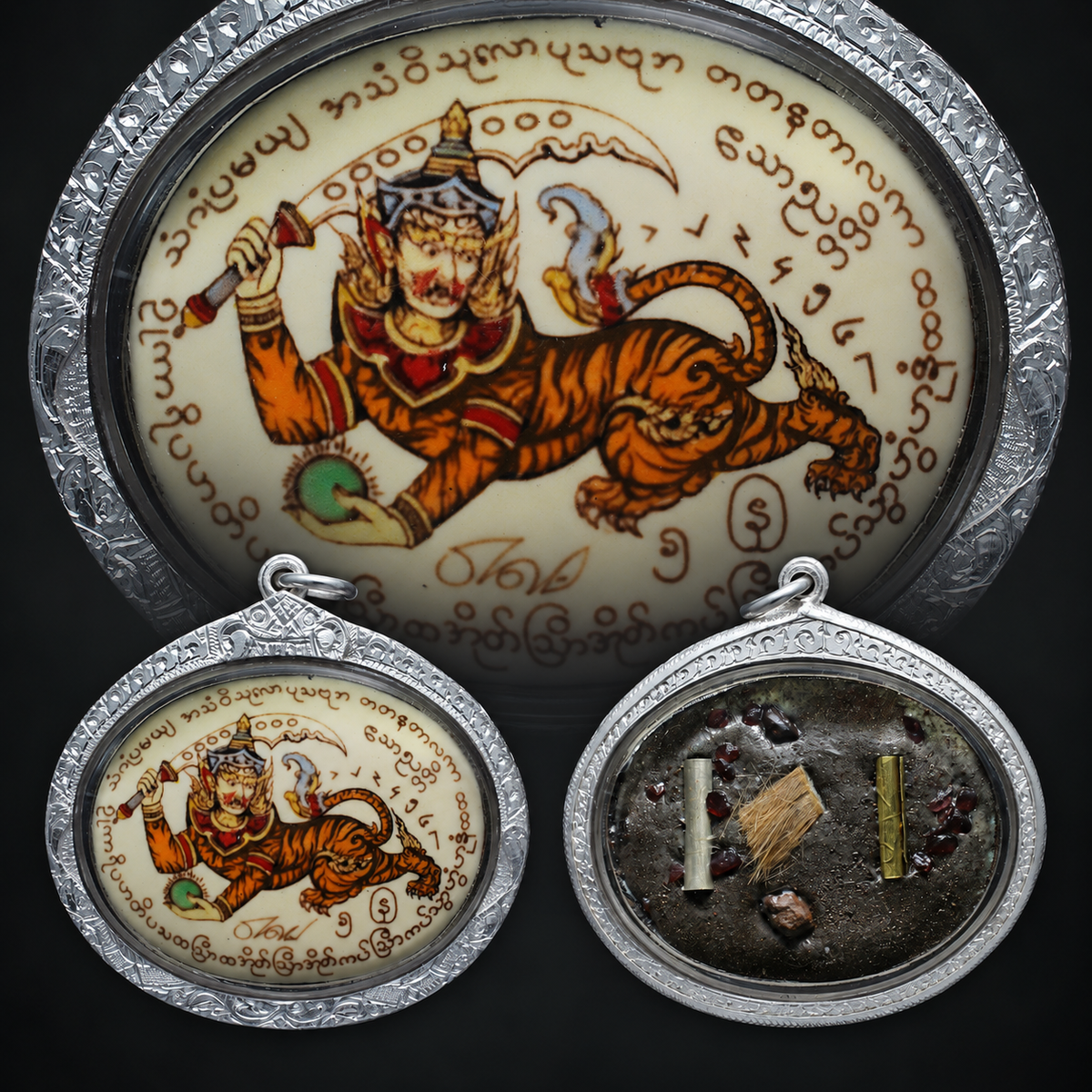
This B.E. 2565 issue combines the image of a tiger warrior with sacred materials and takruts on the reverse. Its traditional qualities centre upon:
protection · baramee · maha amnaj · obstacle clearing · wealth through influence · metta · fulfilment of aspirations
The warrior carries both a weapon and an auspicious orb, representing the two sides of the practice: the ability to cut through obstruction and the ability to retain favourable fortune.
Historical Background
The Meaning of Suea Yen
Within Northern Thai occult tradition, tiger wicha developed into numerous branches.
Some were concerned primarily with kongkrapan and protection, while others emphasised command, intimidation, territorial guardianship or the development of a powerful personal aura.
Suea Yen belongs to the more esoteric side of this tradition.
Older oral accounts connect it with Suea Saming teachings, in which tiger power represents something far greater than ordinary physical strength. The tiger becomes a metaphor for an intense spiritual force that must be controlled by the practitioner rather than allowed to control him.
According to traditional narratives, a practitioner who successfully mastered such disciplines could acquire qualities associated with the tiger — fearlessness, endurance, heightened presence and authority.
Stories also warned of the opposite possibility: uncontrolled practice producing instability and aggression.
For this reason, the deeper meaning of Suea Yen is not uncontrolled ferocity.
It is ferocity brought under command.
Origins of the Materials
The reverse of this piece illustrates the layered construction normally associated with more elaborate ritual lockets.
Sacred powders and consecrated substances form the main base. Embedded within them are two takruts, sacred mineral or stone inclusions, and a bundle of fibrous ritual material positioned towards the centre.
Tiger-related material is traditionally included to establish the connection with the tiger wicha itself.
Another important element of the lineage is the use of an auspicious golden takrut tradition associated with triple-nine markings.
The number 999 is regarded as an auspicious numerical sequence connected with continuing advancement and favourable progression. Within this lineage it reinforces the broader intention of growth, victory and movement beyond present limitations.
Certain versions of the practice also incorporate a golden orb teaching, inherited through an older Northern lineage. The orb symbolises gathered merit, prosperity and favourable opportunity rather than wealth existing independently of the practitioner's effort.
Ritual
The consecration was traditionally conducted through several distinct environments rather than within a single ceremony.
The first stage took place in a cemetery, an important ritual environment within certain Northern occult schools. Such places are considered suitable for rites involving strong protective and boundary-crossing wicha.
The work was subsequently brought into a temple environment, where Buddhist chanting and blessing were used to establish balance and structure around the stronger tiger elements.
A final stage was then undertaken within the master's own ritual space.
Among the masters associated with the blessing were:
Phra Ajarn Thanakorn, connected with Northern Lanna practices;
Por Tan Suksabai, one of the senior masters associated with the Suea Yen lineage;
and LP Det, whose practice is traditionally associated with protective and kongkrapan disciplines.
The artifact was released only after the consecrating masters regarded the work as complete.
Blessings and Effects
Suea Yen combines defensive and assertive qualities.
Its foremost traditional purpose is protection — particularly where a person must operate in environments containing competition, hostility or uncertainty.
It is traditionally associated with protection from accidents, hostile intentions, occult interference and unseen danger.
A second quality is maha amnaj, or commanding authority.
This does not necessarily mean becoming aggressive. In its more balanced interpretation, maha amnaj is the ability to remain composed while others recognise one's authority.
The locket is therefore traditionally sought for:
- protection and avoidance of danger;
- resistance to hostile or harmful influences;
- overcoming difficult people and concealed opposition;
- authority, confidence and leadership;
- favourable negotiations and professional advancement;
- attraction of wealth through stronger opportunities and connections;
- metta and improved relationships;
- fulfilment of important intentions.
The combination of the weapon and auspicious orb on the image expresses these functions particularly clearly.
The weapon represents cutting through difficulty and obstruction.
The orb represents prosperity, accumulated fortune and the ability to retain favourable conditions once they have been obtained.
Modern Application
Suea Yen is especially suitable for situations in which a person must remain strong without becoming unnecessarily confrontational.
Business owners may wear it during negotiations or periods of intense competition.
Managers and supervisors may use it as a reminder of calm authority when handling difficult teams or disputes.
Those in sales, property, finance or client-facing work may approach its metta and baramee qualities for stronger relationships and greater confidence during important conversations.
It is equally appropriate during uncertain periods when the wearer seeks protection and clearer judgement before committing to a major decision.
The most useful modern interpretation of Suea Yen is therefore not aggression.
It is controlled strength — knowing when to remain still and when decisive action is necessary.
Physical Details
The front shows a striking tiger-bodied warrior figure, armed with a raised weapon while extending one hand towards a sacred orb.
The surrounding field is filled with yantric characters and sacred script, reinforcing its Northern Thai–Burmese visual character.
The reverse exposes the sacred filling rather than concealing it. Two takruts are positioned vertically to either side, with sacred inclusions distributed through the dark ritual compound.
A central bundle of sacred material remains visible between them.
The locket is finished in a custom engraved silver casing, giving the piece a substantial presentation while leaving both the front image and reverse materials fully visible.
Master: Por Tan Suksabai
Year: B.E. 2565
Region: Fang / Mae Daeng
Material: Mixed sacred baramee materials
Wrapping: Custom Silver
Category: Mainstream Artifact
Recommended Pairing
Suea Yen already carries a broad combination of authority, protection, metta and advancement, so it is sufficiently complete to be worn alone.
For those focused on business, it pairs naturally with a Buddha or monk amulet traditionally associated with wealth, metta or opening opportunities.
Those primarily seeking protection may pair it with a strong Buddhist protective piece or Tao Wessuwan.
A calmer metta-based amulet may also provide a useful complement for someone whose work requires both firm authority and approachable interpersonal energy.
Personal Notes
What distinguishes this B.E. 2565 Suea Yen is the deliberate balance between two seemingly opposite qualities.
The imagery is unmistakably forceful: the tiger, the armed warrior and the surrounding yantra all speak of strength and command.
Yet the deeper tradition is concerned with controlling that strength rather than displaying it recklessly.
The exposed reverse also makes the construction particularly interesting from a collector's perspective. The takruts, sacred filling and other ritual materials remain visible, allowing the internal structure of the artifact to form part of its identity rather than being hidden behind a sealed backing.
For collectors of Northern wicha, Suea Yen represents an older concept that remains highly relevant today: power is most useful when it is disciplined, stable and applied at the right moment.
-
Free Shipping for Singapore| $15 Worldwide | $60 USA For Items Below $350