

OOBThaiAmulets
Por Sri Ong
Por Sri Ong
Couldn't load pickup availability
MASS01
Bobo Aung Locket
Por Sri Ong · Chiang Dao, Chiang Mai
4cm
Mainstream Artifact
Sacred Craftsmanship
The photographs are representative only. A piece will be selected at random, and the amulet supplied may differ from the exact piece shown in the images.
Each locket was individually assembled and filled by hand. Natural differences in the medicines, herbal mixture, takrut placement and finishing are therefore part of the character of each artifact.
Personal Experiences Shared by Luksits
Among devotees of the Burmese master traditions, Bobo Aung is often approached when life appears to have reached a difficult plateau — particularly where progress depends upon opportunity, influential people, negotiation or a decisive change in circumstances.
Luksits commonly associate his image with baramee and forward movement. Accounts include stalled negotiations beginning to move again, assistance arriving through unexpected people, greater confidence when dealing with senior figures, and opportunities appearing after periods of uncertainty.
Others speak less about dramatic events and more about a gradual change in circumstances: clearer judgement, greater calm when important decisions must be made, and a feeling that obstacles begin to become manageable rather than overwhelming.
For this reason, Bobo Aung pieces remain particularly meaningful to those involved in business, leadership, sales, negotiation and independent work, where both personal presence and good timing can matter greatly.
Summary
This locket represents Bobo Aung, one of the most celebrated weikza figures within Burmese spiritual tradition.
It combines his image with Patthama Siddhi medicine, Burmese sacred herbs, red medicine and a silver takrut, bringing together several elements associated with the traditional Burmese Red-Medicine lineage.
Bobo Aung is remembered in devotional tradition as a master of meditation, mantra and esoteric disciplines. His name is particularly associated with baramee, protection, metta, overcoming obstacles and fulfilment of sincere aspirations.
The limited production of 399 blue-background pieces also gives this particular issue a clearly documented identity within Master Sri Ong's work.
Historical Background
Bobo Aung and the Red-Medicine Tradition
Within the tradition recorded for this locket, Bobo Aung is counted among ten great teachers associated with the Red-Medicine lineage:
Maha Osot Wicha · Sajja Min · Sang Wicha · Phu Tor Ae · Aung Wicha · Pho Min Khong · Bobo Aung · Se Wicha · Phu Tor Piu · Phu Tor Pui
These masters are remembered as holders of disciplines involving red-medicine tattooing, mantra, meditation, herbal knowledge and traditional alchemical practice.
The tradition holds that receiving the baramee of even one such teacher — through sacred tattooing, mantra, an image of the master or sincere recollection — provides a spiritual connection to the lineage.
Protection from harmful influences, poisonous creatures, hostile intentions and occult interference is traditionally attributed to this connection.
Bobo Aung
Bobo Aung occupies a particularly important position within Burmese popular religious tradition.
He is traditionally portrayed as a realised practitioner possessing extraordinary knowledge of meditation and esoteric disciplines. Stories surrounding him describe accomplishments in jhana, kasina meditation, mantra, ritual practice, herbal preparations and alchemy.
His familiar iconography is distinctive: a Burmese spiritual master, often shown seated cross-legged, sometimes with long or loosely arranged hair and frequently associated with a teacup.
His tradition is also closely connected with Mount Popa, one of Myanmar's most important centres of spiritual folklore and pilgrimage.
Origins of the Materials
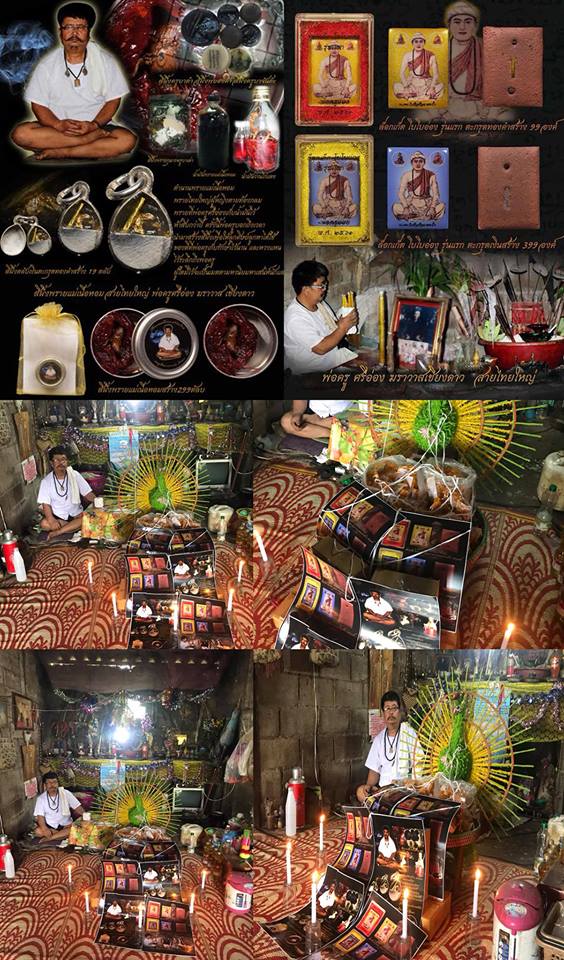
Master Sri Ong is said to have personally travelled to Burma to obtain materials connected with the tradition before preparing these lockets in Chiang Dao.
At the centre of the reverse is Patthama Siddhi medicine.
Within the lineage, this is regarded not simply as an herbal preparation but as a ritually prepared substance connected with the disciplines of the old Burmese masters. The reverse was additionally filled with Burmese maha wan herbs, particularly associated with piya and metta — attraction, goodwill and favourable human relationships.
A visible application of red medicine further connects the piece to the lineage from which its teachings are derived.
Finally, the blue-background version was completed with a silver takrut, together with material used in honouring the teachers.
The result is therefore more than a portrait locket. Its construction was intended to bring together the image, medicine, herbs, yantric element and teacher lineage within a single artifact.
Ritual
The spiritual foundation of this locket rests upon wai kru — remembrance and honouring of the teachers.
In the Burmese master traditions, the image of a teacher serves as a focus through which the practitioner recollects the master's virtues, teachings and baramee.
Bobo Aung's tradition extends further into the Burmese concept of the accomplished weikza.
Traditional accounts maintain that Bobo Aung and Pho Min Khong achieved unusually advanced accomplishments through different approaches to practice. Bobo Aung is said to have progressed systematically through successive stages, while Pho Min Khong is described as approaching the disciplines in reverse, beginning with difficult practices before returning towards their foundations.
Both are traditionally believed to have made vows connected with the preservation of Buddhism until the coming of Metteyya, the future Buddha.
These accounts belong to Burmese devotional tradition rather than conventional historical biography, but they remain important for understanding why Bobo Aung continues to command such reverence.
Blessings and Effects
The locket is traditionally associated with three closely connected qualities: baramee, protection and advancement.
Baramee is especially important. It may be understood here as accumulated spiritual authority and personal weight — the quality through which one's words carry greater influence and others become more willing to listen, cooperate or assist.
The Burmese herbs and medicines introduce the complementary qualities of metta and piya, supporting goodwill, approachability and favourable relationships.
Traditional purposes therefore include:
- strengthening baramee, authority and personal presence;
- metta, popularity and support from others;
- protection from harmful influences and unseen danger;
- opening opportunities and overcoming prolonged obstacles;
- improving negotiations, business relationships and career movement;
- supporting sincere prayers and aspirations;
- encouraging clarity and steadiness during difficult periods.
Rather than representing wealth alone, Bobo Aung's blessing is traditionally understood as helping create the conditions through which progress becomes possible.
Modern Application
This is particularly suitable for someone whose progress depends upon people, judgement and opportunity.
Business owners may keep it at their workplace or personal altar. Those in sales, management, property, finance or negotiation may wear it when meeting clients or handling important agreements.
For someone facing stagnation, the traditional approach is not simply to ask for money. A more appropriate prayer is for obstacles to clear, the right people to appear, sound judgement to arise and suitable opportunities to become visible.
It may equally be carried without a specific worldly request, simply as an object of remembrance and respect towards Bobo Aung and the old Burmese teacher lineage.
Physical Details
The front depicts Bobo Aung seated cross-legged, with two smaller teacher images positioned above him against a distinctive blue background.
The reverse is filled with a reddish-brown sacred herbal and medicinal mixture. A silver takrut is embedded vertically into the filling, while a small application of consecrated red medicine is visible above it.
The entire locket is protected within a clear pendant casing suitable for wearing.
Blue Background: 399 pieces
Takrut: Silver
Reverse: Patthama Siddhi medicine, Burmese maha wan herbs, red medicine and teacher-honouring material
A separate gold-background version with gold takrut was produced in only 99 pieces.
Recommended Pairing
Because Bobo Aung already combines baramee, metta, protection and obstacle-clearing, the locket is sufficiently complete to be worn by itself.
For business or professional use, it may be paired with a Buddha or monk amulet associated with wealth, metta or career advancement.
For those primarily concerned with protection, pairing it with a traditional protective Buddha image or guardian artifact creates a balanced combination without distracting from the locket's central purpose.
Personal Notes
What makes this issue particularly interesting is the direct connection with Master Sri Ong of Chiang Dao and his use of materials personally gathered from Burma.
The reverse construction is especially important. Rather than producing a simple commemorative portrait, Master Sri Ong incorporated Patthama Siddhi medicine, Burmese maha wan herbs, red medicine and a takrut, preserving the character of the lineage within the physical structure of the locket.
The blue-background edition shown here belongs to the 399-piece silver-takrut issue.
For collectors interested in Burmese wicha, the appeal lies not merely in the image of Bobo Aung, but in the combination of teacher lineage, traditional medicine, ritual materials and limited handmade production within a single artifact.

-
Free Shipping for Singapore| $15 Worldwide | $100 USA All products