
OOBThaiAmulets
Por Sala Tan X Por Tan Suk Sabai
Por Sala Tan X Por Tan Suk Sabai
Couldn't load pickup availability
PST05
Phra Pidta Malang Phu
Por Sala Tan
Mainstream Artifact
3 cm
Sacred Craftsmanship
Each piece was individually carved, prepared and finished by hand. Natural differences in the Mai Rak, carving, surface, embedded substances and application of gold therefore make each example distinct.
Personal Experiences Shared by Luksits
Phra Pidta Malang Phu is relatively uncommon compared with Por Sala Tan’s better-known forms, and accounts surrounding it tend to come from practitioners familiar with his older Lanna-style work.
Those who favour this form generally speak about steady rather than sudden improvement. In business, this has been described as customers becoming more consistent, negotiations encountering fewer obstacles and difficult situations gradually becoming easier to penetrate.
Some business owners also associate Malang Phu with the feeling of becoming more firmly established within their trade — particularly when facing established competitors or attempting to build a position in an already crowded market.
Rather than describing an unexpected windfall, the experiences surrounding this form are more often expressed as things slowly moving in the keeper’s favour and remaining there once established.
Summary
Phra Pidta Malang Phu is one of the more obscure Krung Rung forms associated with Lanna occult tradition.
Its importance lies in the combination of two complementary ideas.
Phra Pidta represents restraint, preservation, protection and the sealing of unwanted influences. In amulet tradition, the form is closely connected with Maha Ut, Klaew Klaad and the preservation of accumulated wealth.
Malang Phu, represented through the carpenter bee, carries a different but complementary symbolism: persistence, penetration of obstacles, establishment of territory and gradual expansion.
Por Sala Tan brought these concepts together in a Mai Rak carving intended particularly for steady wealth accumulation, business development, authority and the ability to establish oneself firmly within a competitive environment.
Historical Background
Within older Lanna traditions, animals and insects could become the basis of wicha because practitioners observed their natural behaviour and interpreted particular characteristics symbolically.
Malang Phu — the carpenter bee — became significant because of its remarkable persistence.
Rather than seeking an easy opening, the insect is capable of working repeatedly into solid timber until it creates a place for itself. This behaviour came to represent penetrating resistance, establishing territory and gaining a lasting foothold through persistence.
The tradition is comparatively obscure today, particularly beside more familiar Lanna animal forms.
Por Sala Tan preserved elements of this forest-based approach to wicha, where natural forms were selected because their behaviour reflected the intended character of the sacred object.
In Phra Pidta Malang Phu, that persistent outward movement is balanced by the inward, containing symbolism of Phra Pidta.
Origins of the Materials
The principal material is Mai Rak, a wood traditionally valued in sacred-object making.
Its dense and durable character makes it particularly suitable for objects intended to retain inserted substances and remain stable over long periods. Within the context of this piece, the wood forms the enduring foundation upon which the remaining wicha is constructed.
Inside, Por Sala Tan incorporated Parad, traditionally associated with movement, circulation and an active spiritual current.
Burmese red wax was also inserted. Such wax preparations appear repeatedly in Por Sala Tan’s cross-border work and are traditionally used as binding substances for maintaining and stabilising the intended qualities of an artifact.
Together, the materials form a deliberate structure: Mai Rak for foundation, Parad for movement and Burmese wax for binding and containment.
Ritual
The consecration follows the character of older Northern Lanna wealth and authority practices.
The Malang Phu aspect emphasises persistence — repeatedly working through resistance until an opening appears. Its ritual symbolism therefore concerns not simply obtaining wealth, but creating a position from which wealth can continue to develop.
During preparation, the Parad within the piece was ritually activated as an element of movement and circulation. The Burmese red wax served as a binding medium, while the Mai Rak retained the completed ritual composition.
The Phra Pidta form introduces the complementary principle of closing and preserving.
One aspect seeks to penetrate obstacles and create opportunity; the other seeks to prevent what has already been accumulated from unnecessarily flowing away.
Blessings and Effects
Traditionally, Phra Pidta Malang Phu is associated with gradual wealth accumulation, stable commercial growth, authority and persistence.
The Phra Pidta aspect is sought for protection, Maha Ut, restraint, concentration and the preservation of resources. Symbolically, closing the external openings also represents preventing fortune and accumulated wealth from continually escaping.
Malang Phu contributes qualities of persistence, territorial standing and overcoming resistance. This makes the artifact particularly relevant where the keeper must repeatedly negotiate, compete or establish a foothold before meaningful progress can occur.
Its overall character is therefore less concerned with sudden windfalls than with building, securing and retaining.
Modern Application
For modern use, Phra Pidta Malang Phu is particularly suited to people developing something over the long term.
A business owner may carry or keep it within the premises when seeking stable customer growth and a stronger commercial position. Entrepreneurs entering competitive industries may approach it for persistence and the ability to gradually establish their own territory.
Salespeople may find its symbolism appropriate where success depends upon repeated follow-up and eventually breaking through resistance.
For professionals, the same principles translate into career stability, recognition, authority and establishing a stronger position within an organisation.
It may be worn personally or respectfully positioned within a shop, office or working environment.
Physical Details
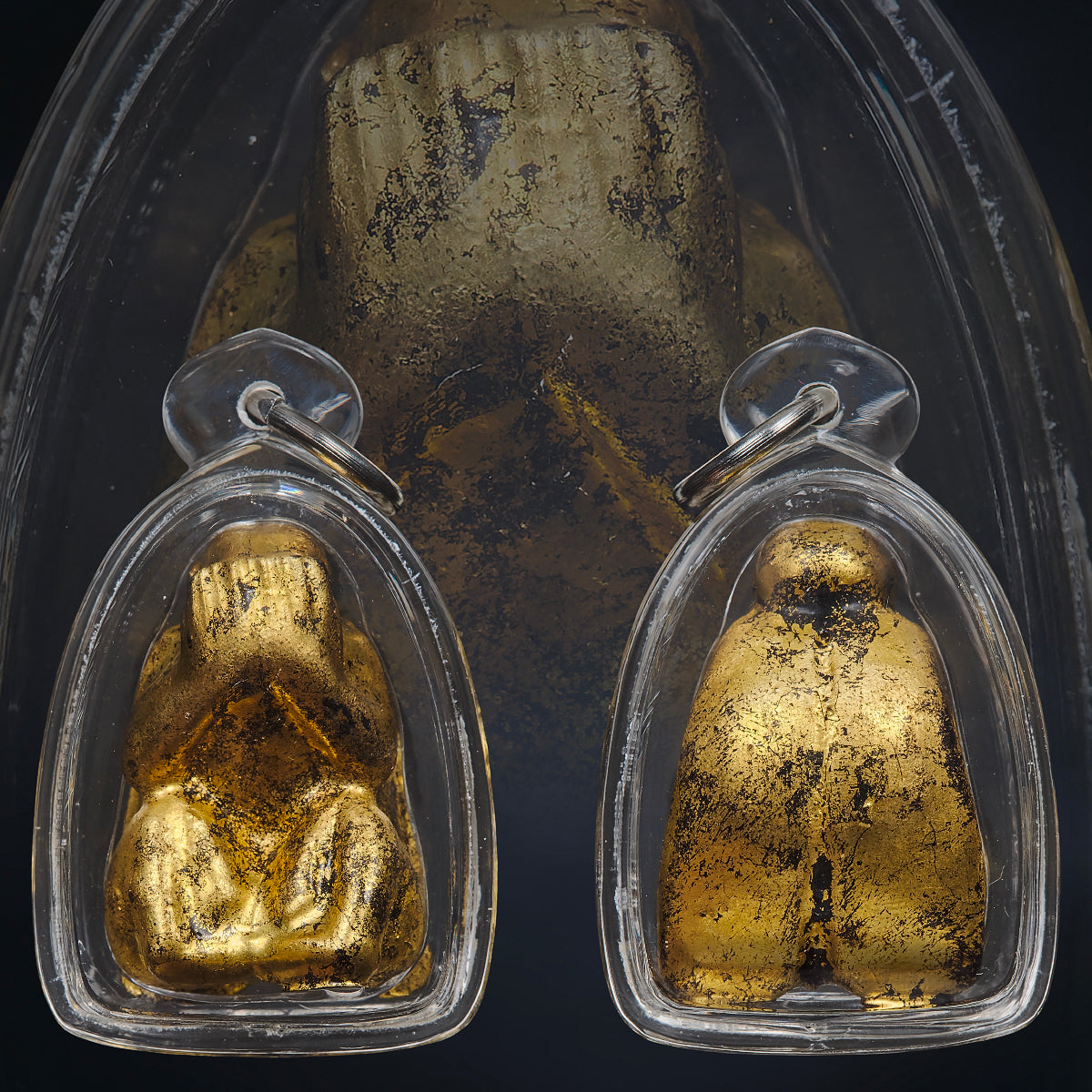
The piece is individually carved from Mai Rak into a compact seated figure. From the front, the most immediate feature is the Phra Pidta posture: both hands rise towards the face while the figure sits firmly upon its base. The simplified carving gives it the direct, primitive character often associated with handmade folk-occult pieces rather than a formal temple mould.
The surface has been extensively covered with gold leaf, now naturally worn and darkened in places. This uneven ageing allows portions of the underlying wood and surface texture to remain visible, giving the piece considerable character.
Viewed from the reverse, the form becomes deliberately simple and almost entirely closed, emphasising the solid body of the Mai Rak carving. Parad and Burmese red wax are incorporated within the construction, forming the concealed ritual components behind the otherwise restrained exterior.
The surviving gold, exposed darker areas and handmade irregularities are part of the artifact’s individual character rather than uniform decorative finishing.
Recommended Pairing
Phra Pidta Malang Phu can function effectively as a standalone business and wealth piece because it already combines movement with preservation.
For someone seeking stronger leadership or professional standing, it may be paired with a baramee-focused monk or Lersi amulet.
For sales, negotiation and customer-facing occupations, pairing it with a Metta-oriented piece can complement Malang Phu’s persistence with greater receptiveness from the people being approached.
A Nang Kwak may also complement it in a business environment: Nang Kwak traditionally calls customers and trade, while Malang Phu represents the slower process of establishing, expanding and retaining that commercial foundation.
Personal Notes
What interests me about this piece is the unusual combination of Phra Pidta and Malang Phu.
Phra Pidta is immediately recognisable, but the Malang Phu wicha behind the carving is considerably less known. It belongs to the kind of older Lanna Krung Rung tradition where practitioners observed something very simple in nature and transformed that behaviour into the symbolic foundation of a wicha.
The carpenter bee does not represent effortless luck. It repeatedly works into something seemingly resistant until it creates its own place. That makes the symbolism particularly suitable for people building businesses, careers or positions that require patience.
At the same time, Phra Pidta introduces the opposite but necessary principle: once something has been gained, know how to close, protect and preserve it.
For me, that balance is the character of this artifact — Malang Phu opens and establishes; Phra Pidta seals and retains.
-
Free Shipping for Singapore| $15 Worldwide | $60 USA For Items Below $350