
OOBThaiAmulets
Por Sala Tan x Ac Lek
Por Sala Tan x Ac Lek
Couldn't load pickup availability
Prai Kasip
Por Sala Tan & Ac Lek
B.E. 2545 (2002)
Barang Artifact
6cm
Sacred Craftsmanship
Each amulet was individually prepared and finished by hand. Natural differences in the powder mixture, surface, moulding and placement of the coffin-nail component mean that surviving examples can vary considerably from one another.
Personal Experiences Shared by Luksits
Among older users, Prai Kasip developed a reputation for what they described as “whispering” rather than directly producing an outcome.
Some luksits involved in gambling or other situations of uncertainty described suddenly feeling that they should stop, change their choice or avoid continuing despite having no obvious reason at the time. Others spoke of unusually vivid dreams, persistent thoughts or a strong feeling towards one particular decision.
There were also accounts of users becoming uncomfortable immediately before an unfavourable situation developed. Only afterwards did they interpret the earlier feeling as a warning.
For this reason, experienced collectors generally did not regard Prai Kasip simply as a gambling charm. Its reputation centred more strongly upon intuition — sensing when circumstances were favourable, when something was wrong and, importantly, when it was time to withdraw.
Summary
Created in B.E. 2545 (2002), this Prai Kasip represents an early collaboration between Por Sala Tan and Ac Lek.
Its traditional purpose centres upon sixth sense, intuitive warning, spiritual sensitivity and Chok Larp, particularly where the keeper must make decisions under uncertain circumstances.
The history of its materials is closely connected with gambling. According to the account preserved with this batch, a fire occurred at a local gambling den in which several people lost their lives. Coffin-nail material associated with the deceased was subsequently obtained and prepared for use within the Prai Kasip.
Rather than treating this material merely as an ingredient, Por Sala Tan incorporated it within a specific Prai framework intended to channel its character towards warning, intuition and assistance.
Historical Background
The name Prai Kasip can be understood through the idea of a Prai that communicates subtly — traditionally described through whispers, impressions, dreams or sudden intuitive feelings.
Such wicha has particular relevance to situations where information is incomplete and decisions must be made quickly. Gambling naturally became one of its best-known associations, but the same principle could historically extend to trade, travel, negotiation and situations involving uncertain people or circumstances.
This B.E. 2545 batch carries an especially unusual history.
The principal spirit-related material was connected to people who had died in a fire at a local gambling den. The location itself had been a place of repeated risk, money, anticipation, gain and loss. Within traditional Barang interpretation, those circumstances gave the material a particular relationship with uncertainty and human instinct.
Por Sala Tan and Ac Lek subsequently incorporated the prepared material into Prai Kasip rather than treating it as a general-purpose Prai artifact.
Origins of the Materials
The amulet body was prepared from a dark sacred powder mixture containing Pong Prai and other ritual substancesused by Por Sala Tan during this period.
The most recognisable component is the coffin nail associated with the fire victims.
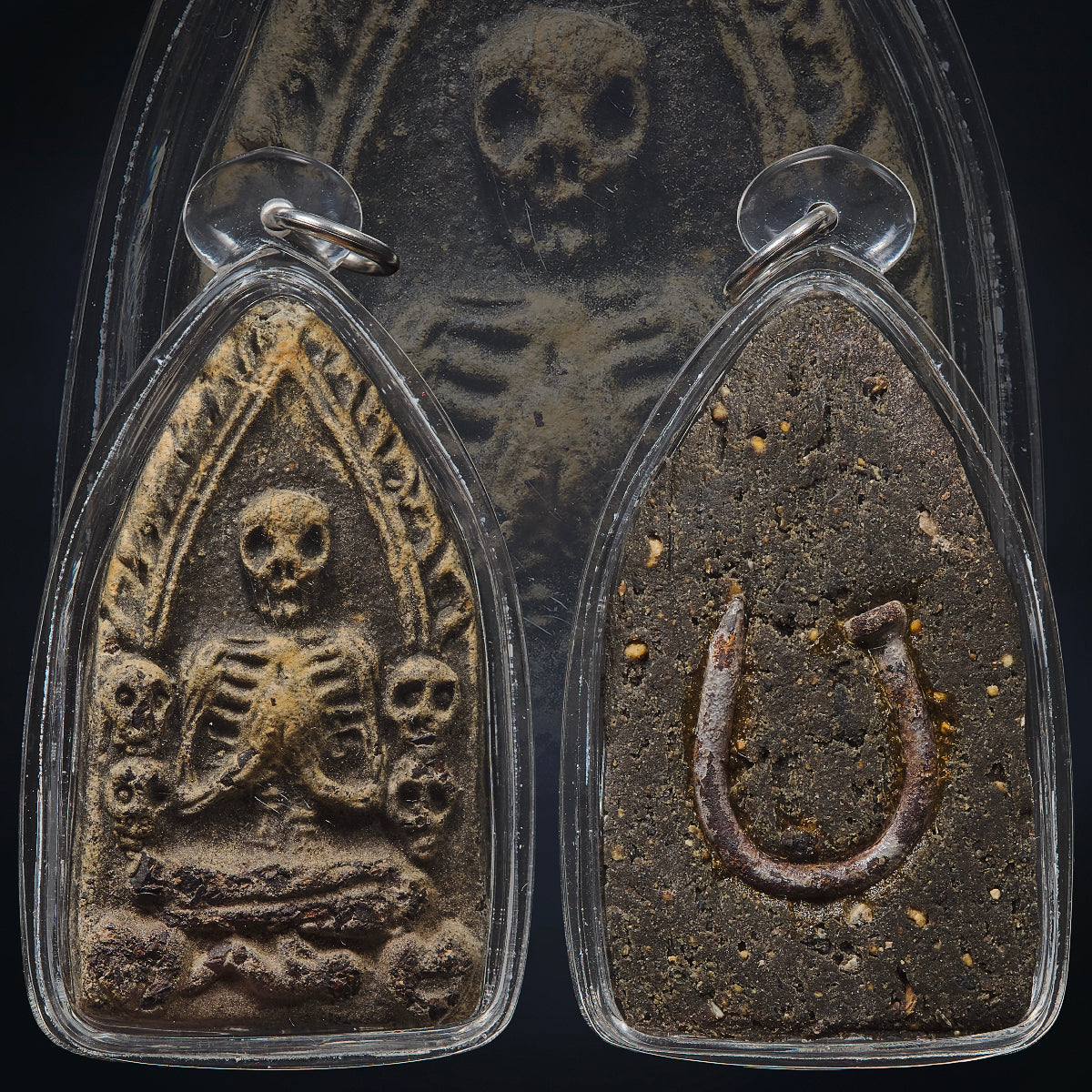
Rather than concealing it entirely within the powder body, the nail material was incorporated prominently into the reverse. On this example, the old iron forms a large horseshoe-like curve against the dark powder surface.
Within the traditional construction, the iron acts as an anchor and conductor for the Prai work.
The powder itself remains visibly coarse, with small fragments and particles distributed throughout. This rough material character is consistent with the individually prepared nature of these early Barang pieces.
Ritual
The batch involved both Por Sala Tan and Ac Lek, with their respective roles complementing one another.
Por Sala Tan handled the principal spirit invocation and ritual framework surrounding the Prai materials. His work concerned establishing the intended relationship between the spiritual component, the physical vessel and the purpose for which Prai Kasip was being created.
Ac Lek prepared the original form and participated in the chanting and reinforcement of the batch over multiple sessions.
The coffin-nail material provided the physical anchor, while the Prai powder formed the body surrounding it. Through consecration, the emphasis was directed towards Kasip — subtle communication, warning and intuitive perception.
This father-and-son involvement makes the B.E. 2545 pieces particularly representative of an earlier period when Ac Lek was still working closely alongside Por Sala Tan.
Blessings and Effects
Prai Kasip is traditionally associated foremost with sixth sense and intuitive guidance.
Users seek it when they need greater sensitivity towards changing circumstances — recognising when something feels favourable, detecting when a situation may be turning against them, or receiving an instinctive warning before proceeding further.
Its traditional qualities therefore include heightened intuition, symbolic dreams, sensitivity towards people and situations, timely warnings and Chok Larp.
Its gambling reputation should be understood within this broader context. The artifact is not traditionally viewed as something that guarantees winning. Rather, its value lies in the idea of knowing when to proceed and when to stop.
That distinction is central to the character of Prai Kasip.
Modern Application
Although historically associated strongly with gamblers and risk-takers, the underlying concept has wider modern relevance.
Business owners and salespeople may approach it for intuition when evaluating customers or opportunities. Those involved in negotiation may use it as a reminder to pay attention to subtle changes in another person's behaviour.
Collectors also associate Prai Kasip with speculative decisions where timing matters, although it should never replace careful analysis or sensible risk management.
For ordinary daily use, its most practical interpretation remains awareness: observe carefully, recognise warning signs and do not allow desire for an outcome to overpower judgement.
Physical Details
This example has a dark, aged powder body enclosed within a clear protective casing. The front presents a striking skeletal Prai figure seated beneath a pointed arch, with smaller skull forms appearing around the central body. The coarse texture and uneven tonal variation give the piece the unmistakable appearance of an individually prepared early Barang artifact rather than a modern precision pressing.
The reverse is comparatively plain, allowing the principal material feature to dominate. A substantial section of aged coffin nail has been bent into a broad U-shaped form and embedded directly into the powder body. Small particles of the sacred mixture remain visible throughout the surrounding surface.
The combination of skeletal imagery, dark Pong Prai body and exposed old iron gives the piece a particularly direct visual relationship with the Prai Kasip wicha for which it was created.
Recommended Pairing
Prai Kasip is best regarded as an intuition and warning artifact, so pairing should complement rather than duplicate this character.
A strong Buddhist protection amulet can provide a balanced foundation for daily carrying. For business use, a Metta-oriented piece may add smoother interpersonal relations while Prai Kasip retains its role of observation and intuitive warning.
For collectors specifically interested in Por Sala Tan's Barang tradition, it can also be paired with a Chok Larp artifact — one concerned with opening opportunity, while Prai Kasip represents the judgement needed to recognise which opportunities are worth pursuing.
Personal Notes
What makes this B.E. 2545 Prai Kasip particularly interesting to me is the relationship between its history, materials and intended wicha.
The coffin nail did not come from an unrelated source and was simply added because it was old. Its history was connected to people who died at a gambling den — an environment already associated with risk, money, uncertainty and strong human attachment. Por Sala Tan subsequently directed that material towards Prai Kasip, a wicha concerned with sensing circumstances and receiving subtle warning.
I also appreciate the early involvement of Ac Lek. His hand-prepared pim gives the piece a rawness that suits the artifact particularly well, while the joint chanting with Por Sala Tan places it within an interesting father-and-son period of their work.
For me, the most meaningful way to understand Prai Kasip is therefore not as a promise of gambling success, but as an artifact of intuition and restraint.
Sometimes the valuable warning is not telling a person how to win.
It is telling them when not to continue.
-
Free Shipping for Singapore| $15 Worldwide | $60 USA For Items Below $350