
OOBThaiAmulets
Por Sala Tan x AC Bed
Por Sala Tan x AC Bed
Couldn't load pickup availability
PST05
Pan Tai — Sacred Plough Iron
Por Sala Tan & AC Bed
Mainstream Artifact
3cm
Sacred Craftsmanship
Each Pan Tai comes from naturally aged working metal rather than a uniform mould. Differences in oxidation, texture, thickness and surface formation are therefore expected, and every surviving piece has its own individual character.
Personal Experiences Shared by Luksits
Several pieces of these Pan Tai were given directly to villagers, particularly people whose livelihoods remained closely connected with agriculture.
Among the accounts passed down were farmers who had been struggling with their harvests. After receiving the Pan Tai and continuing their work, some subsequently reported a noticeable breakthrough in agricultural production, with harvests improving and their livelihood becoming more stable.
The experiences were not limited to farming.
Students who received or kept these pieces were also said to have achieved better academic results, passed important stages of their studies and later experienced a relatively smooth transition into better employment.
Among working adults, the Pan Tai became associated with a similar pattern: circumstances that had remained difficult for some time gradually began to move.
These accounts reflect the symbolism of the plough particularly well. The Pan Tai does not represent prosperity appearing without effort. The farmer must still push the plough, plant the seed and tend the field. Its symbolism is that sustained effort is finally able to break through the hard ground.
Summary
The Pan Tai is one of the more straightforward yet meaningful objects within Por Sala Tan's agricultural wicha.
Its foundation is old iron alloy taken from the working section of a farm plough, traditionally pulled by buffalo and, in later periods, by tractors. This is the part that repeatedly enters compacted earth, cuts through roots and hard soil, and turns the ground before crops can be planted.
For generations, this simple agricultural action carried an obvious folk symbolism:
to break through what is hard, open what is closed, and prepare the ground for prosperity to grow.
Por Sala Tan and AC Bed jointly consecrated these pieces while retaining the metal in its original raw form.
Historical Background
Before mechanised farming became widespread, the plough was among the most important tools in rural Thai life.
Without the plough, hard earth could not easily be opened for cultivation. The tool therefore stood at the beginning of the agricultural cycle — breaking the soil before seed, harvest and ultimately sustenance could follow.
Older folk practitioners naturally transformed this agricultural function into talismanic symbolism.
The plough does not travel around difficult ground.
It passes directly through it.
This became associated with the Thai idea of Phan — to pass through, overcome or get through something. Within folk interpretation, Pan Tai consequently became a material for passing through difficult circumstances, obstacles and periods when progress appeared blocked.
Its connection with cultivated earth created a second symbolism: fertility and sustenance. Once the hard ground has been opened, something productive can finally be planted.
Origins of the Materials
The material is old iron alloy from an agricultural plough or ploughshare, the working implement used by farmers to cut and overturn soil before planting.
Unlike unused iron, this material had already spent considerable time performing its agricultural purpose. It repeatedly entered the earth, endured resistance and opened fields from which generations of crops could grow.
This history is central to its traditional value.
The iron represents labour, endurance, cultivation and livelihood. Its association with fertile ground also connects it naturally with food, harvest and the traditional wish that one's household should never lack sustenance.
For this particular Pan Tai, Por Sala Tan chose not to melt the old material into another form. The original metal itself was preserved, allowing the working history of the plough to remain physically present.
Ritual
The pieces were jointly consecrated by Por Sala Tan and AC Bed.
The ritual emphasis follows the natural character already attributed to the material: opening roads, passing obstacles, maintaining livelihood and strengthening the keeper when confronting difficult circumstances.
Rather than transforming the iron into a different sacred image, the consecration works upon what the material already represents.
The plough had spent its working life cutting, opening and turning the earth. Ritual practice translates these physical actions into symbolic ones — cutting through obstruction, opening opportunity and turning difficult circumstances towards productive results.
Blessings and Effects
Pan Tai is traditionally associated with Perd Thang — opening the way — particularly when progress has become difficult or repeatedly obstructed.
Its agricultural origin gives it strong associations with livelihood, prosperity, fertility and Pho Sap, the principle of having sufficient resources and sustenance. Farmers naturally connected such material with successful cultivation, while merchants and modern professionals interpret the same symbolism through stable income and continued opportunity.
The harder aspect of the plough's symbolism concerns passing safely through adversity. Because the blade forces its way through compact earth, Pan Tai has traditionally been approached for Klaew Klaad, disputes, difficult negotiations, accusations and situations requiring the keeper to come through considerable resistance.
Older interpretations may additionally connect plough iron with toughness, Maha Ut and Kongkrapan.
The central principle, however, remains remarkably simple:
what stands in front may be difficult, but it can be passed through.
Modern Application
Although Pan Tai originated from agricultural culture, its symbolism translates naturally into modern life.
A farmer may keep it for cultivation, harvest and livelihood. A business owner may approach it when sales have stalled or expansion has become difficult. Someone changing careers may regard it as an opening-path artifact when seeking better employment.
Students may similarly associate Pan Tai with passing examinations and progressing successfully from one stage to another, particularly when considerable personal effort has already been invested.
It is also relevant to those facing negotiations, prolonged administrative matters, competitive environments or periods where repeated obstacles appear to prevent progress.
Pan Tai is therefore less a symbol of effortless luck than of breakthrough through persistence.
Physical Details
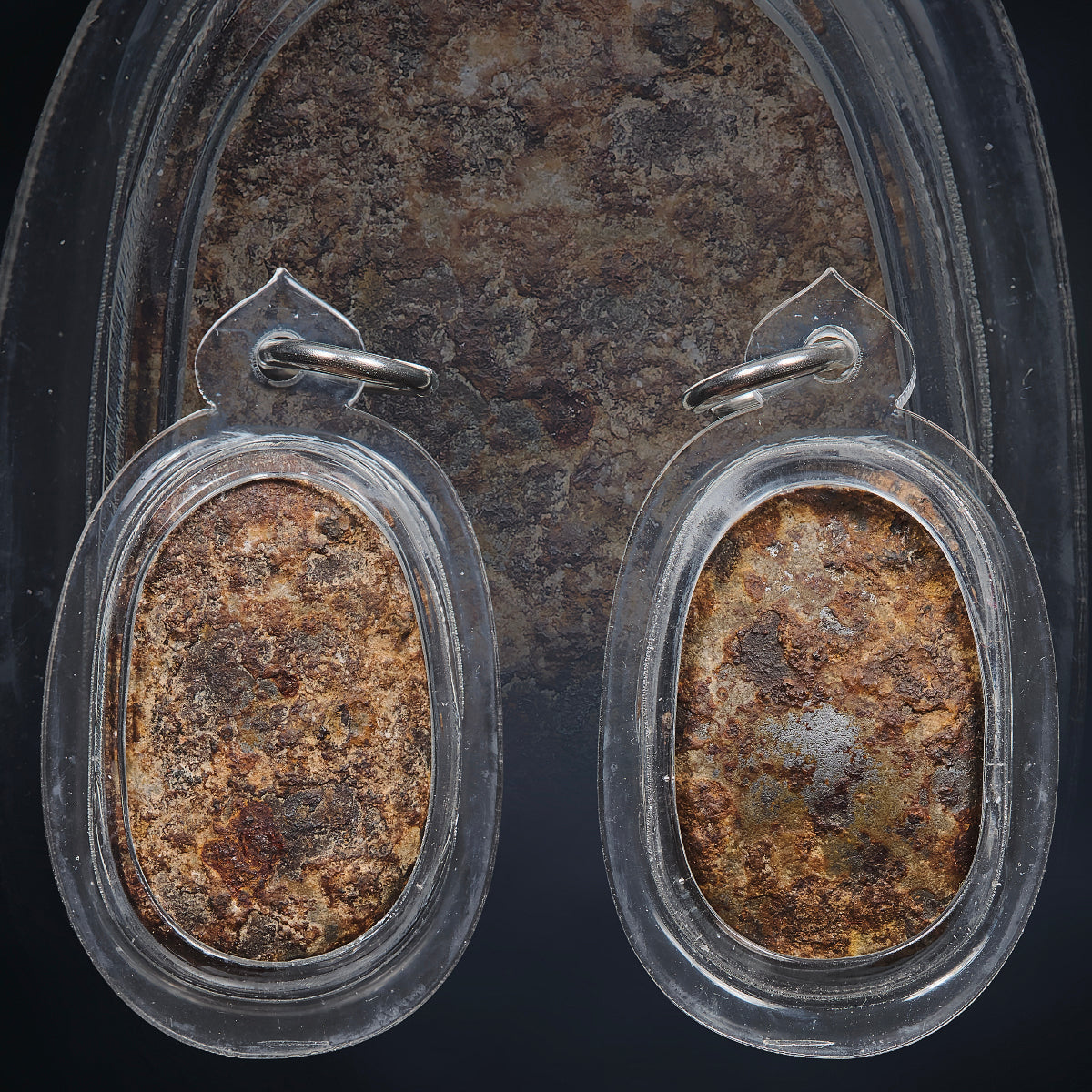
This example retains the appearance of the original plough material rather than presenting a carved or moulded sacred image. It is an oval section of heavily aged iron alloy, with a coarse and irregular surface produced through oxidation, soil exposure and its former agricultural use.
Both faces remain largely untreated. Brown, reddish and darker mineralised areas run naturally across the metal, while pits and variations in texture testify to its age and working history. There is no deliberate religious figure on either side; the old plough iron itself forms the identity of the artifact.
Its plain appearance is therefore important. What may initially resemble nothing more than a weathered fragment of farm iron is precisely what defines this Pan Tai — a working agricultural material preserved in its raw state and subsequently consecrated by Por Sala Tan and AC Bed.
The piece is now protected within a clear pendant casing, allowing both original surfaces to remain visible.
Recommended Pairing
Pan Tai pairs particularly well with wealth and Metta amulets.
A wealth-oriented piece can complement its association with opening livelihood and establishing prosperity, while Metta supports the human relationships that often determine whether an opportunity develops successfully.
For those facing demanding careers or positions of responsibility, pairing Pan Tai with a Baramee-oriented amuletcreates a useful combination of breakthrough and personal standing.
It can equally be kept alone. Its symbolism is already complete: break the ground, open the road, plant the seed and allow sustained effort to produce its harvest.
Personal Notes
What I appreciate about this Pan Tai is its simplicity.
There is no elaborate carving, deity image or decorative surface. Por Sala Tan did not need to turn the material into something visually impressive. The history of the plough itself was the reason for keeping it.
This iron had already performed exactly what the wicha represents. It had met hard ground repeatedly and passed through it. It had opened soil that appeared closed, creating the conditions from which crops, food and livelihood could emerge.
The reports from villagers also make the piece particularly meaningful. Farmers associated it with breakthroughs in their harvests, while younger keepers spoke of better academic results and smoother progress towards employment.
For me, that gives Pan Tai a very practical philosophy.
The amulet does not plant the seed for you. It represents the strength to break the hard ground so that what you plant has a chance to grow.
-
Free Shipping for Singapore| $15 Worldwide | $60 USA For Items Below $350