
OOBThaiAmulets
Por Sala Tan
Por Sala Tan
Couldn't load pickup availability
MS6
Na Hua Chamut
Por Sala Tan
Summary
After wearing this amulet, many collectors of this piece from Por Sala Tan experienced something more specific than ordinary "wealth luck": money began arriving through routes they had not expected.
A customer who had disappeared suddenly returned with a large order. A salesperson received an introduction that became their biggest commission of the month. A business that had been quiet began receiving inquiries again. Someone looking for additional income unexpectedly found a profitable side opportunity. Others sought the piece before negotiations, trading or gambling, hoping for the kind of fortunate opening where one unexpected encounter produces more money than weeks of ordinary work.
This is the traditional character of Na Hua Chamut, an old Northern-Burmese wealth wiccha associated with wealth attraction, commerce, side income, trade success and finding hidden pathways to opportunity. The reference lineage connects the practice with old mountain trade routes linking Burma, Northeast India, Yunnan and the Lanna regions of Thailand.
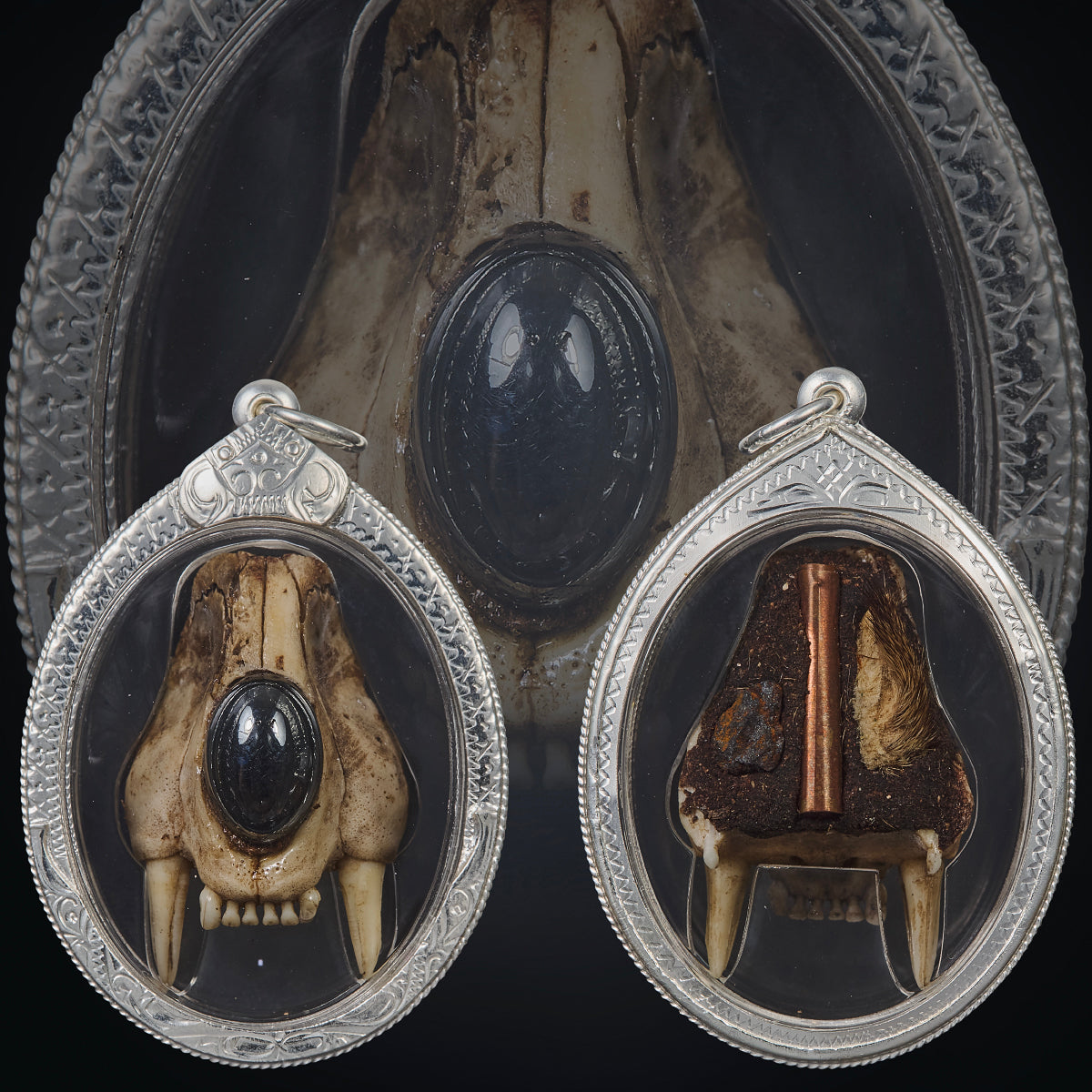
This particular example is considerably more elaborate than a simple charm. The front incorporates a polished piece of Lek Lai, while the reverse contains a handwritten copper takrut, preserved skin and fur, sacred relics and ritual substances. Together they create a compact ritual assembly intended not simply to symbolize wealth, but traditionally to search for it, attract it and direct opportunities toward the owner.
Historical Background
Na Hua Chamut belongs to an older layer of Northern occult practice connected with the mountainous borderlands between Thailand and Burma.
According to the reference lineage, the wiccha became particularly popular during the early-to-mid B.E. 2500s among traders, traveling merchants, plantation owners and people participating in barter economies around the Thai-Burmese frontier. Its roots are described as extending beyond Thailand into Burmese occult traditions and tribal shamanic practices farther west toward Northeast India.
These were practical traditions shaped by environments where survival depended upon knowing where to travel, where resources could be found, whom to trade with and when an opportunity was worth pursuing.
The lineage consequently developed a strong association with mountain ritual specialists involved in spirit negotiation, fire offerings and blessings for commerce and prosperity. The reference history also notes that related Hua Chamut methods were known to Luang Phor Pinak, who incorporated aspects of the wiccha into some of his Palad Khik Hua Chamut creations.
It was therefore never simply decorative occultism.
It was wiccha for people who depended upon movement, trade, instinct and opportunity to make money.
Origins of the Materials
The material construction is one of the most interesting aspects of this particular piece.
At the front is a prominent polished Lek Lai, positioned centrally within the preserved Hua Chamut structure.
Lek Lai occupies a special place within Thai occult belief and is traditionally valued as a mysterious sacred mineral substance. In this piece it forms the visual and ritual focal point of the front, adding another protective and auspicious element to the older wealth-oriented Hua Chamut wiccha.
The surrounding organic structure belongs to the older mountain format described in the reference lineage. Such materials were traditionally sourced from remote plantation and mountain areas and preserved before being passed to ritual specialists. Por Sala Tan is described as receiving these materials from villagers and plantation workers and transforming them into spiritual implements through consecration and liberation rites.
The reference lineage specifically records the addition of sacred inserts and wealth-related substances intended to stabilize and direct the wiccha toward business, income and Baramee, with wealth takruts incorporated during ritual sealing to reinforce its commercial function.
The result is effectively a small portable ritual shrine rather than a conventional cast amulet.
Ritual
The ritual tradition behind Na Hua Chamut is particularly distinctive.
According to the reference information, these pieces underwent a fire ritual associated with teachings linked to Lersi Ser Ming Pai, described as a mountain ascetic lineage remembered for wealth rites and merchant blessings.
Fire functions within this system as an element of activation, transformation and spirit liberation.
During consecration, the prepared materials were subjected to sustained chanting together with fire offerings and takrut empowerment. The purpose was traditionally understood as awakening the material's wealth-fetching qualities while directing its spiritual force toward beneficial outcomes for its future owner.
The handwritten copper takrut at the rear is particularly important in this context.
It is not merely an additional object placed behind the piece. The takrut serves as a ritual mechanism for directing and controlling the intended wiccha, while the skin, fur, relics and other substances form the material foundation.
Older practitioners believed certain spirit-linked materials possessed natural tendencies associated with gathering, locating, attracting and guarding resources. The ritual master's role was to redirect those tendencies through mantra, elemental rites and offerings toward prosperity and beneficial commerce.
Blessings and Effects
The primary reputation of Na Hua Chamut is wealth through movement.
This distinction is important.
It is not simply a "money amulet" where the owner waits for money to appear. Its traditional character is about finding pathways that lead to money.
The reference lineage associates Na Hua Chamut with side wealth, business attraction, successful trade and opportunities arriving through unexpected channels. Historically, owners carried such pieces while traveling, negotiating or beginning new commercial ventures.
One particularly interesting traditional effect is described as "pulling movement" toward the owner.
In modern terms, that movement can manifest as:
-
More customers
-
More inquiries
-
More conversations
-
Unexpected introductions
-
Repeat business
-
Profitable encounters
For someone earning commissions, imagine going from a week with almost no serious prospects to suddenly receiving several inquiries—and one becomes a transaction large enough to cover the entire month's target.
For a business owner, it might be an old customer unexpectedly returning and placing the largest order they have ever made.
For someone searching for additional income, it could appear as an introduction to a side business that eventually earns almost as much as their main job.
That is the type of wealth pathway this wiccha traditionally seeks.
Modern Application
Na Hua Chamut translates remarkably well into modern commercial life because today's economy still depends upon the same thing ancient traders needed:
-
Movement
-
Customers must move toward your business.
-
Messages must arrive.
-
People must talk about you.
-
Introductions must happen.
-
Deals must progress.
-
Money must circulate.
This makes the piece particularly suitable for:
-
Business owners
-
Salespeople
-
Property agents
-
Traders
-
Livestream sellers
-
Brokers
-
Commission-based professionals
Consider a property agent who has listings but cannot find serious buyers.
After beginning to carry the piece, an old contact unexpectedly sends a referral. That referral introduces another buyer. The second buyer purchases a high-value property, resulting in the agent's largest commission of the year.
Or imagine a small online seller whose sales have remained stagnant. Suddenly an existing customer recommends the business to someone with a large following. Orders increase, repeat customers appear and what began as side income becomes substantial monthly revenue.
The sought-after effect is therefore not simply:
"Give me money."
It is:
"Lead me to where the money is."
That subtle difference captures the character of Na Hua Chamut.
Physical Details
This is an unusually elaborate Na Hua Chamut by Por Sala Tan, housed inside a large custom silver-toned protective frame with engraved decorative borders.
The front preserves the distinctive organic structure of the Hua Chamut. Two prominent elongated teeth frame the lower section, while the smaller teeth remain visible between them.
Set prominently into the center is a smooth, highly polished black Lek Lai cabochon. Its deep reflective surface provides a dramatic contrast against the naturally aged cream and brown tones of the surrounding material.
The reverse exposes the ritual construction rather than hiding it.
A single handwritten copper takrut runs vertically through the central area. Alongside it are visible pieces of preserved skin and fur, sacred relic material and dark ritual sealing compounds.
This exposed reverse is particularly desirable from a collector's perspective because it allows the wearer to see the different ritual components that make up the piece rather than having them completely concealed.
The reference example for this lineage is approximately 1.5 inches and is described as suitable for wearing, altar placement or business display. Exact dimensions should be confirmed separately for this individual piece.
Recommended Pairing
Na Hua Chamut is fundamentally a wealth-fetching and opportunity-gathering piece, so the strongest pairing is usually something that improves what happens after the opportunity arrives.
With Salika or Metta Maha Niyom
Ideal for sales and negotiation.
Na Hua Chamut traditionally brings movement and prospects; Metta makes those prospects more receptive to you. This closely follows the older practice of combining wealth-fetching pieces with Salika, Metta substances or merchant takruts.
With Nang Kwak
Recommended for business owners.
One draws commercial movement while the other strengthens customer attraction.
With Maha Amnaj or Baramee
Recommended for promotions, career advancement and leadership.
Na Hua Chamut uncovers the opportunity; Maha Amnaj strengthens recognition and influence when that opportunity arrives.
With Chok Lap or Lap Loi
Recommended for lottery or gambling luck.
A dedicated Chok Lap piece concentrates specifically on windfall fortune, while Na Hua Chamut supplies the broader theme of finding unexpected routes to gain. The reference lineage notes that these pieces were historically made for wealth fetching, crop prosperity, gambling luck and trade-related blessings.
The combination can be summarized simply:
-
Na Hua Chamut finds the opportunity.
-
Metta makes people receptive.
-
Baramee gives you influence.
-
Your own action turns the opening into money.
Personal Notes
This is the type of wealth amulet I would recommend to someone who says:
"I work hard, but I never seem to meet the right customer, find the right deal or be in the right place when money is being made."
That problem fits Na Hua Chamut exceptionally well.
The fascinating aspect of this wiccha is that its traditional wealth effect is not necessarily expected to arrive as a dramatic pile of unexpected cash.
Instead, the first sign may be movement.
-
Your phone starts ringing more.
-
Someone recommends you.
-
A dormant customer returns.
-
An old friend introduces you to a buyer.
-
A negotiation suddenly starts moving.
-
A side opportunity appears.
Then one of those seemingly ordinary events becomes the deal that changes everything.
The reference description similarly notes that reported patterns surrounding Northern wealth pieces often involve human interaction—more inquiries, smoother deal flow, stronger customer retention and unexpected introductions—rather than windfalls alone.
That is what makes this example especially compelling.
The Lek Lai at the front, together with the handwritten copper takrut, skin, fur and sacred relics at the back, gives the piece a much deeper ritual construction than an ordinary wealth charm.
It represents an old mountain idea that remains surprisingly relevant today:
Wealth is rarely sitting still waiting to be found. It moves through people, roads, conversations, introductions and opportunities.
And when one seemingly accidental introduction produces the customer, contract or business opportunity that changes your financial position overnight, the experience can feel just shy of a miracle.
This layout follows your usual Old City format with clear section headings, spacing, callout quotes, and bullet points to improve readability while preserving your original content.
-
Free Shipping for Singapore| $15 Worldwide | $60 USA For Items Below $350