
OOBThaiAmulets
Por Sala Tan
Por Sala Tan
Couldn't load pickup availability
PST03
Nang Kwak
Por Sala Tan
1.5 Inches
Barang Artifact
Sacred Craftsmanship
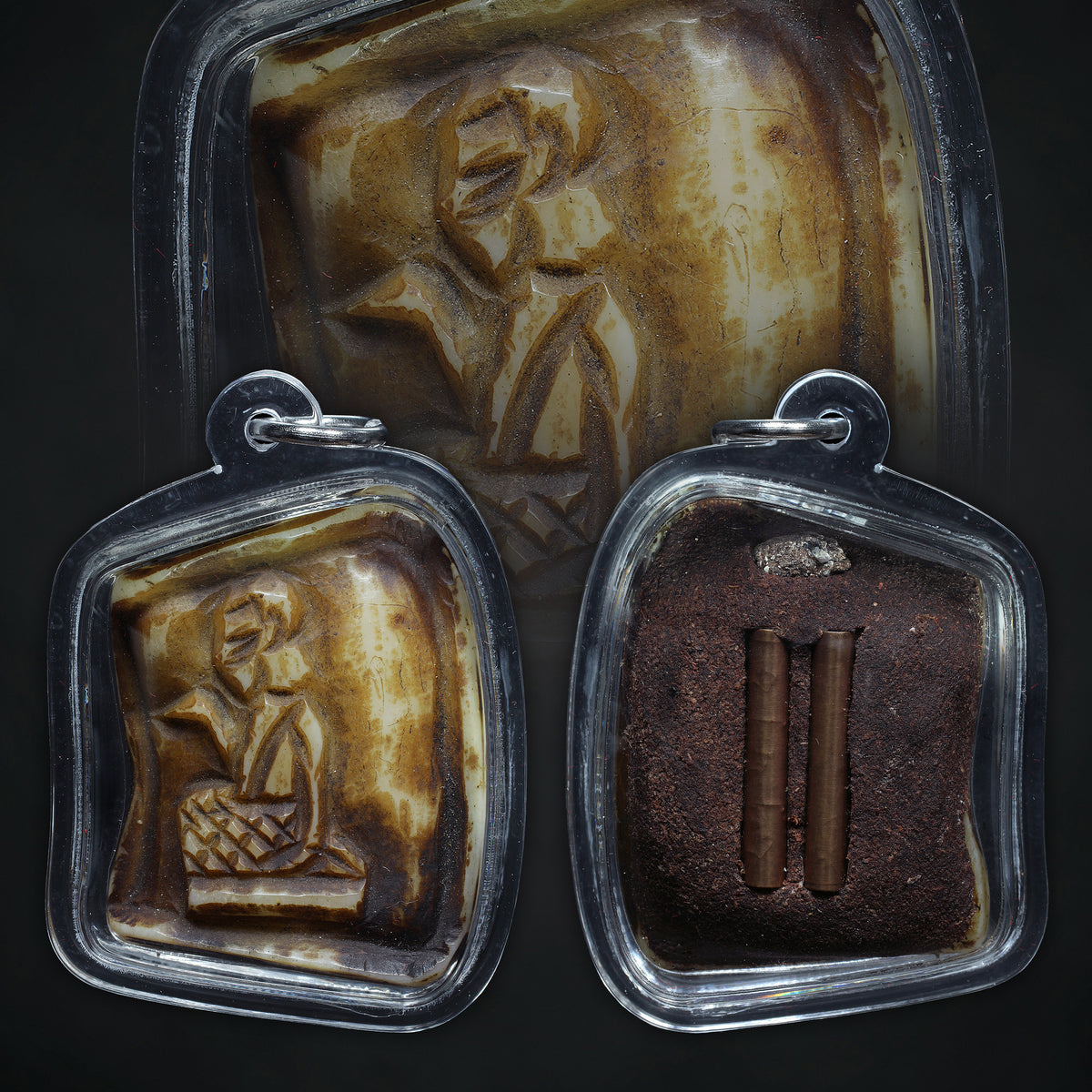
The Nang Kwak of Por Sala Tan is an unusual Barang artifact created from the hip relic of a female spirit whose remains were discovered inside a cave near the Thai–Burma border.
Each artifact is individually handmade from carefully prepared sacred materials. Natural variations in texture, colour and form contribute to the unique character of every piece.
Exact piece as per photo will be given.
Personal Experiences Shared by Luksits
Among Por Sala Tan's followers, his Nang Kwak artifacts have attracted considerable interest because of the positive experiences shared by devotees, particularly those involved in business and retail.
One account concerns a woman who operated a small food stall.
Her business had always been relatively ordinary. Although she was able to cover her daily expenses and maintain a modest livelihood, sales were seldom exceptional.
The situation became increasingly worrying when several competitors opened food stalls near her premises.
With more choices available to customers, she feared that her already modest business would begin to decline.
During this period, Por Sala Tan gave her a Nang Kwak and advised her to keep it respectfully, pray with sincerity and maintain faith while continuing her business.
She followed his advice, keeping the artifact close to her stall.
Unexpectedly, her business did not suffer from the increased competition.
Instead, she began noticing more customers visiting her stall. Some were regular patrons returning more frequently, while others were new customers who had not previously purchased from her.
Over time, her sales improved considerably.
What surprised her most was that the surrounding competition had not diminished. Despite the presence of several nearby food stalls, her own business continued to flourish.
She later shared this experience with other followers, expressing her gratitude to Por Sala Tan and attributing her improved circumstances to the Nang Kwak he had given her.
For her, the artifact became more than a symbol of prosperity. It represented an important turning point during a period when she had been uncertain about the future of her livelihood.
Summary
The Nang Kwak of Por Sala Tan is a traditional wealth-attracting Barang artifact distinguished by its unusual origin and carefully prepared sacred materials.
Carved from the hip relic of a female spirit encountered inside a cave near the Thai–Burma border, the artifact combines traditional Nang Kwak symbolism with Por Sala Tan's specialised spirit-related Wicha.
Its principal qualities are associated with:
- Chok Larp: Attracting good fortune and favourable opportunities.
- Maha Pokasap: Supporting wealth accumulation and financial stability.
- Metta Maha Niyom: Encouraging goodwill, popularity and favourable treatment.
- Maha Saneh: Enhancing personal attraction and social appeal.
- Kha Khai Dee: Supporting sales, customer attraction and commercial activity.
The incorporation of Yaa Lek, cave soil, Takruts and a Yoni seed further distinguishes this piece from conventional Nang Kwak amulets.
Historical Background
Nang Kwak – The Traditional Lady of Fortune
Nang Kwak is one of Thailand's most recognisable figures associated with commerce, prosperity and the attraction of customers.
Her familiar seated posture, with one hand raised in a beckoning gesture, symbolises the invitation of wealth, customers and favourable circumstances.
For generations, Nang Kwak images have been kept in shops, market stalls and places of business.
Merchants traditionally regard her as a spiritual patron of trade, believing that her presence encourages customers to enter their premises and supports harmonious business relationships.
Although Nang Kwak is commonly represented through Buddhist-influenced folk traditions, her symbolism also appears within older animist practices.
In certain traditions, Nang Kwak artifacts are prepared using unusual sacred materials or spirit-related Wicha to emphasise their attraction qualities.
Por Sala Tan and the Cave Spirit
The origin of this particular Nang Kwak begins with an encounter near the Thai–Burma border.
Villagers living near a remote cave had repeatedly reported seeing the apparition of a woman lingering around its entrance.
Her continued appearance caused considerable uneasiness among the local community.
Some villagers feared that the spirit might harbour harmful intentions.
Concerned about the situation, they approached Por Sala Tan and requested that he visit the cave.
According to the account, Por Sala Tan travelled to the location and encountered the female spirit.
Rather than immediately attempting to drive her away, he sought to understand why she remained there.
Through spiritual communication, he learnt that the woman had passed away many years earlier and that her physical remains were still concealed within the cave.
The spirit subsequently guided him to the location of her remains.
Por Sala Tan performed the necessary rites for the deceased woman, with the intention of addressing her unsettled circumstances and allowing her to receive merit.
Following the ceremony, the spirit was said to have permitted Por Sala Tan to collect and use portions of her relics for future sacred-object creation.
The collected materials were carefully preserved rather than immediately used.
Some time later, Por Sala Tan selected a portion of the hip relic to create this Nang Kwak.
Origins of the Materials
Female Hip Relic – The Principal Material
The central figure was carved from a hip relic attributed to the deceased woman discovered inside the cave.
Within Por Sala Tan's Barang tradition, relics associated with particular spirits may be selected for their perceived spiritual characteristics and connection to the original owner.
In this case, the female origin of the relic was considered particularly suitable for a Nang Kwak associated with attraction, feminine charm and prosperity.
Yaa Lek – Traditional Attraction Herbs
The reverse contains Yaa Lek, a traditional herbal preparation associated with attraction, luck and favourable attention.
Within certain regional practices, Yaa Lek is connected with ritual herbal preparations used for anointment and cleansing.
Its inclusion was intended to strengthen the Nang Kwak's Metta Maha Niyom and wealth-attracting qualities.
Cave Soil – Connection to the Original Location
Soil collected from the cave was mixed into the preparation applied to the reverse.
This material establishes a symbolic connection between the completed artifact and the location where the female spirit's remains were discovered.
Sacred Takruts and Yoni Seed
Two Takruts were embedded into the reverse to reinforce the intended blessings.
A Yoni seed was also incorporated to harmonise the feminine spiritual associations of the relic with the attraction qualities of Nang Kwak.
Together, these materials form the principal components of the artifact's traditional Barang preparation.
Ritual
The preparation of this Nang Kwak began long before the physical carving.
The first stage involved Por Sala Tan's visit to the cave and his encounter with the female spirit.
After locating the remains, he performed rites intended to address the spirit's circumstances and dedicate merit to the deceased.
According to the account, permission was subsequently granted for portions of the relics to be collected.
The materials were preserved until Por Sala Tan considered them suitable for sacred-object creation.
A portion of the hip relic was then carved into the traditional Nang Kwak form.
The reverse was prepared using Yaa Lek mixed with soil from the original cave.
Two Takruts were embedded into the herbal preparation, followed by the inclusion of a Yoni seed.
The completed artifact was prepared according to Por Sala Tan's spirit-related Barang Wicha, with emphasis on Metta Maha Niyom, Saneh, Chok Larp and commercial prosperity.
Blessings and Effects
1. Kha Khai Dee – Customer Attraction and Good Sales
The principal quality associated with Nang Kwak is attracting customers and supporting commercial activity.
Traditionally valued by merchants, food stall owners and retailers seeking steady business.
2. Maha Pokasap – Wealth and Financial Stability
Associated with accumulating wealth, maintaining income and encouraging favourable financial circumstances.
Particularly meaningful for individuals operating small businesses.
3. Metta Maha Niyom – Goodwill and Popularity
Traditionally believed to encourage favourable treatment, kindness and cooperation from others.
This quality is especially relevant to individuals whose livelihoods depend upon customer relationships.
4. Maha Saneh – Personal Attraction
The combination of the female relic, Yaa Lek and Yoni seed is traditionally associated with Saneh and personal charm.
Its purpose is to encourage attraction, approachability and positive social interactions.
5. Chok Larp – Fortune and Opportunities
Associated with unexpected opportunities, favourable encounters and improvements in commercial circumstances.
6. Protection of Livelihood
Within Nang Kwak traditions, prosperity is not limited to attracting new customers.
It also concerns maintaining an existing livelihood during periods of competition or uncertainty.
Modern Application
The Nang Kwak remains particularly relevant to individuals involved in commerce and customer-facing occupations.
Food Stall Owners and Merchants: Traditionally kept to attract customers, encourage repeat business and maintain steady sales.
Retailers and Shop Owners: Associated with favourable customer relationships and commercial prosperity.
Sales Professionals: Valued for Metta Maha Niyom, personal attraction and improved communication.
Business Owners Facing Competition: Traditionally associated with maintaining customer loyalty and overcoming difficult trading conditions.
Collectors of Barang Artifacts: Appreciated for its unusual cave provenance, female relic construction and combination of traditional attraction materials.
Physical Details
The Nang Kwak of Por Sala Tan is a small, individually carved artifact depicting a seated female figure with one hand raised in the traditional beckoning gesture. The front displays a natural ivory-brown surface with darker areas of aged patina. The reverse is covered with a dark herbal preparation containing Yaa Lek and cave soil, with two visible copper-coloured Takruts embedded vertically and a small Yoni seed positioned above them. The piece is housed within a transparent protective casing.
Recommended Pairing
Phra Sivali – Prosperity and Abundance
Traditionally associated with favourable opportunities, abundance and successful journeys.
Complements Nang Kwak's customer-attracting qualities.
Phra Khun Paen – Metta Maha Niyom and Personal Charm
Associated with popularity, attraction and favourable relationships.
This pairing emphasises personal appeal and harmonious social interactions.
Por Sala Tan's Yin Tong – Saneh and Harmonious Relationships
Associated with attraction, personal charm and favourable interactions.
A complementary pairing for individuals seeking both commercial prosperity and improved relationships.
Personal Notes
The Nang Kwak of Por Sala Tan is particularly interesting because its origins differ considerably from conventional Nang Kwak amulets.
Rather than being produced from ordinary sacred powder or metal, this example was carved from a relic associated with a female spirit encountered inside a remote cave.
The circumstances surrounding the discovery are an important part of its history.
According to the account, the villagers initially feared the spirit because of her repeated appearances near the cave.
However, Por Sala Tan's encounter revealed a different situation.
The spirit was said to have remained near the location of her physical remains, and the subsequent ceremony was intended to address her circumstances rather than treat her as a hostile presence.
Another distinctive aspect is the careful preservation of the collected materials.
Por Sala Tan did not immediately transform the relics into sacred objects. Instead, they were retained for future use.
The eventual selection of the hip relic for Nang Kwak reflects the association between feminine spiritual symbolism and traditional attraction Wicha.
The reverse construction is equally significant.
The combination of Yaa Lek, cave soil, two Takruts and a Yoni seed demonstrates how Por Sala Tan incorporated different materials to support a particular spiritual purpose.
The experience shared by the food stall owner also reflects the reason Nang Kwak remains popular among merchants.
Her concern was not necessarily becoming wealthy overnight, but maintaining a livelihood in the face of increasing competition.
According to her account, the business not only survived but improved despite the opening of several competing stalls nearby.
For collectors familiar with Por Sala Tan's work, this Nang Kwak represents an unusual combination of cave provenance, spirit-related Wicha, traditional herbal preparations and the enduring Thai belief in Nang Kwak as a patron of commerce and prosperity.
-
Free Shipping for Singapore| $15 Worldwide | $60 USA For Items Below $350