
OOBThaiAmulets
Por Sala Tan
Por Sala Tan
Couldn't load pickup availability
PST07
Keow Moo Tong Deang
Por Sala Tan
1.5 Inches
Mainstream Artifact
Individual Craftsmanship
Each artifact was individually handmade from natural relic and prepared sacred materials. Differences in tooth shape, colour, surface, yantra, Tong Deang material and ritual substances make every surviving example individually distinctive.
Personal Experiences Shared by Luksits
Among luksits, Keow Moo Tong Deang is remembered primarily as a piece for difficult circumstances.
It was not necessarily carried because life was already going smoothly.
People approached this type of artifact when they were facing resistance — difficult competitors, uncertain business conditions, hostile individuals or situations where progress seemed continually blocked.
The Moo Paa symbolism was particularly meaningful in such circumstances.
A wild boar does not represent delicate movement around every obstacle. When threatened or cornered, it has the strength and determination to continue forward.
Some users therefore approached Keow Moo Tong Deang before negotiations, important business matters or journeys where they expected difficulties.
Others regarded it primarily as a protective piece, particularly when dealing with environments where the intentions of others were uncertain.
The recurring character is resilience — remaining standing when circumstances become difficult and finding enough force to continue through them.
Summary
The Keow Moo Tong Deang combines two old sources of symbolism within a single Por Sala Tan artifact.
The first is the Keow Moo Paa, representing raw strength, survival, courage and the determination to break through resistance.
The second is Tong Deang, connected in the local account with the soil of an old Fang location remembered for earlier protective and war-related practices.
Por Sala Tan brought these elements together through yantra and prolonged ritual preparation.
The resulting piece is traditionally approached for Maha Amnaj, protection, resilience, obstacle clearing, authority and stability of livelihood.
It is not primarily a soft Metta artifact.
Its character is firmer:
when the road becomes difficult, continue forward without allowing the obstacle to overpower you.
Historical Background
The Moo Paa — wild boar — occupies a distinctive place in older rural symbolism.
Anyone familiar with the animal understands why.
A wild boar possesses a compact body, considerable strength and an ability to survive in demanding forest environments. When threatened, it can defend itself with extraordinary determination.
Within older Kreung Rang traditions, such natural qualities could become the symbolic foundation of an artifact.
The tooth in particular represented the animal's ability to fight, penetrate and survive.
This made Keow Moo Paa suitable for protective Wicha and for users whose lives exposed them to uncertain conditions.
Por Sala Tan's piece adds another local layer through its connection with Fang.
According to the lineage surrounding the artifact, the location where Por Sala Tan obtained and prepared the associated material was known for Tong Deang soil and carried memories of older war charms and protective practices.
Local accounts spoke of warriors preparing themselves and their weapons before travelling through dangerous territory.
Whether carried by warrior, traveller or later businessman, the underlying principle remained similar:
prepare yourself before entering difficult ground.
Origins of the Materials
The principal relic is Keow Moo Paa, the tooth of a wild boar.
Its natural strength and durability provided the physical foundation of the piece.
The second important material is Tong Deang soil from the Fang area, gathered from a location associated within the tradition with older protective and war-related practices.
Additional forest and ceremonial soil and sacred substances were incorporated during Por Sala Tan's preparation.
The visible tooth was then inscribed with sacred yantra.
This created a layered artifact in which the materials themselves carried much of the symbolism:
Moo Paa for strength and survival.
Tong Deang for grounding, protection and stability.
Yantra for directing the Wicha.
Forest and ceremonial materials for connecting the finished artifact with the places and rites through which it was prepared.
Ritual
Por Sala Tan's preparation of Keow Moo Tong Deang was closely connected with forest meditation and the gathering of materials from their original environment.
The tooth was not treated merely as an unusual natural object.
Its association with the Moo Paa was first recognised through the qualities traditionally attributed to the animal: determination, survival and direct force.
Por Sala Tan then worked sacred yantra onto the tooth.
The Fang Tong Deang material and additional ceremonial substances were incorporated around it, creating the darker ritual body that now surrounds much of the relic.
Consecration concentrated upon protection, Maha Amnaj, resilience and overcoming obstacles.
The intention was therefore not simply aggression.
Raw strength had to be governed by Wicha.
The wild force represented by the Moo Paa was given direction, while the Tong Deang element provided a grounding foundation.
Blessings and Effects
Keow Moo Tong Deang is traditionally associated with:
- Maha Amnaj — authority and commanding presence
- Protection against danger
- Protection against hostile intentions
- Resistance against spiritual disturbances
- Breaking through obstacles
- Courage during difficult circumstances
- Strength against competition
- Resilience and endurance
- Leadership and decisiveness
- Stability of livelihood
- Business strength
- Opportunities after periods of obstruction
- Remaining firm under pressure
The wealth aspect of this artifact should be understood through its broader character.
It is not simply about attracting money without effort.
Instead, it supports the traditional idea of protecting one's livelihood, overcoming what prevents progress and establishing enough stability for prosperity to develop.
Modern Application
The modern environment may be very different from the forests in which older Moo Paa symbolism developed, but the underlying lesson remains easily understood.
A business owner may encounter aggressive competition.
A manager may need to make an unpopular but necessary decision.
A salesperson may repeatedly face rejection before finally securing an important account.
Someone negotiating a contract may need enough confidence to hold their position rather than yielding under pressure.
In such situations, Keow Moo Tong Deang represents steadiness under resistance.
For those in leadership, its Maha Amnaj character is traditionally approached for presence and authority.
For business owners, it represents protecting what has already been built while continuing through periods of competition or uncertainty.
For travellers or people regularly entering unfamiliar environments, its older protective character remains equally relevant.
Physical Details
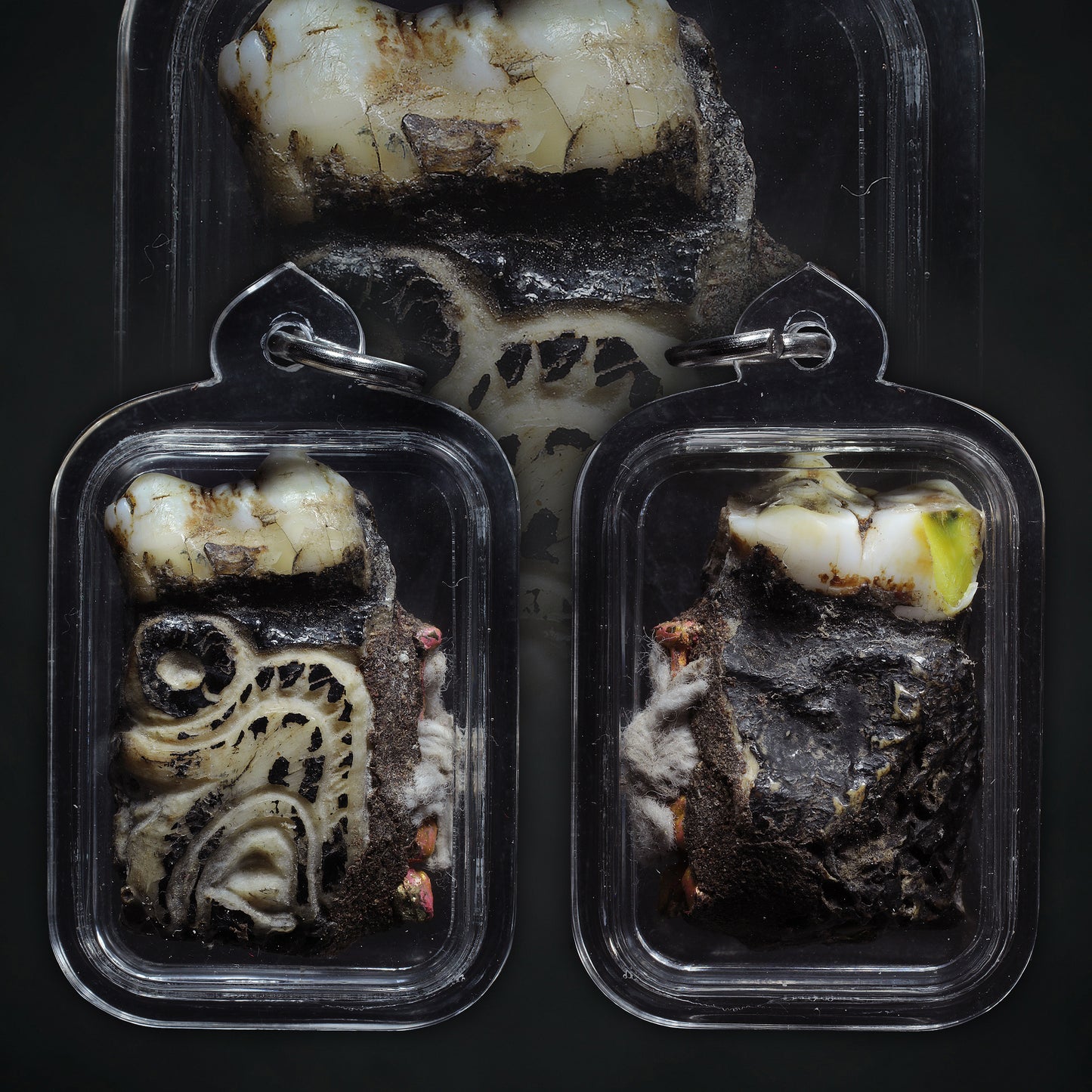
An individually prepared Keow Moo Tong Deang by Por Sala Tan, centred upon a substantial natural Keow Moo Paa or wild boar tooth relic. Much of the pale tooth remains visible, retaining its natural irregularities, ageing and original structure. Sacred black yantra markings were applied directly onto the exposed surface. Dark Tong Deang-related material, forest soil and prepared ritual substances surround portions of the tooth, producing a heavily textured outer body. Additional sacred materials are incorporated around the sides and reverse. The artifact is presently preserved within a clear protective casing.
Recommended Pairing
Keow Moo Tong Deang already carries a strong character of Maha Amnaj, protection and resilience, so it pairs particularly well with softer forms of Wicha.
For business and sales, Metta Maha Niyom provides a natural balance. Keow Moo Tong Deang represents firmness and authority, while Metta encourages smoother relationships with customers, colleagues and business partners.
For wealth, it may be paired with Maha Pokasap or Choke Lap. The Keow Moo helps the bearer push through resistance and defend their position, while the wealth piece concentrates more directly upon financial opportunities and accumulation.
For someone specifically seeking courage and strong Baramee, a Suer may reinforce the protective and authoritative character, although such a pairing will naturally create a considerably firmer combination.
Personal Notes
What I find particularly meaningful about Keow Moo Tong Deang is that the artifact does not separate strength from hardship.
The Moo Paa became symbolic precisely because it survives in difficult surroundings.
Its strength has meaning because there is something to resist.
Its determination has meaning because there is something blocking the way.
And its protective nature has meaning because the forest is not always safe.
The same principle can be applied to everyday life.
There will be periods when business is difficult, competitors become aggressive, negotiations stall or circumstances refuse to move in the direction we want.
The lesson of the Moo Paa is not that every obstacle will simply disappear.
It is that an obstacle does not automatically mean the end of the path.
Combined with the old Tong Deang tradition of Fang, Por Sala Tan transformed that natural symbolism into a Kreung Rang concerned with protection, authority and endurance.
For me, that is the character of this Keow Moo Tong Deang:
protect what you have built, remain firm when challenged, and when the road becomes difficult, possess enough strength to continue through it.
-
Free Shipping for Singapore| $15 Worldwide | $60 USA For Items Below $350