
OOBThaiAmulets
Por Sala Tan
Por Sala Tan
Couldn't load pickup availability
PST06
Mae Kali
Por Sala Tan
2 Inches
Barang Artifact
Personal Note
I was introduced to Kali through Mae Pim while studying a book on the avatars and manifestations of Goddess Parvati, the consort of Lord Shiva. As I researched further, I began to see meaningful connections to Kali and was eventually led to her former shrine at Lim Chu Kang Hindu Cemetery, Path 2. Although the shrine has since been removed by the authorities, I visited it several times.
Over time, I came to understand Kali beyond her fierce appearance. To me, she represents the protective love of a mother for her children and followers. Her image holding the demon’s head reflects her victory over harmful forces and her determination to defend those under her care. She is also revered as a force that clears obstacles, cuts through negativity, and helps one move forward with greater resolve.
Personally, when I venerate Kali, I find that obstacles seem to be resolved one by one, allowing me to focus more clearly and work towards my goals with greater speed and confidence.
Por Sala Tan is widely known for his seneh and metta creations, but his amulets for wealth, progress, and success should not be overlooked. This piece carries that same intention of overcoming limitations and moving ahead in life.
As always, I recommend pairing specialised pieces like this with mainstream Buddha amulets. Building one’s baramee through a balanced collection provides a stronger foundation, allowing the wearer to benefit more fully from the focused purpose of a particular amulet.
Sacred Craftsmanship
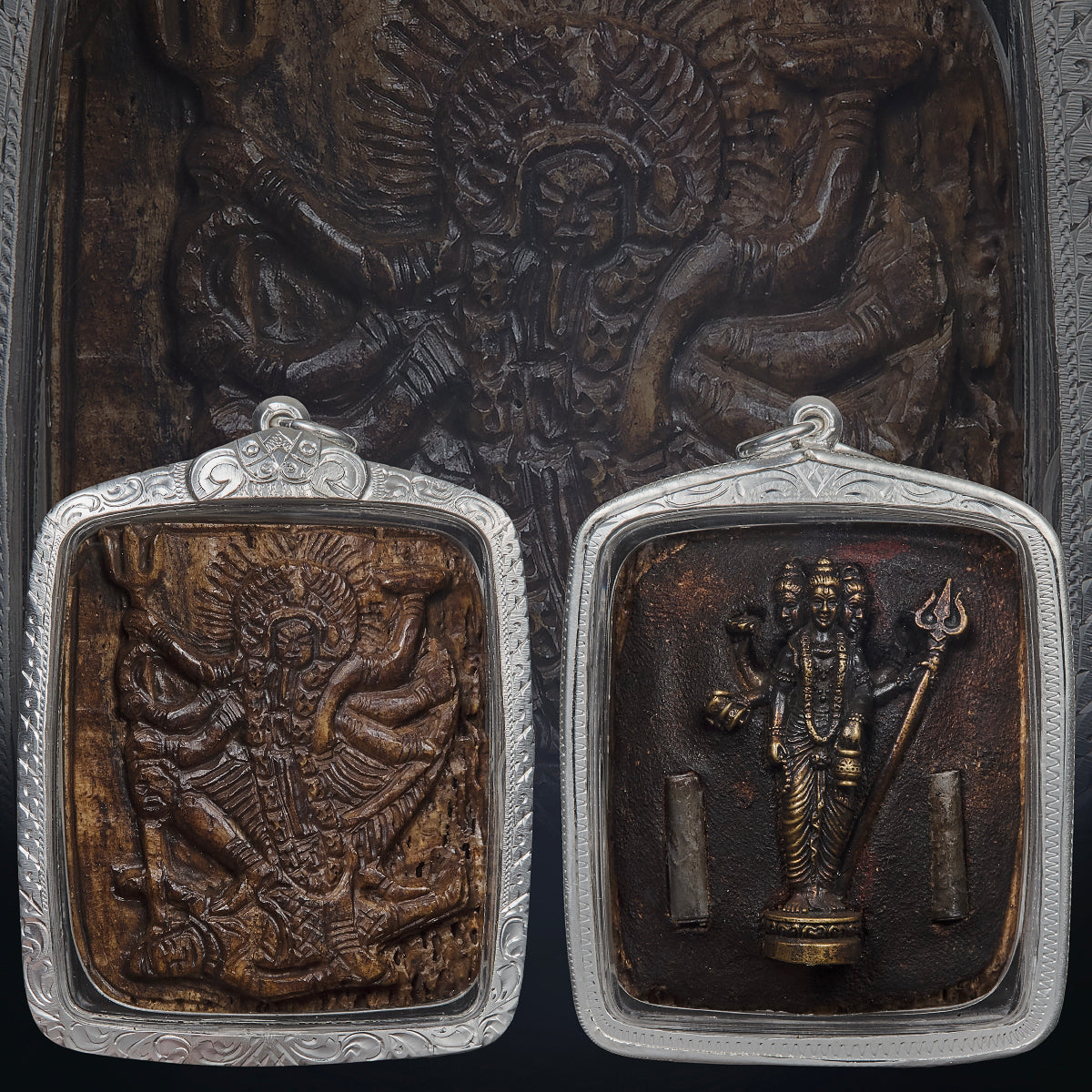
This Mae Kali was individually carved from Paneang, depicting the fierce form of Kali standing over Shiva.
The reverse carries an unusually complex ritual construction. Por Sala Tan prepared it with Nam Man Prai, Tid Jai, relic fragments, soil from the original burial site in Thailand and soil brought back from the woman's village in Burma.
Multiple takruts were placed around the composition to restrain and stabilise the spirit attached to the materials.
At the centre, Por Sala Tan embedded an image of Lord Dattatreya — the three-headed guru deity associated with Brahma, Vishnu and Shiva. His presence was deliberately introduced as a balancing influence, representing discipline, wisdom, harmony and self-control.
Each artifact was carved and assembled by hand. Differences in the Paneang, sacred substances, takrut placement and embedded materials are natural characteristics of the work.
Personal Experiences Shared by Luksits
Pieces of this nature are generally approached for protection, firmness and emotional control during difficult circumstances.
Luksits who work with Mae Kali commonly describe becoming less easily intimidated when dealing with aggressive people or complicated situations.
Some report greater decisiveness when facing prolonged obstacles, while others speak of receiving subtle warnings — an uneasy feeling before entering a situation, hesitation over an agreement, or information appearing at precisely the right moment.
What is particularly significant about this piece is the deliberate balance between Kali and Dattatreya.
The spirit associated with the original relic was described as deeply resentful and difficult to settle. Por Sala Tan therefore did not rely upon force alone.
Kali represents the strength to contain and overcome destructive force, while Dattatreya represents the wisdom and discipline required to prevent that force from becoming uncontrolled.
For the wearer, the same symbolism applies: strength without losing judgement, and protection without allowing anger to control one's decisions.
Summary
This is one of Por Sala Tan's more complex spirit-bound Paneang artifacts.
Its history concerns a Burmese woman who died violently while travelling in Northern Thailand. According to a local village shaman, her spirit remained near the place where her remains had been buried because she was unable to return to her family and homeland.
Por Sala Tan was asked to intervene.
After communicating with the spirit and locating the burial place, he eventually performed a binding ritual together with the village shaman. He then honoured the spirit's request by physically carrying selected remains back to her home village in Burma for a final ceremony.
The materials were subsequently returned to Thailand.
Por Sala Tan selected Mae Kali as the principal sacred form because he considered her fierce protective force strong enough to govern the spirit.
He then added Lord Dattatreya at the reverse as a second and equally important influence — not to intensify the spirit, but to introduce order, restraint, harmony and the guidance of the supreme teacher.
Historical Background
Mae Kali
Kali, or Kālī, is one of the principal goddesses of Hindu Shakta tradition.
Her appearance is deliberately fierce: wild hair, dark complexion, an extended tongue, severed-head garland and a skirt formed from human arms are among her most recognisable attributes.
In the familiar four-armed form, she may hold a khadga, or curved sword, and a severed head, while her remaining hands express abhaya, freedom from fear, and varada, the granting of blessings.
These elements should not be read simply as violence.
Kali represents time, transformation, fierce protection and the destruction of ignorance or forces that prevent liberation.
Her image therefore combines destruction with protection.
That distinction is particularly important in this artifact.
Kali and Shiva
The carving shows Kali standing upon Lord Shiva, who lies calmly beneath her.
One well-known devotional interpretation explains that Kali's force becomes so overwhelming during battle that Shiva lies in her path. When she steps upon him, awareness returns and her destructive momentum is restrained.
The image therefore represents more than victory.
Kali is active Shakti — tremendous force and transformation.
Shiva is still consciousness — awareness, stability and control.
Together they express power brought back into balance.
This concept closely mirrors Por Sala Tan's intention for the spirit attached to this artifact.
Lord Dattatreya — Supreme Teacher of the Three Deities
The reverse introduces another important figure: Lord Dattatreya.
Dattatreya is revered in Hindu traditions as a supreme guru and wandering yogi. His familiar three-headed form symbolically unites aspects of:
Brahma — creation
Vishnu — preservation
Shiva — transformation
For this reason he is sometimes loosely associated with the Trimurti, although Dattatreya is more accurately understood as a distinct guru deity embodying their combined qualities.
His central meaning is wisdom, discipline, spiritual guidance and the ability to harmonise seemingly opposite forces.
Por Sala Tan selected his image for precisely this reason.
Origins of the Materials
The history of this artifact begins in a mountainous village in Northern Thailand near the Burmese border.
A village shaman asked Por Sala Tan for assistance after residents experienced repeated disturbances attributed to a wandering female spirit.
The woman was believed to have been Burmese and had travelled frequently between Thailand and Burma during her lifetime.
She eventually died in Thailand through violent and unnatural circumstances.
Her remains were buried near a cave outside the village.
According to the shaman, the spirit remained strongly attached to the area because she wished to return to her family in Burma.
Over time, that unresolved attachment was believed to have developed into resentment.
People who approached the area subsequently reported disturbances.
Ritual
Por Sala Tan travelled to the burial area and communicated with the presence.
According to the account preserved with this piece, the spirit identified the location of her remains and expressed one clear wish:
to return home and see her family again.
Por Sala Tan agreed to help, but explained that she could not remain in Burma as an uncontrolled wandering spirit.
He initially asked her to settle within her own remains.
She refused.
Por Sala Tan and the village shaman therefore performed an extended binding ceremony using chanting and traditional ritual methods.
The process was described as difficult because the spirit strongly resisted.
Eventually, her presence was ritually attached to the recovered material.
Por Sala Tan then fulfilled his promise.
He carried the remains back across the border into Burma, travelling to the woman's home village where a further ceremony was performed.
Soil from that village was collected before the materials were brought back to Thailand.
Blessings and Effects
Por Sala Tan subsequently carved the Paneang into Mae Kali.
He regarded Kali's fierce protective nature as sufficiently strong to contain and govern the spirit.
The reverse was then covered with Nam Man Prai, together with:
- earth from the original burial site;
- soil collected from the woman's village in Burma;
- Tid Jai;
- relic fragments;
- multiple takruts.
The takruts were specifically intended to seal and restrain the rage of the spirit.
However, Por Sala Tan added one further component.
At the centre he embedded Lord Dattatreya.
Where Kali provides force, Dattatreya provides guidance.
Where Kali confronts destructive energy, Dattatreya introduces discipline and equilibrium.
Traditional qualities associated with the completed artifact therefore include fierce protection, resistance to hostile influences, courage, warning of danger, obstacle clearing, greater personal resolve and emotional self-control.
The intention is not uncontrolled aggression.
It is power kept under command.
Modern Application
This piece is particularly relevant for someone who must operate under pressure, opposition or uncertainty.
It may be approached during disputes, competitive business situations or periods when a person must remain firm without becoming emotionally reactive.
Kali's symbolism encourages the wearer to confront what must be confronted.
Dattatreya adds another lesson: do not allow the problem itself to determine your state of mind.
For professional life, this translates naturally into stronger boundaries, clearer judgement and the ability to remain composed when dealing with difficult people.
For personal practice, it may represent the transformation of anger, fear or resentment into something more disciplined and useful.
Physical Details
The front is carved directly from Paneang.
Mae Kali appears in a forceful multi-armed form, with her hair spreading around the head and her body standing over the reclining Shiva.
The carving retains the natural tones and aged texture of the underlying material.
The reverse is substantially different.
A dark sacred compound forms the base, within which several takruts are arranged around a central figure.
That central image is Lord Dattatreya, recognisable by his three-headed form and trident.
His position is significant.
Rather than being placed merely as decoration, he sits at the heart of the ritual backing, surrounded by the materials associated with the spirit.
The entire artifact is protected within a custom engraved silver casing, while both front and reverse remain visible.
Recommended Pairing
Because this piece already combines fierce protection and spiritual restraint, it is sufficiently complete to be carried by itself.
For everyday wearing, a traditional Buddha or respected monk amulet would provide a natural Buddhist devotional balance.
For professional use, a metta or wealth-oriented amulet may complement Mae Kali by supporting smoother relationships and opportunity while this piece remains focused upon protection, boundaries and personal strength.
There is little need to pair it with another strongly spirit-based artifact unless the wearer already follows that form of practice.
Personal Notes
The most important development in this version is the addition of Lord Dattatreya at the reverse.
Without that detail, the piece might easily be interpreted simply as a very fierce Mae Kali artifact created to overpower an equally fierce spirit.
That is only half of the idea.
Por Sala Tan's intention appears more structured.
Kali restrains the destructive force.
Dattatreya teaches it discipline.
The same balance is intended for the person carrying the artifact.
The spirit was believed to have become angry through violent death, separation from family and the inability to return home. Por Sala Tan first addressed that unresolved attachment by physically taking the materials back to her village in Burma.
Only afterwards did he build the final ritual structure.
Soil from Thailand, where she died and was buried, was combined with soil from Burma, where she wished to return.
Mae Kali provided the authority to contain her force.
The surrounding takruts sealed that force.
And Dattatreya was placed at the centre to represent self-control, discipline, wisdom and harmony.
This makes the artifact considerably more nuanced than a simple fierce-protection piece.
Its deeper theme is the transformation of resentment into protection, uncontrolled force into disciplined strength, and disturbance into balance.
-
Free Shipping for Singapore| $15 Worldwide | $100 USA All products