
OOBThaiAmulets
Por Sala Tan
Por Sala Tan
Couldn't load pickup availability
PST02
Nang Kwak Rak Saneh Si Peng
Por Sala Tan • Fang
B.E. 2550 (2007)
1 Inch
Mainstream Artifact
Sacred Craftsmanship
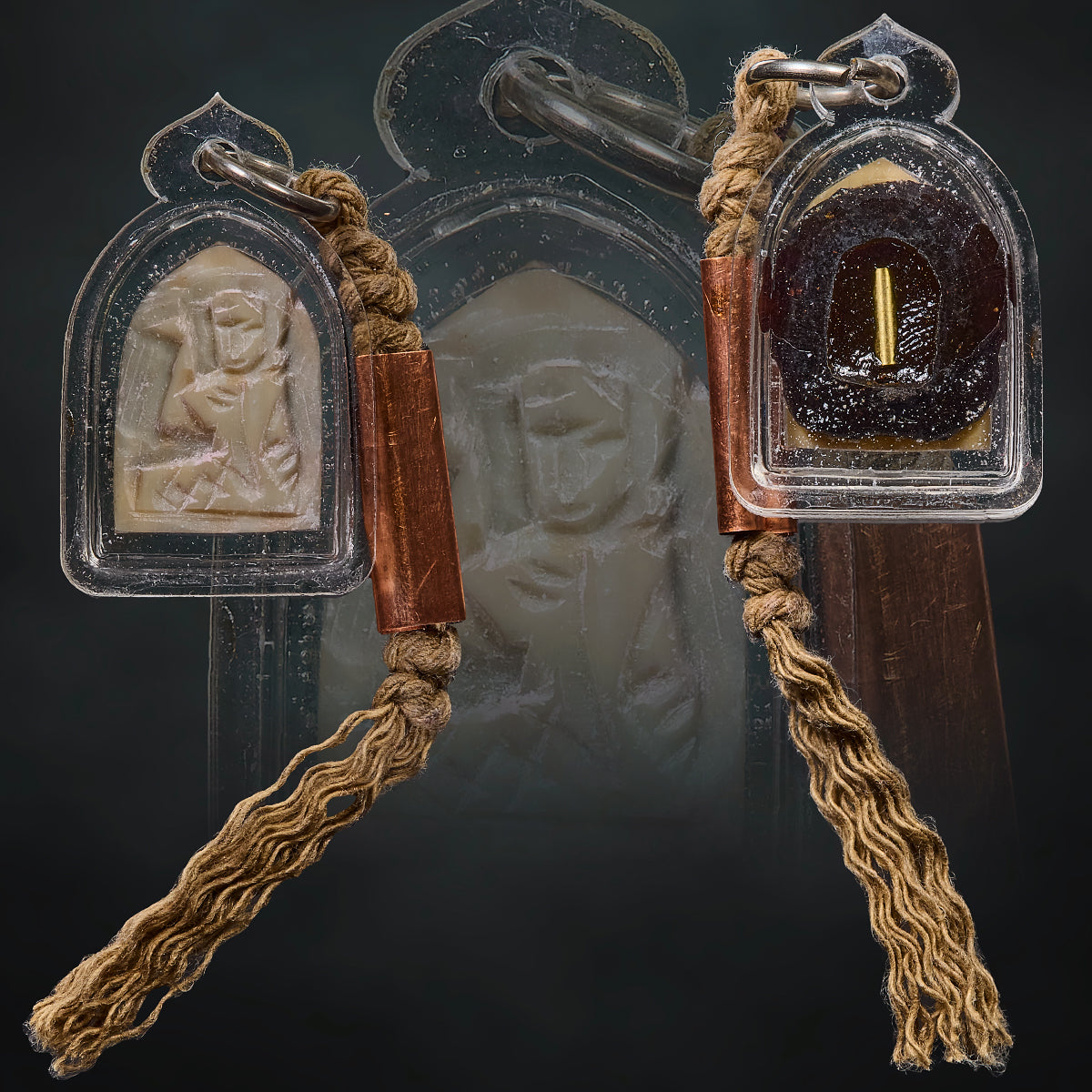
This Nang Kwak Rak Saneh Si Peng is one of Por Sala Tan's more unusual small-format works, combining a traditional Nang Kwak image with Graduk Chang, specialised attraction herbs, sacred wax, Sai Sin and Takrut.
Each artifact was individually assembled from natural Graduk Chang, prepared herbal wax and hand-arranged ritual materials. Differences in carving, wax, Sai Sin, surface and construction are therefore expected and make every surviving example individually distinctive.
The photographs are representative only. A piece will be selected at random, and the item supplied may differ slightly from the exact piece shown in the images.
Personal Experiences Shared by Luksits
One of the pleasures of travelling regularly to northern Thailand to meet Por Sala Tan and those around his lineage was that there always seemed to be something previously unseen.
Even after many visits, unusual pieces would emerge from old collections — sometimes experimental works, sometimes very small batches and sometimes artifacts that had remained with individual luksits for years.
This Nang Kwak was one of those pieces.
According to Ajarn Lek, Por Sala Tan regarded the gradual contact between the prepared Si Peng substance and the owner as an important part of the concept. He compared it to continually strengthening one's saneh: rather than expecting the owner to apply a substance only when required, the piece remained with the person during ordinary daily life.
Some followers reported noticing changes in interpersonal reactions relatively quickly, although others regarded the effect as something that became more apparent with continued carrying.
The experiences most often associated with the piece concerned people becoming warmer, conversations becoming easier, customers responding more positively and the owner attracting greater attention.
Ajarn Lek also explained that the gradual reduction of the prepared wax should not automatically be regarded as damage to the artifact. Within the intended use of the piece, the substance was prepared to interact gradually with the wearer.
Summary
The Nang Kwak Rak Saneh Si Peng B.E. 2550 represents Por Sala Tan's distinctive approach to an otherwise familiar Thai prosperity image.
At its centre is a small Graduk Chang Nang Kwak, accompanied by a preparation of Wahn Ka Kar Long root and Saneh Si Peng, together with Takrut and Sai Sin.
The significance of the piece lies particularly in its method of construction. The herbal preparation was deliberately placed at the reverse rather than supplied separately, making the attraction substance an integral part of the amulet itself.
Its principal traditional qualities concern saneh, Metta Maha Niyom, customer attraction, popularity, commercial opportunity and harmonious interaction with others.
Historical Background
Nang Kwak is among Thailand's most recognisable figures associated with commerce and prosperity.
She is commonly represented as a seated woman raising one hand in a beckoning gesture. For generations, her image has appeared in shops, restaurants, market stalls and businesses where owners seek favourable customers and steady trade.
The underlying symbolism is simple: to call good people, customers and opportunities towards the owner.
Por Sala Tan's version belongs to a more specialised tradition.
Rather than relying solely upon the established symbolism of Nang Kwak, he combined the image with herbal saneh wicha. This shifted the emphasis from commercial fortune alone towards the broader relationship between attraction, personal presence, goodwill and opportunity.
The result is closer to Por Sala Tan's characteristic Barang work, where physical materials, natural substances and individually prepared wicha were combined according to a particular purpose.
Origins of the Materials
The Nang Kwak itself was made from Graduk Chang, a material traditionally associated with strength, Baramee, stability and the commanding presence of the elephant.
The principal herbal substance was Wahn Ka Kar Long.
According to the history surrounding this batch, the plant grew on a hill behind Por Sala Tan's old grounds in Fang. The location carried particular importance within his lineage because it was associated with an earlier ceremony concerning the liberation of a spiritual being connected with the Naga family.
For this reason, the hill was regarded as more than an ordinary place for gathering herbs.
Masters from outside the area were said to travel north specifically to obtain limited quantities of Ka Kar Long growing there. Por Sala Tan, however, had direct access to the locality and could collect the material when preparing his own work.
The most important portion was the root.
Its naturally paired male and female characteristics were interpreted within traditional herbal wicha as complementary polarity. This made it particularly appropriate for saneh — attraction created through the harmonising of different energies rather than attraction through force.
Ritual
Por Sala Tan concentrated the Ka Kar Long root into a specially prepared Saneh Si Peng substance.
Significantly, this batch was centred upon Ka Kar Long rather than a complicated mixture of many unrelated attraction herbs. The intention was to preserve the particular character of this one plant.
After preparation and consecration, the substance was placed directly behind the Graduk Chang Nang Kwak.
A Takrut was incorporated to direct and stabilise the work, while Sai Sin formed part of the ritual binding.
The reverse was intentionally not treated as a completely isolated chamber. According to Ajarn Lek's explanation of the piece, the small opening allowed the prepared substance to remain in gradual contact with the environment of the wearer.
Over extended periods, the wax-like preparation could therefore soften, diminish or eventually disappear.
Within the lineage explanation, this was considered part of the intended process rather than evidence that the amulet had become incomplete. The physical substance served as a medium through which the saneh preparation accompanied the owner over time.
Blessings and Effects
The principal purpose of this Nang Kwak is Saneh Si Peng.
Saneh in this context concerns attraction, personal magnetism and the ability to draw favourable attention. Metta Maha Niyom complements it by encouraging kindness, goodwill and receptiveness from those encountered in everyday life.
Nang Kwak adds the traditional commercial dimension of calling customers and opportunities.
The piece is therefore particularly associated with saneh, Metta Maha Niyom, popularity, customer attraction, improved social interaction, commercial opportunity and favourable personal relationships.
The male-and-female nature attributed to Ka Kar Long also gives the preparation a balancing quality within the traditional interpretation, making the piece relevant not only to romantic attraction but to interpersonal harmony more generally.
Modern Application
This is particularly suitable for people whose livelihood depends upon being seen, remembered and received favourably.
Shop owners, salespeople, service professionals, agents and those regularly negotiating with customers may naturally appreciate its Nang Kwak and Metta aspects.
Its saneh character also makes it relevant to social and personal relationships, particularly where greater warmth, approachability or attraction is desired.
The piece was designed to be carried close to the owner, whether on the body or kept securely in a pocket or personal bag.
Because the herbal preparation at the reverse forms part of the original construction, an owner should also understand that changes in its appearance over time may reflect the nature of the material itself.
Physical Details
The artifact measures approximately 1 inch.
The front contains a small pale Graduk Chang carving of Nang Kwak, seated in her characteristic posture. The natural colour and texture of the material remain visible beneath the simple carving.
At the reverse is the dark prepared Ka Kar Long and Saneh Si Peng substance, with a small Takrut visible at its centre. Original aged Sai Sin is attached to the casing, together with an additional copper-covered ritual component.
The piece is protected by a clear casing while retaining the deliberately arranged reverse area associated with its original method of use.
Its compact size and relatively simple appearance conceal a surprisingly elaborate construction involving Graduk Chang, herbal wicha, Si Peng, Takrut and ritual Sai Sin.
Recommended Pairing
For business use, this Nang Kwak may be paired with Phra Sivali, creating a complementary combination of customer attraction and livelihood support.
A Phra Somdej provides a different balance, adding Buddhist Baramee and stability to the stronger saneh orientation of the Nang Kwak.
For those already carrying another Por Sala Tan piece, a Lersi is particularly suitable where the intention is to combine attraction with wisdom, direction and disciplined use of opportunities.
The Nang Kwak itself, however, was conceived as a complete compact work. Its Graduk Chang image, Ka Kar Long root preparation, Saneh Si Peng, Takrut and Sai Sin were deliberately brought together to serve one central purpose: to attract people, goodwill and opportunity towards the owner.
-
Free Shipping for Singapore| $15 Worldwide | $100 USA All products