
OOBThaiAmulets
Por Sala Tan
Por Sala Tan
Couldn't load pickup availability
PST06
Bobo Aung
Por Sala Tan
Mainstream Artifact
2 Inches
Sacred Craftsmanship
Each artifact was individually carved and assembled by hand. Natural differences within the old Graduk Chang Graden, together with variations in the sacred mixture, takruts, joss-stick fragments and quartz placement, make every completed piece individually distinctive.
Personal Experiences Shared by Luksits
Among Por Sala Tan's luksits, Bobo Aung is generally approached differently from artifacts centred primarily upon immediate wealth or attraction. The emphasis is often upon guidance, wisdom, perseverance and recognising the correct direction during uncertain periods.
Some luksits describe becoming more deliberate when dealing with difficult decisions. Instead of reacting immediately, they found themselves observing circumstances more carefully, considering advice and waiting until the appropriate opportunity appeared.
Others associate Bobo Aung with learning and the relationship between student and teacher. This is particularly meaningful in this example because the Graduk Chang Graden itself was said to have travelled through a teacher-to-student lineage before eventually reaching Por Sala Tan.
The central rutilated quartz further reinforces this interpretation. Its fine golden threads can symbolically represent light passing through confusion — an appropriate image for a Weizza tradition concerned with knowledge, discipline and the gradual development of understanding.
Summary
This Bobo Aung represents a particularly complete expression of Por Sala Tan's Burmese wicha and his journey through the sacred landscape surrounding Mount Popa.
The main image was carved from old Graduk Chang Graden received from an elderly Burmese Nat practitioner, who explained that the material had previously been passed down from his own teacher. The practitioner described his lineage as being connected with Bobo Aung and spoke of receiving guidance associated with the great Weizza during meditation.
The reverse brings together materials directly associated with Por Sala Tan's Burmese journey: sacred soil, incense powders, ritual powders, red temple joss-stick ends, multiple takruts and rutilated quartz given by the Nat practitioner.
Importantly, the process did not finish when the artifact was physically assembled. The completed piece was subsequently consecrated at Mount Popa with the Nat practitioner and taken for chanting at various temples and holy sites throughout Burma.
It is therefore an artifact built around lineage, place, teacher, material and ritual journey, rather than simply an image of Bobo Aung.
Historical Background
Bobo Aung is one of the most recognised figures within Burmese Weizza tradition.
Weizza refers to accomplished adepts within Burmese Buddhist esoteric traditions who are associated with intensive meditation and specialised bodies of knowledge that may include sacred formulas, alchemy, astrology, healing and protective practices.
Bobo Aung is traditionally associated with the Konbaung-period spiritual world of Burma. Over generations, devotional accounts have attributed extraordinary accomplishments to him, although many miraculous elements belong to religious and folk tradition rather than independently documented biography.
Beyond these legends, Bobo Aung has become an enduring representation of the master who acquires knowledge through discipline and perseverance. His image consequently carries particular meaning for practitioners concerned with learning, meditation, spiritual development and maintaining faith in one's path during periods of difficulty.
Origins of the Materials
The materials of this artifact are unusually important because many are directly connected with Burma and the journey during which the artifact was conceived.
The central Graduk Chang Graden came from the elderly Nat practitioner encountered by Por Sala Tan. According to the provenance accompanying the material, it had been handed down from the practitioner's own teacher before being entrusted to Por Sala Tan.
As Por Sala Tan travelled, he collected soil and incense material from sacred locations, together with the red burnt ends of joss sticks remaining from offerings at Burmese temples. Sacred powders were also obtained and exchanged during encounters with local practitioners.
The rutilated quartz came directly from the Nat practitioner at Mount Popa.
Known in the Thai gem trade as Ploi Mai Thong, or “golden-thread gem”, rutilated quartz contains naturally occurring needle-like inclusions. Within this artifact, these visible golden threads can be interpreted symbolically as clarity, direction and the illumination of knowledge.
The importance of the stone is therefore not merely decorative. Its provenance links the centre of the reverse directly with the Burmese practitioner involved in the artifact's creation.
Ritual
After receiving the Graduk Chang Graden, Por Sala Tan prepared the material according to his wicha and had it carved into the seated form of Bobo Aung.
The reverse was then covered with a sacred mixture incorporating soil, incense material and ritual powders collected during the Burmese journey.
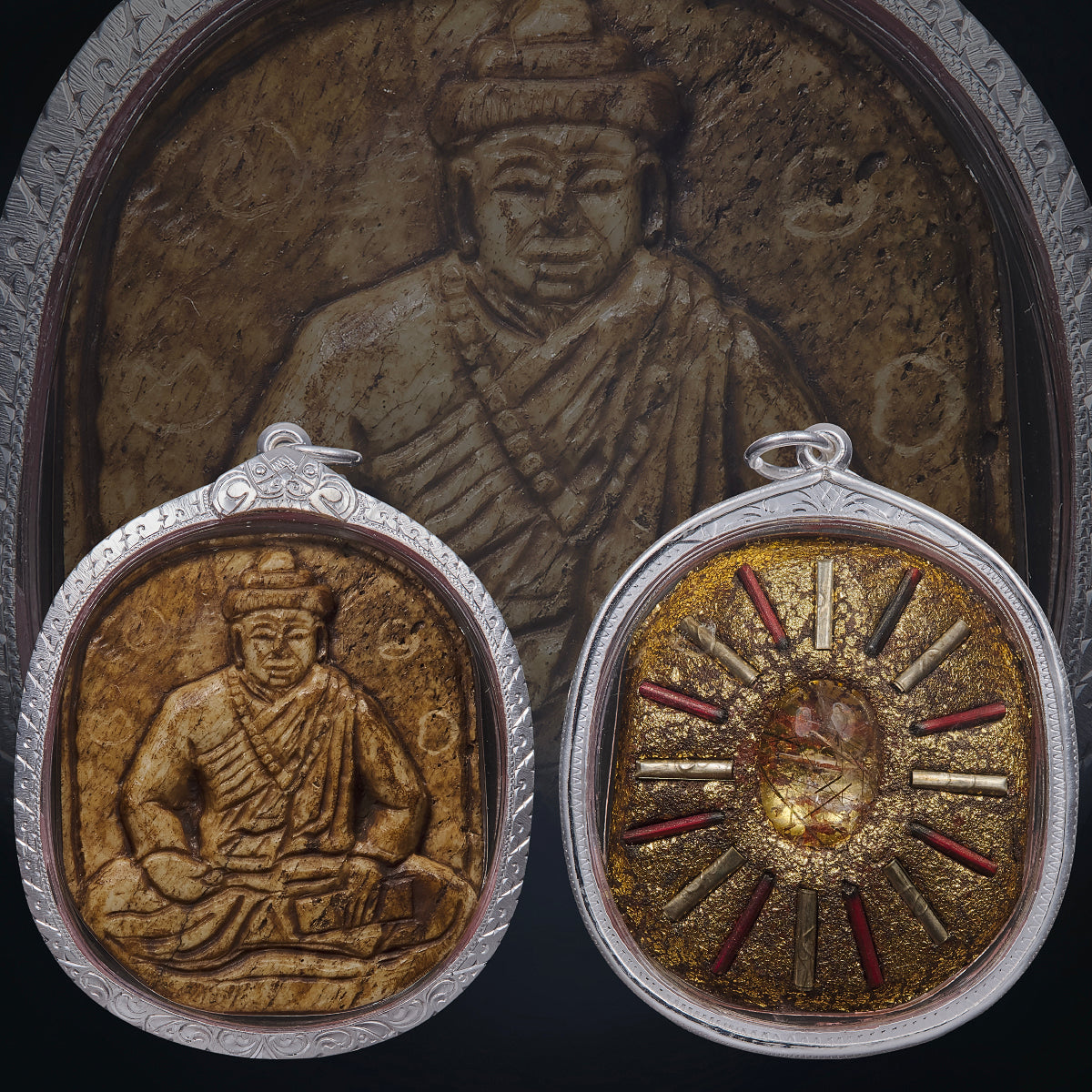
Numerous small takruts were embedded around the reverse together with the distinctive red ends of Burmese temple joss sticks. These were arranged radially around the central stone.
At the heart of the arrangement Por Sala Tan embedded the rutilated quartz given to him by the Nat practitioner.
Once physically completed, the artifact underwent an additional stage of ritual work. Por Sala Tan brought the finished piece to Mount Popa, where it was consecrated together with the Nat practitioner associated with its origin story.
It was subsequently carried through Por Sala Tan's travels and chanted over at various temples and holy sites in Burma, building layers of ritual association around an artifact already composed substantially from Burmese sacred materials.
This final stage is particularly significant: the materials were not merely taken from their places of origin and assembled elsewhere. The completed artifact itself was returned into the Burmese sacred landscape for consecration and chanting.
Blessings and Effects
Bobo Aung artifacts are traditionally associated with wisdom, guidance, perseverance, protection and overcoming difficult circumstances through knowledge and disciplined action.
For those studying or developing a specialised skill, Bobo Aung may represent the importance of finding good teachers and remaining committed long enough for knowledge to mature.
For business owners and professionals, the emphasis can be placed upon clear judgement, recognising opportunities, building credibility and avoiding impulsive decisions.
Traditional devotional qualities commonly associated with such an artifact include Baramee, for respected presence and authority; Panya, for wisdom and judgement; Metta, for goodwill and favourable relationships; and protective qualities when travelling or passing through uncertain circumstances.
The overall character is one of guidance rather than force — developing sufficient clarity to recognise the path ahead and sufficient discipline to follow it.
Modern Application
This Bobo Aung is particularly meaningful for people whose progress depends upon knowledge, patience, judgement and continued learning.
It may suit students, teachers, practitioners, business owners, executives and those developing a specialised profession or craft. It is equally relevant during periods of transition, when several possible directions are available and careful judgement becomes more important than speed.
The story behind the artifact also carries a strong lesson concerning lineage. Knowledge was passed from teacher to student; material was passed from teacher to practitioner; the practitioner then entrusted it to Por Sala Tan, who transformed it into another medium through which that remembrance could continue.
In modern use, the artifact can therefore serve as a reminder to respect one's teachers, continue learning, remain disciplined and seek clarity before making important decisions.
Physical Details
The front depicts Bobo Aung seated cross-legged, individually carved from old Graduk Chang Graden. The figure wears traditional robes crossing the torso, with a distinctive head covering and strongly defined facial features. Natural variations, grain and ageing within the original material remain visible, preserving much of its old handcrafted character.
The reverse is considerably more elaborate. A foundation of sacred soil, incense and ritual powders forms a dark textured field that has been finished with a rich gold-toned surface. Around it, numerous small takruts alternate with red Burmese joss-stick ends, creating a radiating arrangement.
At the centre is a polished piece of rutilated quartz, visibly containing its characteristic internal needle-like inclusions. The quartz forms the focal point of the entire reverse, surrounded by the takruts and temple materials almost like rays extending from a central source.
The complete artifact is protected within a fitted silver casing while allowing both the carved front and complex ritual construction of the reverse to remain visible.
Recommended Pairing
This Bobo Aung pairs naturally with a Lersi artifact where the intention is wisdom, teacher guidance, meditation and development of specialised knowledge.
It can also be paired with one of Por Sala Tan's Nat artifacts, particularly where the collector wishes to preserve the Burmese context of the piece. The combination reflects two related but distinct traditions encountered within the wider Burmese sacred landscape.
Personal Notes
This is one of the most complete Bobo Aung pieces I have encountered from Por Sala Tan, particularly because so many of its important sacred materials are directly connected with the place and circumstances from which the artifact originated.
The Graduk Chang Graden came through a Burmese practitioner and his teacher lineage. The rutilated quartz was given by the Nat practitioner. Sacred soil, incense powders and red joss-stick ends were gathered from temples and holy sites during Por Sala Tan's travels through Burma.
More importantly, the story did not end with the collection of these materials. After the Bobo Aung had been carved and the reverse fully assembled, the completed artifact was consecrated at Mount Popa together with the Nat practitioner and subsequently received chanting at various temples and holy sites throughout Burma.
For me, this makes the piece especially complete: the subject, lineage, principal materials, journey and final consecration all return to the Burmese sacred landscape from which its story began.
-
Free Shipping for Singapore| $15 Worldwide | $60 USA For Items Below $350