
OOBThaiAmulets
Por Sala Tan
Por Sala Tan
Couldn't load pickup availability
PST06
Phra Ngan Ta Prai
Por Sala Tan
Barang Artifact
2.5 inches
Sacred Craftsmanship
Each artifact was individually carved and ritually assembled by hand. Differences in the original relic, carving, painted details, ritual mixture and placement of the embedded materials therefore make every surviving example naturally unique.
Personal Experiences Shared by Luksits
A story associated with this type of Phra Ngan concerned a quiet carpenter who was highly skilled at his craft. His finished work was beautiful, yet he struggled to sell it.
Whenever customers approached, he tended to look down, speak too softly and assume that they would not be interested in what he had made.
An elderly trader eventually gave him a small Phra Ngan carved by Por Sala Tan, explaining that it came from the same family of materials and practices as this piece.
The carpenter asked:
“Will this make people buy my work?”
The trader replied:
“Eyes are not for making people fall under your spell. They are for helping you see the value of your own work.”
He then pointed to the oil and added:
“Oil is not for forcing anyone’s heart. It reminds you to speak gently.”
The carpenter began carrying the artifact. Gradually, he also changed the way he approached his business. He cleaned and arranged his stall more carefully, learned how to explain his carvings, asked customers what they were looking for and thanked those who stopped to view his work.
Over time, his pieces began to sell.
When speaking about the experience later, he did not claim that Phra Ngan had controlled his customers. Instead, he felt that carrying it had helped him become less afraid of being noticed and more confident in presenting the value of his own work.
Summary
Phra Ngan occupies an unusual position within Thai and neighbouring folk-occult traditions. It is commonly associated with Maha Saneh, Metta Maha Niyom, attraction, persuasive communication, trade, opportunity and personal magnetism.
This particular Phra Ngan Ta Prai is one of Por Sala Tan's more strongly constructed examples because its symbolism is supported by the materials themselves.
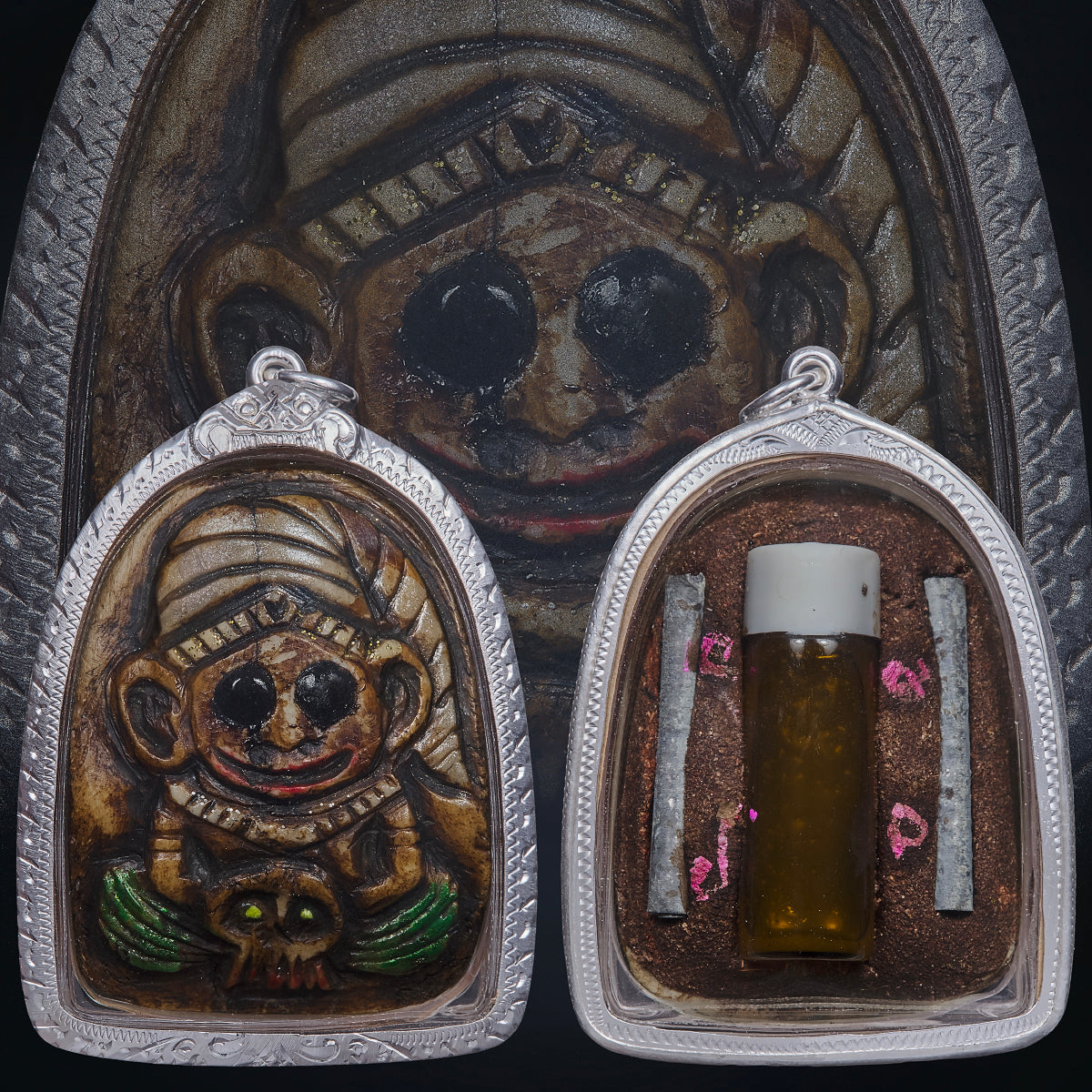
The figure was carved from a hip relic, while the reverse combines cemetery soil, sacred herbs, two takruts and a complete bottle of Nam Man Prai. Its enormous dark eyes further distinguish the carving and give meaning to the designation Ta Prai.
Rather than interpreting attraction simply as romantic charm, Por Sala Tan's Phra Ngan can also be understood through visibility — being noticed, having the confidence to speak, making a favourable impression and recognising opportunities when they appear.
Historical Background
Phra Ngan is a familiar figure within Thai, Khmer and neighbouring folk-talisman traditions, although interpretations differ considerably between individual practitioners and lineages.
Collectors generally associate Phra Ngan with Saneh and Metta, particularly personal attraction, popularity, persuasive speech and relationships. Among merchants, traders and those whose livelihood depends upon dealing directly with people, the same qualities naturally became associated with customers, negotiation and business.
Some traditions also attribute protective and opportunity-related qualities to Phra Ngan.
The figure should therefore not be reduced solely to romantic attraction. Within practical amulet culture, attraction can equally mean being approachable, being remembered, gaining cooperation and having people willing to listen.
The unusually prominent eyes of this example add another symbolic dimension: seeing and being seen.
Origins of the Materials
The principal carving material came to Por Sala Tan through another practitioner.
Among the ritual materials passed to him was a hip relic, which Por Sala Tan subsequently selected for carving into Phra Ngan Ta Prai.
Such transferred materials are significant within practitioner traditions because their provenance forms part of the object's ritual history. Rather than using newly purchased material, Por Sala Tan was working with something that had already passed through another practitioner's keeping before reaching him.
The reverse incorporates further materials associated with his Prai practice, particularly cemetery soil and selected sacred herbs.
At its centre is the small bottle of Nam Man Prai.
Nam Man Prai literally translates as “Prai oil” or “spirit oil.” Within Thai folk-occult traditions, the term covers oils prepared or employed within Prai-oriented practices, particularly those concerned with Saneh, attraction and Metta. Accounts of its exact ingredients and preparation vary considerably between lineages and should therefore be understood according to the individual practitioner's tradition.
Ritual
After the hip relic had been carved into the Phra Ngan figure, Por Sala Tan prepared the artifact according to its intended Saneh and Metta character.
The reverse was packed with cemetery soil mixed with sacred herbs. Two takruts were positioned vertically, forming a balanced arrangement around the central bottle.
The bottle of Nam Man Prai was then incorporated directly into the reverse. This is an important feature because the oil remains physically present as a separate ritual component rather than disappearing into the surrounding mixture.
The finished construction brings together three layers: the relic body, the Prai-oriented materials, and the written wicha contained within the takruts.
Blessings and Effects
Traditionally, the strongest emphasis of Phra Ngan Ta Prai is Maha Saneh — personal attraction and magnetism — together with Metta Maha Niyom, or favourable reception from those one encounters.
For someone involved in sales or business, these qualities translate naturally into customer relations, persuasive but pleasant communication, negotiation and being remembered after a meeting.
The artifact is therefore traditionally associated with Maha Saneh, Metta Maha Niyom, opposite attraction, popularity, persuasive speech, trade, opportunity and protection.
The Ta Prai imagery also lends itself to another interpretation: greater awareness of people and opportunities. In this sense, the eyes represent not only attracting attention but recognising when an opening has appeared.
Modern Application
Phra Ngan Ta Prai is particularly relevant to people whose progress depends upon interpersonal confidence.
Salespeople, traders, business owners, service professionals and those regularly meeting new clients may interpret its Metta and Saneh qualities as encouragement towards better communication, stronger presentation and a more approachable presence.
Its lesson is well captured by the carpenter's story. An artifact may become a source of confidence, but the holder still has to speak, present his work, recognise opportunities and treat people properly.
For relationships, the same principle applies. Metta and Saneh are best understood as encouraging warmth, confidence and mutual attraction rather than attempting to override another person's choice.
Physical Details
The front depicts Phra Ngan Ta Prai seated beneath an elaborate headdress, hand-carved directly from the selected hip relic. Two exceptionally large dark eyes dominate the face, accompanied by a broad red-painted mouth and traces of gold decoration. Green detailing survives around the smaller figure or motif beneath Phra Ngan, giving the piece a particularly individual folk-art character.
The reverse is completely different in construction. A dark reddish-brown mixture of cemetery soil and sacred herbsforms the base. Two long metal takruts are embedded vertically on either side, while a sealed glass bottle of golden-brown Nam Man Prai occupies the centre. Small ritual markings remain visible around the arrangement.
Together, the front and reverse reveal the two sides of the artifact clearly: the carved Phra Ngan image as its spiritual identity, and the exposed ritual materials as its working foundation.
Recommended Pairing
Because this Phra Ngan already carries a concentrated Saneh and Prai character, it pairs particularly well with an artifact representing Baramee, wisdom or protection.
A Lersi artifact can provide balance through judgment and discipline, while Tao Wessuwan or another guardian-oriented piece may complement it with stronger protective symbolism.
For business use, pairing it with a wealth or Baramee artifact creates a balanced combination of attraction, communication, opportunity and respected presence.
-
Free Shipping for Singapore| $15 Worldwide | $60 USA For Items Below $350