
OOBThaiAmulets
Por Sala Tan
Por Sala Tan
Couldn't load pickup availability
PST05
Palakit Jing Jok
Por Sala Tan
Mainstream artifact
2 inches
Sacred Craftsmanship
Each Palakit by Por Sala Tan was individually carved and prepared by hand from the available sacred material. Natural differences in the relic, carving, ritual markings and herbal preparation therefore make every example unique.
Personal Experiences Shared by Luksits
Among Por Sala Tan's luksits and long-time collectors, his Palakit have always been particularly difficult to obtain. He seldom made them, and when an example became available, collectors familiar with his work were often quick to secure it.
Much of their popularity developed through word of mouth. Users traditionally sought Por Sala Tan's Palakit for metta, attraction, business opportunities and favourable interpersonal response, particularly among those whose livelihood depended upon customers, negotiation and personal connections.
The Jing Jok aspect of this piece adds another layer. Jing Jok wicha has traditionally been associated with attracting attention, creating social response and strengthening personal charm. Combined with the wealth-fetching herbs at the base, this particular Palakit became especially suited to those seeking customers, commercial opportunities and favourable encounters.
The strong following surrounding Por Sala Tan's Palakit helps explain why surviving pieces rarely remain available for long. As with all such accounts, individual experiences are personal testimonies rather than guaranteed outcomes.
Summary
The Palakit Jing Jok combines several traditional forms of attraction wicha within a single handmade artefact.
The Palakit represents generative force, growth, abundance and attraction. Its meaning within traditional Thai folk practice extends beyond romantic attraction; the same principle of fertility can symbolically apply to business, where customers, opportunities and income are desired to increase and multiply.
The Jing Jok contributes metta, saneh and social attraction, while the sacred herbs concealed at the base direct these qualities towards wealth, luck and opportunity.
What distinguishes this example is the story behind its creation. Por Sala Tan did not begin with a predetermined design. The repeated appearance of Jing Jok around the stored relic became the inspiration for what the material would eventually become.
Historical Background
The Palakit is one of the most recognisable forms within traditional Thai folk wicha. Although its physical form carries obvious fertility symbolism, its traditional purpose is considerably broader.
Fertility represents the ability to produce, increase and multiply. Applied to everyday livelihood, these ideas naturally became associated with prosperous trade, growing business, increasing customers and continuing financial circulation.
Palakit were therefore not limited to matters of attraction. They were also carried or kept by merchants and traders seeking prosperity and favourable commercial circumstances.
The Jing Jok, or house gecko, developed its own place within folk belief and occult symbolism. Frequently appearing around homes and places of human activity, it became associated with attraction, awareness, social contact and the drawing of attention.
By combining Jing Jok imagery with the Palakit form, Por Sala Tan brought together two traditions centred upon the principle of drawing favourable conditions towards the owner.
Origins of the Materials
The principal body was carved from an old sacred relic received from a fellow practitioner during Por Sala Tan's travels in northern Thailand.
Por Sala Tan kept the material in his room together with other relics rather than immediately turning it into an artefact. It was during this period that he began noticing Jing Jok repeatedly moving around and across the relics.
This observation eventually determined the form he chose to carve.
The dark material visible towards the base consists of prepared sacred herbs associated with fetching wealth, calling luck and attracting favourable opportunities. These ingredients were incorporated to complement the metta and saneh character of the Jing Jok while directing the finished piece towards livelihood and prosperity.
Sacred markings were additionally applied directly onto the relic, completing the physical preparation before blessing.
Ritual
After selecting the relic, Por Sala Tan carved the Palakit and Jing Jok imagery directly into the material.
The finished carving was then prepared according to his wicha. Sacred markings were applied to the relic, while the wealth-fetching and luck-calling herbal mixture was placed at the base.
The completed artefact was subsequently blessed for the combined qualities of Palakit, Jing Jok, metta, saneh, luck and prosperity.
Its ritual identity therefore comes from the interaction of several elements rather than from the carved form alone. The sacred relic provides the foundation, the Palakit represents productive and attractive force, the Jing Jok strengthens interpersonal attraction, and the herbal preparation directs these qualities towards fortune and opportunity.
Blessings and Effects
The Palakit Jing Jok is traditionally associated first with Metta Maha Niyom and Saneh — encouraging goodwill, attraction and a favourable response from people encountered by the owner.
For business use, its qualities are directed towards Kha Khai, supporting trade and selling, together with the attraction of customers and commercial opportunities. The wealth-fetching herbs further connect the piece with Choke Lap, favourable or unexpected fortune, and the opening of opportunities related to livelihood.
The Jing Jok aspect is particularly relevant where success depends upon people. It represents the ability to attract attention and create favourable interaction, whether with customers, potential clients, business contacts or those in a position to offer assistance.
The traditional principle behind the piece is therefore less about aggressively pursuing an outcome and more about drawing the right people and opportunities closer.
Modern Application
The symbolism of the Palakit Jing Jok remains particularly relevant to people whose income depends upon customers, communication and personal connections.
Business owners may carry it with the intention of attracting trade. Salespeople may use it as a focus before meeting customers or presenting products. Property agents, commission-based professionals and traders may similarly associate its wicha with meeting suitable clients and receiving useful introductions.
Its meaning can also extend beyond direct selling. An unexpected introduction, a returning customer, someone recommending one's services or simply being remembered favourably after a meeting can all represent the type of opportunity traditionally associated with attraction wicha.
The wealth herbs at the base reinforce this practical direction. The purpose is not merely personal charm, but attraction that can develop into productive opportunity.
Physical Details
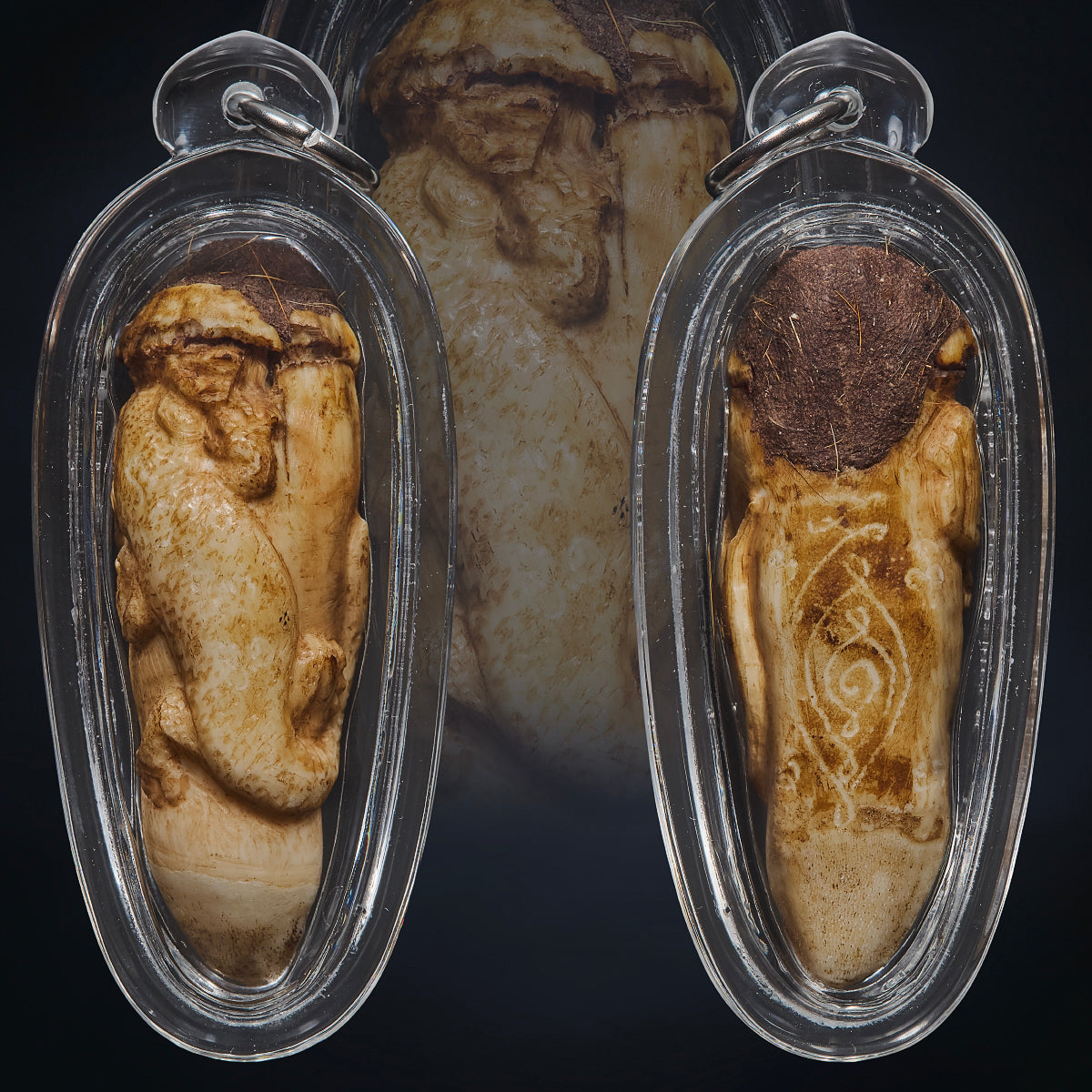
This is an individually carved Palakit Jing Jok by Por Sala Tan, made from an old sacred relic received from a fellow practitioner during his travels in northern Thailand.
The elongated natural form of the relic was retained as part of the Palakit design rather than being heavily reshaped. Jing Jok figures are carved directly along the body, making them an integral part of the artefact rather than separate additions.
On the reverse, sacred ritual markings can still be seen upon the aged surface of the relic. Towards the upper base is a concentrated dark mass of wealth-fetching, luck-calling and sacred herbs, deliberately incorporated into the finished piece.
The natural colouring, irregularities and aged texture of the original relic remain visible throughout. These characteristics, together with the hand carving and individually applied ritual materials, give the piece its distinctive handmade appearance.
The artefact is now housed within a fitted clear protective casing, allowing both the carved Jing Jok and the prepared reverse to remain visible while protecting the original material.
Recommended Pairing
The Palakit Jing Jok already carries a concentrated combination of metta, saneh, commerce and fortune-oriented wicha, making it suitable as a standalone piece.
For those placing greater emphasis upon business, it may be paired with Nang Kwak for customer attraction or Phra Sivali for livelihood and abundance. A Salika piece also complements it naturally where persuasive speech and communication are particularly important.
Personal Notes
Por Sala Tan's Palakit are seldom encountered compared with many of his other artefacts. They were never pieces that appeared continuously, and collectors familiar with his work have traditionally been quick to secure them whenever one surfaced.
Their popularity is particularly interesting because Por Sala Tan did not approach every Palakit as a standard repeated design.
This piece is a good example.
The relic had already been sitting in his room. There was initially no plan to turn it into a Palakit Jing Jok. Only after Por Sala Tan repeatedly noticed Jing Jok moving around and across the material did he decide upon its eventual form.
That small detail gives the artefact much of its character. Rather than selecting the image first and searching for material afterwards, Por Sala Tan allowed what he observed around the relic to influence how he worked with it.
The relic came first. The Jing Jok provided the sign. Por Sala Tan then gave that sign its physical form.
-
Free Shipping for Singapore| $15 Worldwide | $60 USA For Items Below $350