
OOBThaiAmulets
Por Sala Tan
Por Sala Tan
Couldn't load pickup availability
PST05
Yant Suer Mop Son Lep
Por Sala Tan
1.5 inches
Barang Artifact
Sacred Craftsmanship
Each piece was individually prepared from sacred materials and assembled by hand, resulting in natural variations in carving, surface, relic placement and construction that make every example distinct.
Personal Experiences Shared by Luksits
Among practitioners who favour tiger wiccha, the effects are often described less as sudden external events and more as a gradual change in composure, confidence and the way difficult people respond to them.
Some speak of becoming less easily intimidated during arguments or negotiations. Others describe recognising problematic people earlier, responding more calmly to office politics, or becoming more willing to wait before revealing their intentions.
This reflects the character of Suer Mop Son Lep particularly well.
Its philosophy is not to display strength unnecessarily. The tiger remains still, watches carefully and reveals its claws only when circumstances require it.
For businesspeople and those working in competitive environments, this translates naturally into knowing when to speak, when to remain silent, when to negotiate and when to act decisively.
Summary
The Yant Suer Mop Son Lep represents a very different expression of tiger wiccha from aggressive or attacking tiger imagery.
Its name may be understood as the Crouching Tiger Concealing Its Claws — a tiger whose power remains hidden until needed.
At approximately 1.5 inches, this piece was intentionally produced in a compact form suitable for everyday carrying.
The central philosophy is simple:
Power held in reserve.
Watchfulness without fear.
Strength governed by patience.
In Thai understanding, it reflects the quality of “still, but not weak.”
Historical Background
Tiger imagery occupies an important position across Thai yantra, Sak Yant and older occult traditions. The tiger represents survival, authority, courage, command and the ability to defend one's territory.
Not every tiger yantra, however, expresses these qualities in the same manner.
The crouching tiger represents a predator that has deliberately lowered itself and concealed its claws. It may appear passive, yet it remains fully conscious of everything around it.
Older practitioners therefore interpreted this posture as concealed ability. A capable person does not need to continually advertise his strength.
This principle became particularly relevant to people who operated in uncertain environments — traders, travellers, village leaders, businessmen and others who needed both authority and restraint.
Within Northern tiger traditions, strength was frequently associated with one's internal condition. The practitioner was expected to become calmer rather than more reckless: difficult to provoke, difficult to manipulate and capable of responding decisively when circumstances genuinely required it.
Por Sala Tan's Yant Suer Mop Son Lep follows this restrained interpretation of tiger wiccha.
Origins of the Materials
The principal body of this piece was made from Relics of a Chamut, combined with older substances selected for tiger-related wiccha.
Its rear chamber contains Pong Suer, together with Nang Suer, Fang Suer relics and paneang of a Chamut. These materials traditionally belong to the protective and authoritative vocabulary of tiger practice and were incorporated to reinforce vigilance, courage, territorial protection and firmness against hostile influences.
Several Takruts were also embedded into the reverse.
Within Por Sala Tan's preparation, these were important balancing components rather than simple decoration. They helped direct and regulate the stronger tiger materials within the small body of the amulet.
This was particularly relevant because fitting several layers of tiger-lineage material into an approximately one-inch piece required careful preparation. Larger tiger artifacts could accommodate such substances more easily; producing the same concept in miniature was considerably more restrictive.
Ritual
The ritual centred upon the qualities represented by the crouching tiger: vigilance, territorial authority, protection and disciplined response.
Rather than encouraging aggression, the intention was to cultivate steadiness in the presence of hostility — remaining composed when confronted by rivals, jealousy, intimidation or uncertain situations.
The embedded Takruts formed part of this ritual structure, anchoring and harmonising the different tiger-related substances incorporated into the reverse.
The completed pieces were then consecrated together during the dedicated ceremony.
Blessings and Effects
The Yant Suer Mop Son Lep is traditionally associated with Maha Amnaj, protection, courage and the ability to retain authority without unnecessary confrontation.
Its crouching posture adds several distinctive qualities: watchfulness, concealed ability, patience and strategic timing. The tiger does not waste its strength chasing every disturbance; it observes first and responds only when necessary.
It is consequently approached for protection against enemies and rivals, maintaining authority, guarding business and possessions, avoiding danger, strengthening confidence and remaining composed under social or professional pressure.
There is also an element of Metta Maha Niyom. Authority becomes more useful when accompanied by respect and acceptance rather than fear alone, making this form of tiger wiccha relevant to leadership, negotiation and business relationships.
Modern Application
The symbolism translates particularly well into modern professional environments.
For a business owner, it represents protecting one's position without reacting impulsively to every competitor. For someone facing office politics, it encourages observation before response. For negotiators and salespeople, it represents keeping one's full capability concealed until the appropriate moment.
It may therefore appeal particularly to business owners, managers, salespeople, negotiators, transport operators and people working within competitive or politically complicated environments.
Its small size also makes it practical for discreet everyday carry, whether kept close to the body, inside a work bag or together with personal belongings.
The principle remains the same regardless of setting: observe carefully, preserve your strength and act when the timing is right.
Physical Details
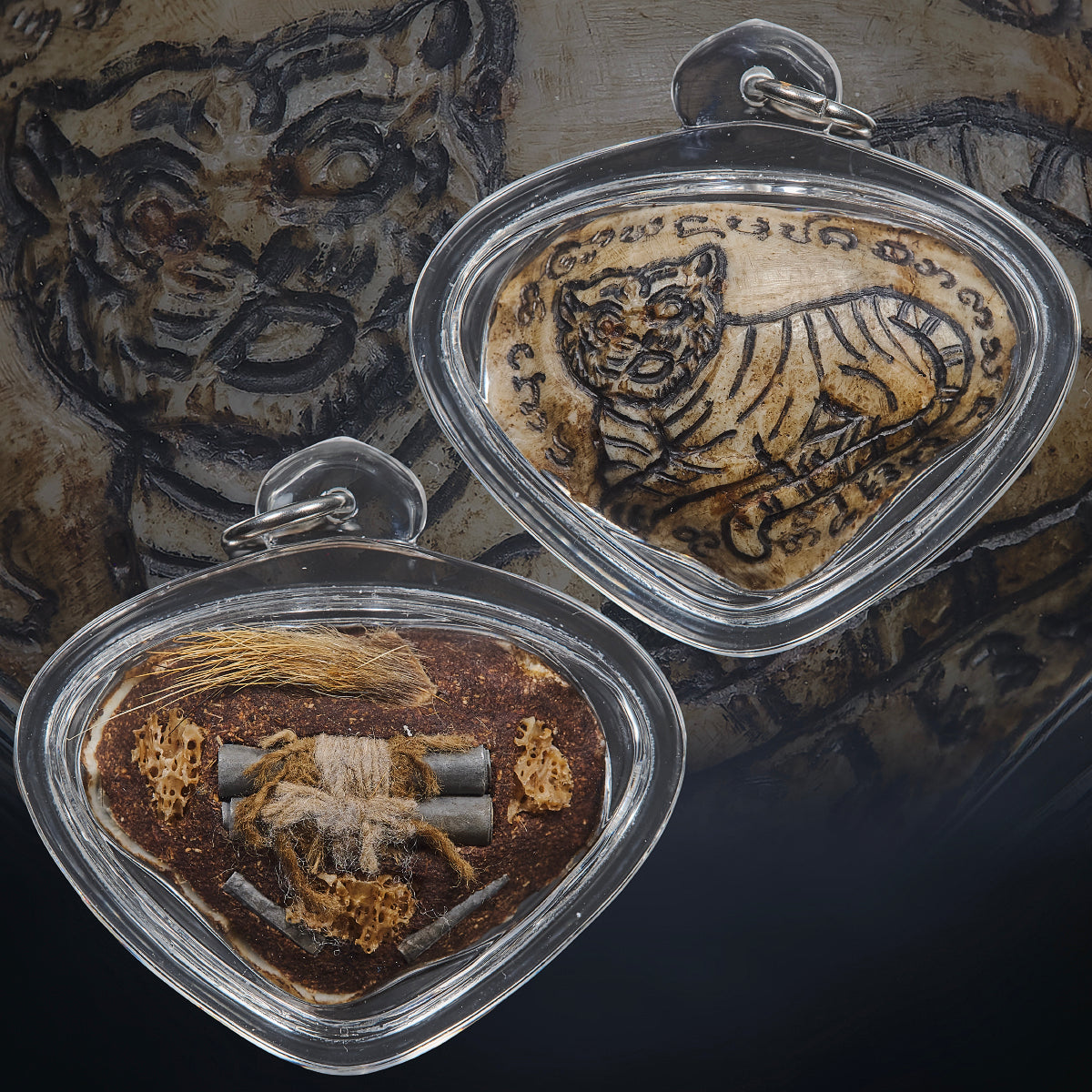
This miniature Yant Suer Mop Son Lep measures approximately 1.5 inches. The front depicts the crouching tiger with its claws concealed, rendered in the traditional style associated with Por Sala Tan's tiger work.
The body is made from Relics of a Chamut, while the reverse contains Pong Suer, Nang Suer relics, Fang Suer relics and Paneang of chamut together with multiple embedded Takruts. The materials are visibly hand-arranged rather than mechanically uniform, giving each example an individual construction and appearance.
The finished artifact is protected within a compact casing suitable for everyday wear or carry. Limited pieces are known from this single ceremony, making it one of Por Sala Tan's much smaller tiger-wiccha productions.
Recommended Pairing
Yant Suer Mop Son Lep pairs naturally with Baramee-oriented amulets such as Somdej or Phra Kring, where the tiger contributes firmness and protective authority while the Buddhist image provides a broader spiritual foundation.
It may also be combined with Rahu or Lersi pieces when the intention is protection, judgment and maintaining composure through complicated situations.
For someone already carrying strong Metta or Saneh amulets, Suer Mop Son Lep provides a useful counterbalance: attraction and approachability on one side, with boundaries, authority and concealed strength on the other.
The character of this piece is perhaps best understood through the tiger itself.
It does not need to show its claws for others to know they are there.
-
Free Shipping for Singapore| $15 Worldwide | $60 USA For Items Below $350