
OOBThaiAmulets
Por Sala Tan
Por Sala Tan
Couldn't load pickup availability
PST05
Yant 9 Pean Din Suriyan Jantri
Por Sala Tan
B.E. 250x
Mainstream Artifact
1.5 inches
Sacred Craftsmanship
Because each example was individually inscribed and prepared by hand, variations in the sacred lettering, geometry, spacing and surface are natural. No two early examples should be expected to appear completely identical.
Personal Experiences Shared by Luksits
During Por Sala Tan's earlier years, this was particularly sought after by luksits who were themselves practising wicha. They regarded it as a means of strengthening personal Baramee so that their practice could develop upon a stronger spiritual foundation.
It was not restricted to practitioners.
According to accounts surrounding these early pieces, lay luksits holding positions of responsibility — including village chiefs, police personnel and military officials — would specifically request the Yant 9 Pean Din from Por Sala Tan.
They associated it with stronger personal presence, authority and the ability to command respect when dealing with people under difficult circumstances. Others carried it more generally for health, prosperity and support in their livelihood.
Among collectors of Por Sala Tan's Barang artifacts, another longstanding use was particularly interesting. Those keeping numerous Yin or spirit-based objects sometimes carried this yantra as a Baramee foundation, believing its strong solar component helped maintain balance while supporting the workings of their other sacred objects.
Summary
The Yant 9 Pean Din Suriyan Jantri represents a different side of Por Sala Tan's work.
Rather than being centred upon a particular Prai, Jinn or spirit, its construction is based upon planetary, solar and lunar wicha.
The front incorporates the 9 Pean Din, interpreted within this lineage through the nine planetary forces and the auspicious symbolism of nine pots of gold. The reverse develops the solar aspect through eclipse-related yantra and Suriyan symbolism.
Together, the composition was intended to establish a strong field of Baramee, authority, prosperity and energetic balance.
Its rarity today comes not simply from age. Por Sala Tan stopped producing this elaborate yantra around B.E. 2515, making surviving examples characteristic of his early period.
Historical Background
Planetary yantra occupy an important place within older Southeast Asian astrological and magical traditions. The movements of the Sun, Moon and planets were regarded as more than methods of measuring time; particular celestial configurations were considered suitable moments for performing specific rites.
Por Sala Tan's Yant 9 Pean Din Suriyan Jantri brings several of these ideas into one composition.
At its centre is the concept of the nine planetary influences. Around this foundation are additional lunar and solar formations, creating a yantra intended to draw upon both sides of the celestial cycle.
The piece therefore could not simply be written and blessed on a single convenient day.
Its preparation followed the movement of the heavens themselves.
Origins of the Materials
The yantra is made from lead, a traditional material well suited to hand inscription. Its relatively soft surface allowed Por Sala Tan to cut extremely fine aksorn and geometric lines directly into the metal.
For this particular wicha, however, the importance lies less in rarity of material than in what was placed upon it.
The lead functions as the physical field upon which the planetary structure was established. The front and reverse were treated as complementary surfaces, allowing lunar, planetary and solar elements to operate within a single object.
This surviving example retains the characteristic aged grey surface of old lead, with the hand-worked lines remaining visible across both faces.
Ritual
The consecration of the Yant 9 Pean Din Suriyan Jantri reportedly extended for more than one year.
Por Sala Tan worked with different solar and lunar events, returning to the yantra at appropriate periods rather than completing its empowerment through one ceremony.
The purpose was to progressively establish the various celestial forces represented within the design.
The Jantri — lunar — component was associated particularly with attraction, Saneh and secondary channels of fortune.
The Suriyan — solar — component represented Baramee, strength, authority and an enduring outward current.
Eclipse-related periods were incorporated into the ritual sequence as well. Only after the necessary stages had been completed was the working regarded as properly sealed.
This lengthy process helps explain why these pieces were never produced casually or in large quantities.
Blessings and Effects
The principal quality of the Yant 9 Pean Din is Baramee — the strengthening of personal presence, standing and spiritual authority.
The nine planetary arrangement is traditionally connected with prosperity and the symbolism of the nine pots of gold, while the lunar aspect introduces Metta, Saneh, attraction and opportunities for additional income.
The solar side contributes a different character: authority, strength, confidence, leadership and the ability to sustain one's position.
Traditional applications therefore encompass Baramee, health, wealth, authority, prosperity, Metta-Saneh and support for spiritual practice.
For practitioners, its purpose extends further. A stronger Baramee foundation was regarded as beneficial when undertaking wicha or maintaining other empowered objects.
Modern Application
For contemporary collectors, the Yant 9 Pean Din remains particularly appropriate for people carrying significant responsibility.
Business owners, managers, senior professionals and those whose occupations depend upon leadership may appreciate its traditional emphasis upon Baramee and authority. Its wealth and lunar components also make it relevant to commerce, networking and circumstances where favourable relationships matter.
It is equally interesting for collectors maintaining several Prai, Jinn or other Yin-oriented artifacts. Within Por Sala Tan's tradition, the strong Suriyan current was used as a balancing Baramee force, allowing the keeper to maintain a stronger personal foundation alongside spirit-based pieces.
Rather than functioning solely as another attraction or wealth amulet, it can therefore be understood as a foundation piece within a larger collection.
Physical Details
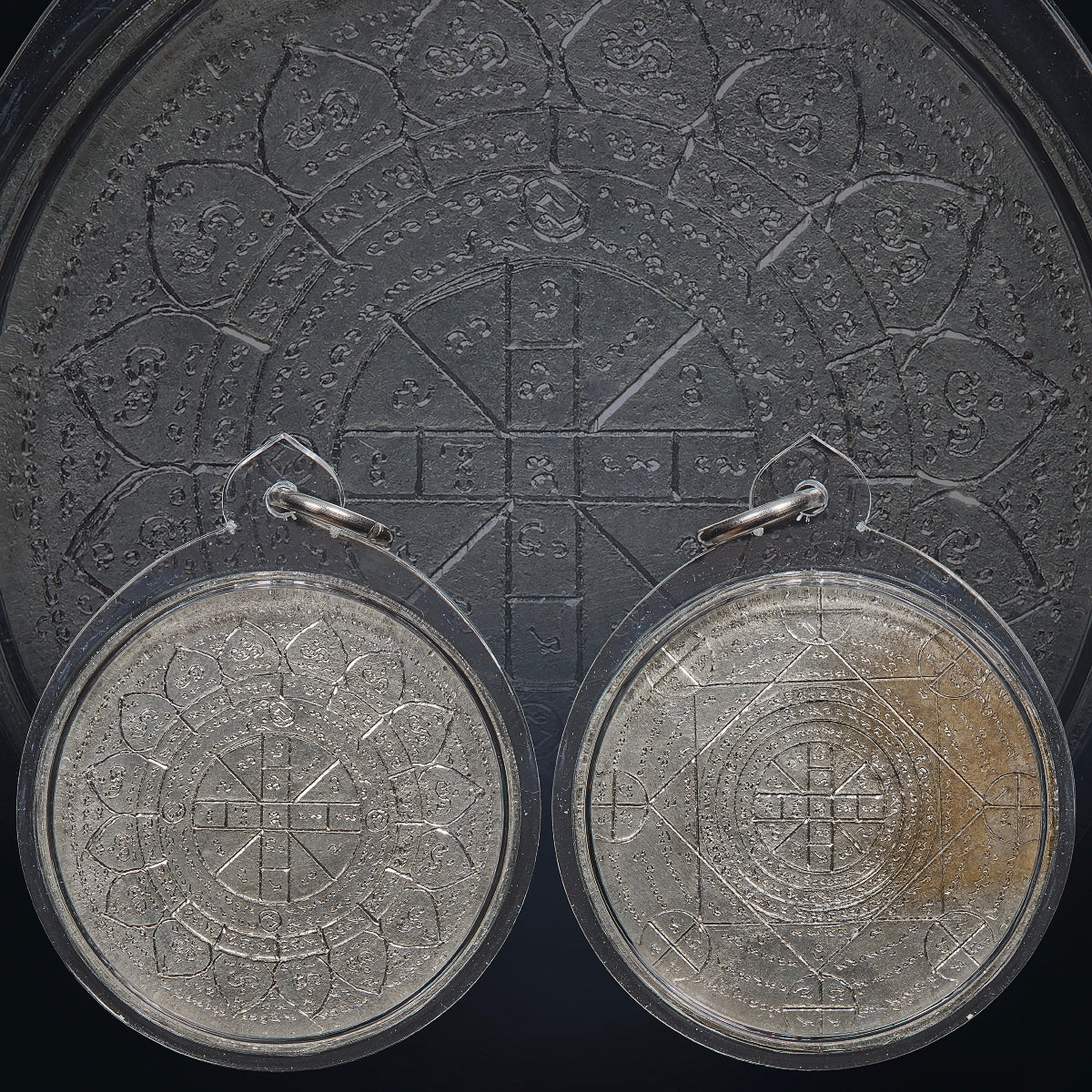
This is a circular lead yantra measuring approximately 1.5 inches, now preserved within a clear protective casing. Both faces are densely covered with fine hand-inscribed sacred geometry and aksorn, demonstrating the degree of precision required for this early design.
The front is dominated by the 9 Pean Din planetary arrangement. Eight surrounding formations encircle the larger central planetary structure, traditionally identified with Jupiter, while additional lunar yantra occupy the composition beyond the principal circle.
The reverse continues with a different geometric arrangement centred upon the solar system of the wicha. Eclipse-related yantra are positioned within the composition, surrounded by further sacred writing and the larger Suriyan structure. Ageing of the lead has produced subtle differences in tone between the two surfaces, while the fine inscriptions remain remarkably visible.
Recommended Pairing
This is one of Por Sala Tan's pieces that requires very little pairing because its construction already combines several complementary currents.
For someone carrying Prai or other Yin-based artifacts, however, the Yant 9 Pean Din is especially appropriate as a Baramee and Suriyan foundation. The intention is not to overpower the other artifact, but to strengthen the keeper's own standing while maintaining balance within the collection.
It can likewise accompany a Buddhist amulet or Lersi piece when greater emphasis upon discipline, authority and personal Baramee is desired.
Personal Notes
What interests me most about this Yant 9 Pean Din is that it shows Por Sala Tan's earlier technical ability as a yantra practitioner, rather than the spirit-based artifacts for which many collectors know him today.
Looking closely at the piece, the amount of writing is remarkable. The circles, individual planetary compartments, central geometry and extremely small aksorn had to be arranged within a lead disc only around 1.5 inches across.
This also explains why Por Sala Tan eventually stopped making it. According to the history passed down with these pieces, he produced this yantra only until around B.E. 2515, as the proportions demanded eyesight and precision that became increasingly difficult to maintain.
The year-long consecration is equally significant. This was not simply a yantra written one afternoon and blessed immediately afterwards. Its wicha depended upon different lunar, solar and eclipse periods, meaning completion followed the appropriate celestial occasions.
For collectors of Por Sala Tan, I regard the Yant 9 Pean Din Suriyan Jantri as an important early piece — particularly for understanding the depth of his planetary and Baramee wicha before many of his later Barang artifacts became better known.
-
Free Shipping for Singapore| $15 Worldwide | $60 USA For Items Below $350