
OOBThaiAmulets
Por Sala Tan
Por Sala Tan
Couldn't load pickup availability
PST05
Mae Yoni
Por Sala Tan
Barang Artifact
2 inches
Sacred Craftsmanship
Each artifact was individually assembled and prepared by hand. Differences in the drawn image, relic, alloy surface, sacred soil and embedded materials are therefore part of the character of each piece.
Personal Experiences Shared by Luksits
Collectors who have carried Por Sala Tan’s wish-granting artifacts often speak positively of their experiences, particularly when asking for assistance with a realistic objective they are already actively pursuing.
One account concerns a local man who wanted to secure a good job opportunity.
He made a wish to the artifact, asking for assistance in opening the right opportunity and allowing the process to move favourably. At the same time, he continued putting in his own effort. He actively pursued suitable positions and prepared carefully for the interview rather than simply waiting for something to happen.
Eventually, an opportunity opened and he managed to secure an interview. He subsequently performed well and obtained the job he had hoped for.
He associated the favourable outcome with assistance from the wish-granting spirit, but his experience also reflected an important principle Por Sala Tan taught regarding such artifacts: the wish and the keeper’s own effort must work together.
The spirit may help circumstances move, bring an opportunity closer or allow the right people to cross the keeper’s path. The keeper must still recognise that opportunity and act upon it.
Other keepers associate Mae Yoni particularly with Metta, Maha Saneh, favourable attraction and people becoming more receptive towards them.
Summary
Mae Yoni is a rare Por Sala Tan artifact centred upon a female spirit he encountered inside a cave while searching for sacred herbs and plants near the northern border.
The spirit was said to have originated from Burma and to have passed away inside the cave decades earlier. Her presence remained there because her remains had never left the place.
After communicating with her during trance meditation, Por Sala Tan performed rites intended to help her move beyond her attachment to the cave. According to the account, she subsequently permitted part of her relic to become a vessel through which she could assist others and accumulate merit.
The resulting Mae Yoni combines a relic medium, Por Sala Tan’s hand-drawn representation of the spirit, old Thai-Burmese ritual metals, cave soil, Nur Din and takruts.
Its traditional emphasis is wish granting, Metta, Maha Saneh, favourable attraction and the opening of opportunities.
Historical Background
The origin of this Mae Yoni began during one of Por Sala Tan’s journeys into the northern border regions in search of unusual sacred herbs and naturally occurring ritual materials.
During the journey, he came across a cave and felt a persistent urge to enter.
Once inside, he sensed what he described as a particularly strong presence. Por Sala Tan settled into meditation and gradually entered a trance state.
Within that state, he perceived the figure of a woman.
Through their communication, Por Sala Tan understood that she had originally come from Burma and had died within the cave many decades earlier. Her remains were still there, and her spirit had continued lingering around the place.
Rather than immediately taking material from the site, Por Sala Tan first performed rites for the spirit. The purpose was to help release her attachment and allow her circumstances to change.
According to the tradition preserved with the artifact, the Mae spirit agreed that part of her relic could subsequently be used as a medium through which she could assist devotees, receive dedication of merit and continue progressing spiritually.
This encounter became the origin of Mae Yoni.
Origins of the Materials
The most significant material is the relic associated with the Mae spirit herself.
Por Sala Tan used this as the central medium and, relying upon what he remembered from the trance encounter, drew the appearance of the woman directly onto its surface.
The surrounding metal was specially prepared from an old mixed-metal alloy. Materials reportedly included fragments from old bells, alms bowls and aged sacred statues, with metals sourced from both Thailand and Burma.
Many of the old Burmese images were predominantly copper-based, contributing to the distinctive warm copper tone visible around the central relic.
Por Sala Tan intentionally incorporated Burmese materials because of the spirit’s Burmese origin. To strengthen this geographical connection further, soil from the cave and the Burma border region was collected and incorporated into his own sacred mixture.
The reverse was subsequently prepared with Nur Din and embedded takruts.
Ritual
This Mae Yoni belongs to Por Sala Tan’s spirit-medium tradition, where the physical artifact is prepared only after communication and ritual agreement with the associated presence.
The important stage occurred inside the cave itself, where Por Sala Tan entered trance and perceived the Mae spirit.
After performing rites intended to release her attachment to the location, he prepared the relic as a medium rather than simply treating it as an ordinary ingredient.
The old metals were melted and combined to create the surrounding alloy. Metta See Peng, sacred soil and Por Sala Tan’s own prepared materials were incorporated according to the intended wicha.
The back was completed with Nur Din and several takruts before the artifact underwent its final ritual preparation.
In this form, Mae Yoni became both a representation of the woman Por Sala Tan encountered and a physical medium associated with her continuing merit-making.
Blessings and Effects
Mae Yoni is principally associated with Metta, Maha Saneh, wish granting and favourable attraction.
Its traditional qualities include:
- greater receptiveness and goodwill from others;
- personal attraction and social charisma;
- favourable responses during meetings or negotiations;
- opening opportunities in employment and business;
- assistance in bringing suitable people into one’s path;
- support when pursuing a realistic personal wish.
The wish-granting aspect should not be understood as passive fortune. Within Por Sala Tan’s practice, assistance creates the strongest conditions when the keeper is already making an effort towards the same objective.
In this sense, Mae Yoni is traditionally regarded as helping to open the road rather than walk it for the keeper.
Modern Application
Mae Yoni is particularly relevant to situations where success depends upon people, timing and opportunity.
For business owners and salespeople, its Metta and Maha Saneh qualities are traditionally sought for customer receptiveness, smoother conversation and stronger interpersonal connection.
For employment, it may be approached when seeking interviews, promotions, new positions or assistance from people capable of opening a useful door.
Its attraction aspect also extends to social and relationship matters, where the emphasis is upon becoming more noticeable, approachable and favourably received.
For wish-making, the intention should be clear and realistic, followed by practical action towards achieving it.
Physical Details
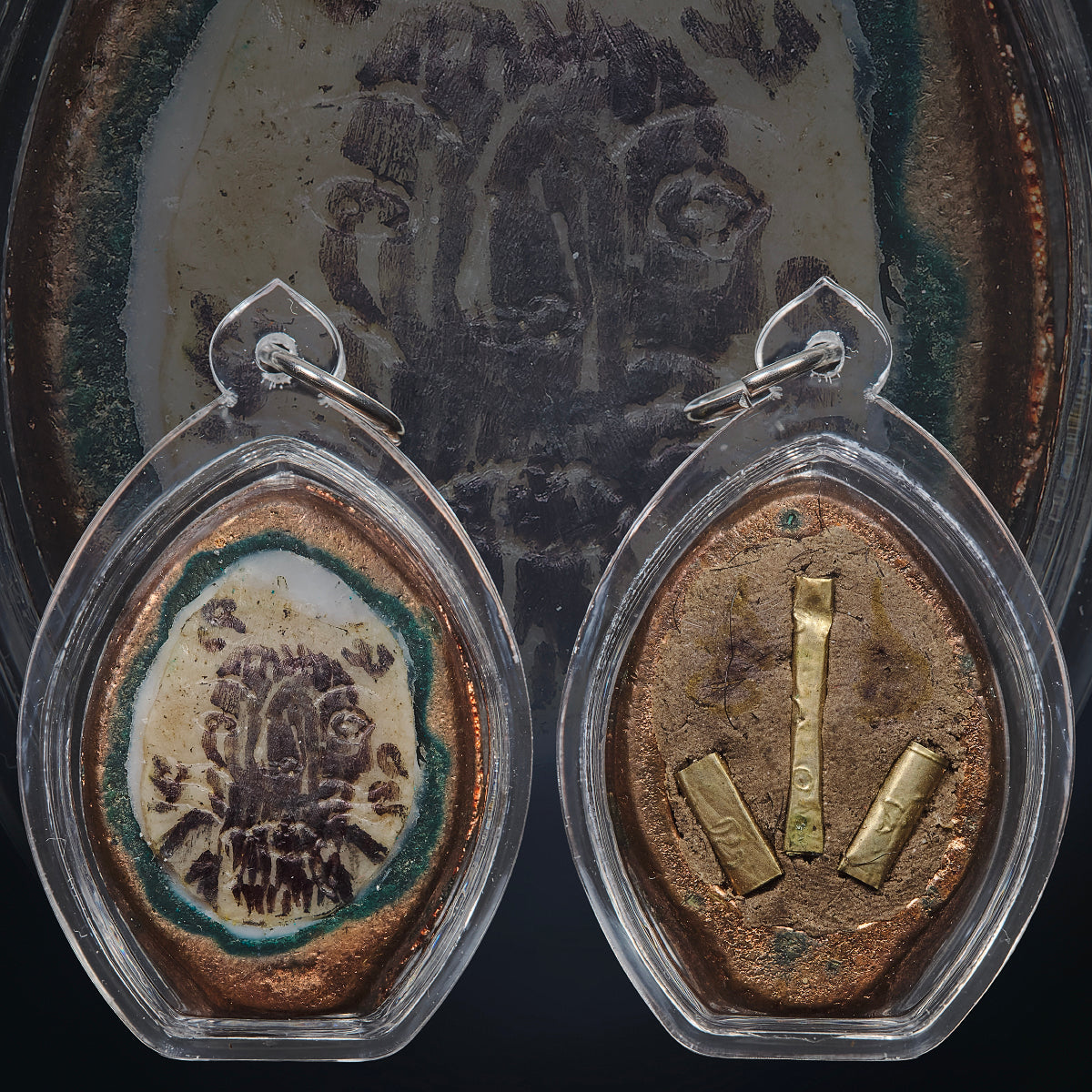
The artifact has an oval form with a warm copper-toned mixed-metal surround. At the centre is the pale relic medium upon which Por Sala Tan hand-drew the female figure he remembered seeing during trance, surrounded by additional handwritten sacred markings. Traces of green and darker ritual material remain around the central section, while the surrounding alloy retains the irregular surface expected from its mixture of older metals.
The reverse is substantially different in character. It is covered with the prepared Nur Din and sacred soil mixture, creating an earthy brown surface into which three metal takruts have been embedded. The central takrut is longer, flanked by two shorter scrolls.
The handmade construction is especially evident in this piece: the drawing, metal surface, soil mixture and placement of the takruts were individually prepared rather than produced as a uniform factory-made object.
Recommended Pairing
Mae Yoni may be carried alone when the principal intention concerns Metta, Saneh, relationships, employment or wish granting.
For business and commercial use, it may be paired with Nang Kwak to place greater emphasis upon customers and trade.
For career advancement or dealings with senior people, pairing with a respected monk or Buddha-form amulet can provide a complementary emphasis upon baramee, stability and clear judgement.
Personal Notes
What makes this Mae Yoni particularly interesting to me is that its image is not simply a generic representation of a female spirit.
According to its history, Por Sala Tan actually went into trance and saw the Mae spirit inside the cave. The woman depicted on the front was subsequently drawn according to what remained in his memory from that encounter.
The choice of materials was equally deliberate. Because the spirit was understood to have come from Burma, Por Sala Tan incorporated old Burmese metals and material from the border region rather than relying entirely upon his usual mixture.
This creates a close relationship between the spirit, her place of origin, the cave relic, the drawing and the physical materials of the artifact.
For me, that is what distinguishes this piece. It preserves the story of a specific encounter rather than simply representing the broader concept of Mae Yoni, and the hand-drawn image gives the artifact a particularly personal connection to Por Sala Tan’s original trance experience.
-
Free Shipping for Singapore| $15 Worldwide | $60 USA For Items Below $350