
OOBThaiAmulets
Por Sala Tan
Por Sala Tan
Couldn't load pickup availability
PST05
Ngan Naman Dum
Por Sala Tan
B.E 2510 (1967)
Barang Artifact
Sacred Craftsmanship
Each artifact was individually formed and ritually worked by hand. Natural differences in the old materials, black oil compound, surface texture, gold-leaf application, bindings and embedded components therefore make every surviving example unique.
Summary
The Ngan Naman Dum is a Barang artifact prepared by Por Sala Tan in B.E. 2510 following an unusual incident at an abandoned temple in Fang.
A group of forest monks intended to restore the temple so that they could reside there and serve the surrounding community. During the cleaning process, however, they repeatedly encountered a mysterious black oil appearing across the floor.
The senior monk also perceived small unidentified beings during meditation.
When Por Sala Tan was called to investigate, he identified them as Mini Ngans remaining from the practices of an earlier master who had once used the abandoned temple for Barang ceremonies.
Por Sala Tan subsequently prepared a specialised compound and used it to contain the Mini Ngans individually.
A total of 99 pieces were created.
The name Ngan Naman Dum directly reflects one of the most distinctive materials associated with the event: the black oil — Naman Dum — gathered from the temple itself.
Historical Background
The temple had already been abandoned for some time when a group of forest monks decided to restore it.
Their intention was practical and community-minded. Once repaired, the old temple could again provide accommodation for monks while becoming a functioning religious centre for nearby villagers.
Cleaning the grounds initially proceeded normally.
One room, however, presented a recurring problem.
A dark oily substance repeatedly appeared upon the floor. The monks would clean it away, only to discover that it had returned.
During meditation, the lead monk subsequently perceived small mysterious forms within the same area.
The monks initially considered whether lingering spirits might be responsible. Rites were therefore performed to release spiritual presences associated with the abandoned site.
The activity nevertheless continued.
Unable to identify the phenomenon through their own practice, the monks sought assistance from Por Sala Tan, whose experience included forms of wiccha outside the monks' own tradition.
Origins of the Materials
Black Oil — Naman Dum
The defining material was the black oily substance collected from the floor of the abandoned temple.
According to the account, Por Sala Tan recognised its connection with the Mini Ngans and incorporated it directly into the compound prepared for the ritual.
Rather than discarding the substance, he therefore transformed the material associated with the disturbance into part of the vessel used to contain it.
Coffin Wood from Nine Children's Coffins
Material from nine children's coffins formed another component of the preparation.
Within this particular Barang construction, the coffin material belonged to the death-associated ingredients used to create a sufficiently receptive ritual medium.
Soil from Seven Cemeteries
Por Sala Tan also gathered soil associated with seven cemeteries.
The use of multiple cemetery sources created another layer within the compound, connecting the finished material with the traditional death-ground aspect of the wiccha.
Yoni Seeds from Seven Mae
The preparation further incorporated Yoni seeds associated with seven female spirits, referred to as Mae within the account.
These formed part of the specialised material formula Por Sala Tan used when preparing the vessels for the Mini Ngans.
Black Sesame
Black sesame seeds completed another component of the mixture.
Together, these materials were combined with the Naman Dum collected from the temple, producing the dark ritual substance from which the individual pieces were prepared.
Ritual
Por Sala Tan's first task was to determine what remained within the abandoned temple.
According to the lineage account, he concluded that the small presences were not ordinary wandering spirits. Instead, they were Mini Ngans connected with an earlier practitioner who had once conducted Barang ceremonies at the site.
The former practitioner was remembered as someone who frequently consumed alcohol and did not always complete his ritual work properly.
Por Sala Tan observed that the Mini Ngans had previously been regularly fed rice wine. With the temple abandoned and their former ritual cycle discontinued, they were described as moving through the room in search of the offerings to which they had become accustomed.
Por Sala Tan therefore prepared the compound of coffin wood, cemetery soil, Yoni seeds, black sesame and the black temple oil.
Using this material as the ritual medium, he worked with the Mini Ngans one by one, incorporating each into an individual Ngan.
The process continued until 99 Mini Ngans had been prepared.
Rather than being a conventional mass-produced batch followed by a collective blessing, the traditional account therefore describes the 99 pieces as the direct result of the temple-clearing ritual itself.
Blessings and Effects
Within Por Sala Tan's Barang tradition, Ngan is principally associated with Metta, Saneh, opportunity, communication and assistance in worldly affairs.
The Ngan Naman Dum has a distinctly different background from ordinary attraction pieces because its origin is tied to the Mini Ngans encountered at the abandoned temple.
Traditional applications associated with such a piece include:
- Metta Maha Niyom — favourable reception and goodwill.
- Maha Saneh — personal attraction and magnetism.
- Chok Lap — unexpected opportunities and fortunate openings.
- Business Assistance — supporting trade, customers and livelihood.
- Opportunity — helping circumstances develop where previously there was little movement.
- Communication — supporting smoother interaction with other people.
- Awareness — traditionally associated with greater sensitivity towards circumstances and surroundings.
Its Barang character makes it very different in orientation from a conventional Buddha-form amulet. It belongs specifically to Por Sala Tan's spirit-associated folk-wiccha practice.
Modern Application
For modern keepers, Ngan Naman Dum is best understood as a specialised Barang artifact with strong historical provenance, rather than simply another wealth or attraction amulet.
Its traditional qualities translate most naturally into occupations involving people, opportunity and commercial interaction — particularly sales, trading, negotiation and independent business.
Collectors may value it for another reason altogether.
With only 99 examples reportedly prepared, its significance lies heavily in the unusual circumstances of its creation. The batch preserves a specific episode involving an abandoned temple, forest monks, an earlier Barang practitioner and Por Sala Tan's intervention.
It is therefore both a functional artifact within its tradition and a record of an unusual episode in Por Sala Tan's early wiccha.
Physical Details
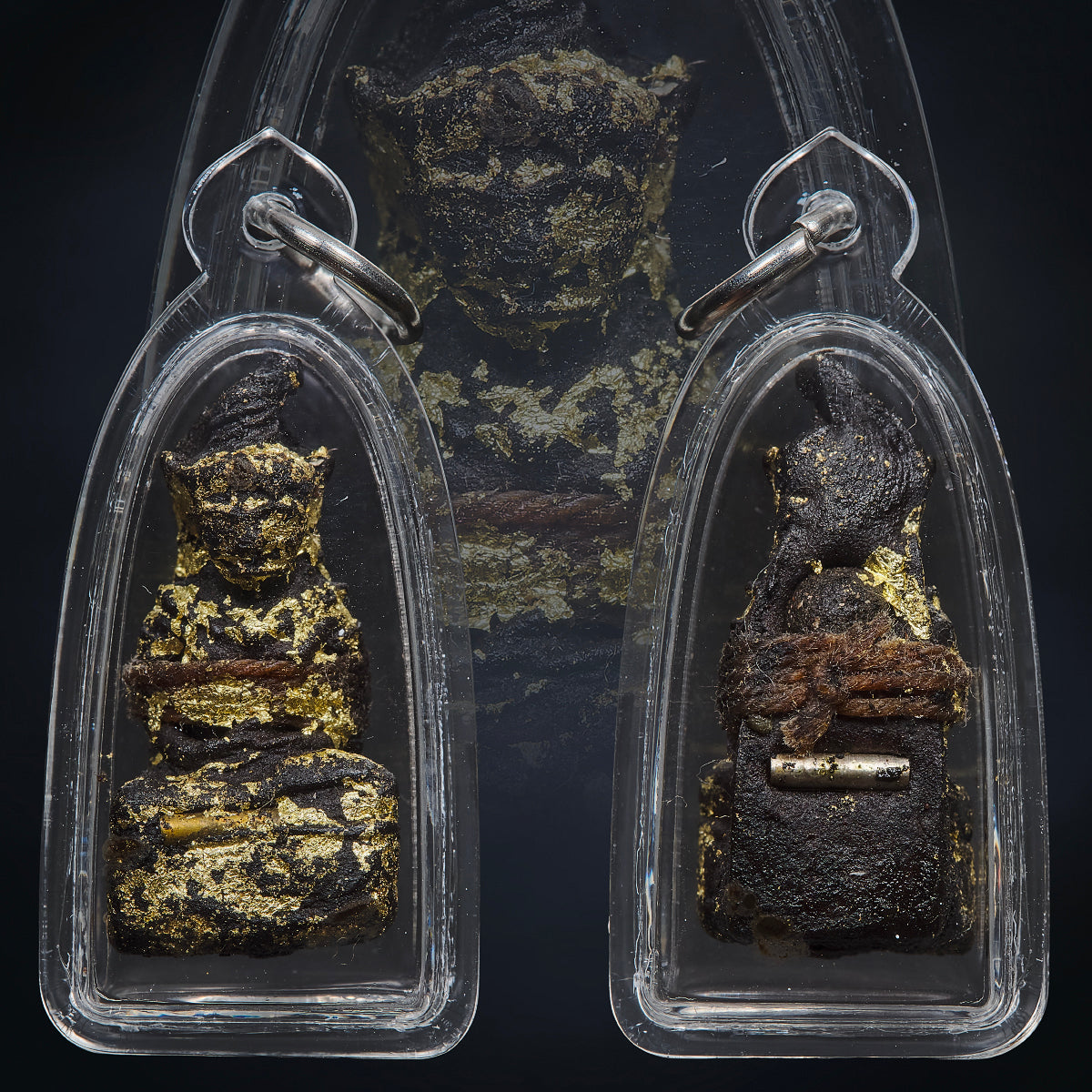
This Ngan Naman Dum dates to B.E. 2510 (1967) and measures approximately 2 cm. The compact standing Ngan is formed from a dark Barang compound with an aged black-brown surface and surviving traces of applied gold leaf. A cord or old binding remains around the central body, while a small takrut-like metal component is visibly embedded towards the lower portion of the reverse. The irregular surface, aged material and hand-finished construction are consistent with the individually prepared character of the batch. The artifact is protected within a fitted clear plastic casing.
Recommended Pairing
Because Ngan Naman Dum is strongly Barang in character, it may be paired with a mainstream Buddha-form amuletsuch as Phra Somdej or Phra Kring where the keeper prefers a more balanced everyday arrangement.
For commercial purposes, it can also accompany a Salika, with the Salika concentrating upon speech and customer communication while the Ngan supports Metta, opportunity and worldly assistance.
A dedicated wealth amulet may likewise complement the piece where financial movement is the principal intention.
Personal Notes
What makes Ngan Naman Dum particularly significant is that the batch was apparently never conceived as an ordinary commercial release.
Its creation arose from a problem.
Forest monks wanted to restore an abandoned temple, but repeatedly encountered the mysterious black oil and small presences within one of its rooms. Their own rites had not resolved what they were experiencing, leading them to seek Por Sala Tan's assistance.
Por Sala Tan interpreted what remained there through a very different branch of wiccha.
Instead of simply attempting to drive the Mini Ngans away, he prepared the necessary materials and worked with them individually, ultimately producing 99 pieces.
Those pieces were then distributed amongst the monks and villagers connected with the ceremony, while the remaining examples passed to Ac Tum and Ac Lek.
The larger Bucha said to remain at the temple is especially important to the story, because it links the portable artifacts back to the place and ceremony from which they originated.
For me, this is what distinguishes Ngan Naman Dum within Por Sala Tan's work.
It was not a batch created first and given a story afterwards; according to its lineage history, the event itself was the reason the batch came into existence.
-
Free Shipping for Singapore| $15 Worldwide | $60 USA For Items Below $350