
OOBThaiAmulets
Por Sala Tan
Por Sala Tan
Couldn't load pickup availability
PST02
Prai Som Wang
Por Sala Tan
4cm
Barang Artifact
Sacred Craftsmanship
Prai Som Wang is one of the more unusual spirit-based artifacts associated with Por Sala Tan's earlier years of travelling through the northern and border regions.
Each artifact was individually carved from selected Graduk and assembled through ritual preparation. Natural variations in the Graduk, ageing, surface texture, form and sacred-rope bindings therefore make every surviving Prai Som Wang unique.
Personal Experiences Shared by Luksits
I first came across this particular Prai Som Wang while looking through some of the personal artifacts that Ac Lek had kept for many years.
Among the different pieces in his collection, this one immediately caught my attention.
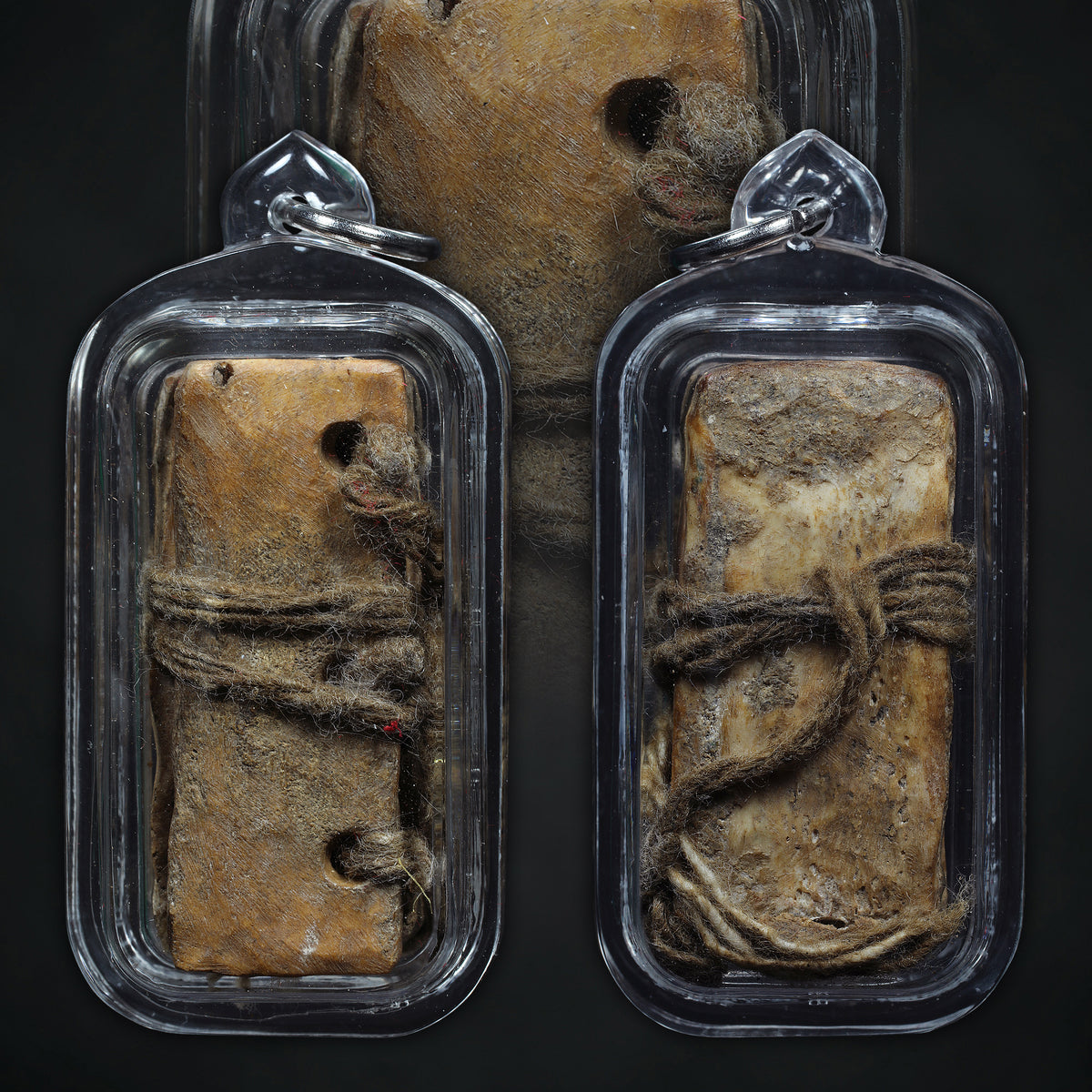
There was no elaborate carving and nothing outwardly designed to impress. What I saw was simply an old rectangular piece of Graduk, visibly aged and tightly bound with sacred ropes.
Its simplicity made me curious.
Ac Lek then explained that the Graduk had been collected by Por Sala Tan during his early travelling years and had subsequently been made into a sealed container for an unknown relic.
According to him, the relic inside was regarded as immensely strong, particularly for wishing and wealth fetching.
What made the story even more interesting was that Por Sala Tan had specifically told his luksits never to open the container.
The sacred ropes were part of the binding ritual. Removing them merely to discover what was hidden inside would break the original arrangement Por Sala Tan had deliberately created.
For me, this became one of the most intriguing aspects of Prai Som Wang.
Many sacred artifacts reveal their important materials openly. This one does the opposite.
Its most important component remains hidden.
Summary
Prai Som Wang is a rare sealed spirit artifact created by Por Sala Tan from selected Graduk collected during his earlier travels.
Rather than carving the material into a conventional sacred image, Por Sala Tan transformed the Graduk into a small ritual container.
An unknown relic was placed inside through a specific ritual intended to house and contain its spiritual presence. The container was then closed and bound with sacred ropes.
According to Ac Lek, the relic within was especially valued for wish fulfilment, wealth fetching and favourable fortune.
Only certain portions of the original Graduk could be used, limiting the number Por Sala Tan was able to make.
Its name, Prai Som Wang, is particularly fitting to the character attributed to the artifact: a Prai associated with helping the keeper towards the fulfilment of hopes and wishes.
Historical Background
Prai Som Wang
Within Thai occult traditions, Prai is a broad term whose meaning varies considerably between masters and lineages.
Not every Prai artifact follows the same construction, and not every spirit-based object is intended for the same purpose.
Some are directed towards Saneh.
Others concern protection, warnings or communication.
Prai Som Wang belongs more closely to the tradition of wish fulfilment and the movement of fortune.
The name Som Wang — carries the sense of having one's hopes fulfilled or obtaining what one has wished for.
This does not necessarily mean that every request is expected to manifest immediately. Within the traditional understanding of such objects, the Prai may instead assist by bringing opportunities, helpful circumstances or unexpected openings through which an objective becomes possible.
The unusual aspect of Por Sala Tan's Prai Som Wang is its physical form.
There is no visible spirit image.
Instead, the artifact itself is a sealed housing.
The spirit or relic is concealed within the Graduk, making containment rather than representation the central idea behind the object.
Origins of the Materials
According to Ac Lek, Por Sala Tan obtained the Graduk during his early years of travelling through different regions.
This period was important in the development of his practice. Travelling brought him into contact with remote communities, monks, Lersi practitioners, local ritual specialists and materials that were difficult to encounter within a single temple or village.
The precise origin of this particular Graduk was not disclosed in the surviving account.
What was remembered was that only specific sections could be used.
Por Sala Tan examined and selected those portions suitable for carving into the small containers. The limited amount of usable material naturally restricted production.
Inside the Graduk container is the second and most important component.
Its identity remains unknown.
Ac Lek described it simply as an exceptionally strong relic associated with wishing and wealth fetching.
Por Sala Tan himself instructed that the container should remain closed. For this reason, identifying the contents through physical examination would contradict the way the artifact was originally intended to be preserved.
The unknown relic should therefore remain exactly that — unknown and sealed.
Ritual
Prai Som Wang required a specific method of preparation because Por Sala Tan was not simply attaching a relic to an amulet.
He was creating a housing for a spiritual presence.
First, an appropriate section of Graduk had to be selected.
The material was then carefully worked into a small container with an internal chamber capable of receiving the chosen relic.
The unknown relic was placed within this cavity as part of the ritual.
According to the history passed down through Ac Lek, Por Sala Tan performed a specific ceremony to invite, contain and stabilise the spirit within the prepared Graduk vessel.
Only after this process was completed could the container be closed.
Sacred ropes were then wound around the exterior and tied firmly into place.
The binding therefore performed two functions.
Physically, it prevented the container from opening.
Ritually, it represented the sealing and containment of the spiritual force within.
This explains Por Sala Tan's instruction not to untie or dismantle Prai Som Wang. The rope is not packaging surrounding the artifact.
The binding is part of the artifact.
Blessings and Effects
The principal quality associated with Prai Som Wang is wish fulfilment.
The keeper traditionally approaches the piece with a clear intention or objective, particularly when seeking improvement in practical circumstances.
Wealth Fetching is another important aspect. Rather than representing wealth already possessed, this concerns drawing opportunities, transactions, assistance or circumstances through which financial improvement may occur.
Maha Lap relates to greater fortune and unexpected beneficial opportunities.
Chok Lap concerns fortunate openings — occasions when circumstances unexpectedly move in the keeper's favour.
Prai Som Wang may also be approached for opportunity and obstacle clearing, particularly when the desired objective appears difficult to reach through the present path.
There is an additional symbolism created by the physical construction.
The relic is placed inside.
The Graduk surrounds it.
The sacred ropes bind the container.
Everything is directed towards holding rather than dispersing.
Modern Application
Prai Som Wang is most naturally approached when the keeper has a specific objective rather than an undefined desire for general luck.
For someone in business, the wish might concern an important opportunity, financial improvement, a new customer or the successful development of a project.
For someone facing a difficult period, the intention may instead concern finding a path through an obstacle or receiving the opportunity needed to change circumstances.
Its wealth-fetching character also makes it relevant to entrepreneurs, salespeople and those whose income depends upon opportunities rather than a fixed salary.
However, the physical artifact itself should require very little handling.
The original sacred ropes should be preserved.
There is no need to investigate the internal chamber, remove the binding or attempt to expose the relic.
The most appropriate way to preserve Prai Som Wang is exactly as Por Sala Tan completed it.
Physical Details
Prai Som Wang takes the form of a compact rectangular Graduk container, individually shaped and prepared by hand.
The material displays substantial natural ageing, with tones ranging from warm tan and cream to darker brown areas. Natural pores, surface wear and irregular textures remain visible throughout.
Small openings associated with the original construction can also be seen.
Most distinctive are the old sacred ropes wound around the body of the container. The fibres show considerable age, with multiple turns and knots remaining intact.
One side displays a comparatively smoother tan surface, while the opposite face reveals a rougher, more weathered texture with lighter areas of exposed Graduk.
The artifact is presently protected within a fitted clear casing, allowing the original container and sacred bindings to remain undisturbed.
The relic itself cannot be seen.
That is exactly how the piece was intended to remain.
Recommended Pairing
Phra Sivali is particularly appropriate where the keeper's wishes concern livelihood, provisions, business opportunities or financial stability.
A Nang Kwak may complement Prai Som Wang for shopkeepers and business owners, with Nang Kwak traditionally directed towards customer attraction while Prai Som Wang remains focused upon wishes and favourable opportunities.
A Salika can be useful where fulfilment of the objective depends heavily upon communication, negotiation or gaining the cooperation of other people.
For a stronger Buddhist foundation, Phra Somdej provides Baramee, composure and spiritual balance alongside the more esoteric character of Prai Som Wang.
Personal Notes
I came across this Prai Som Wang while looking through Ac Lek's personal collection of artifacts.
It was immediately different from many of Por Sala Tan's other pieces.
There was no recognisable deity.
No elaborate carving.
No obvious Takrut displayed across the surface.
There was simply an old piece of Graduk, fashioned into a container and tightly bound with sacred ropes.
After Ac Lek explained its history, that simplicity became its most interesting characteristic.
Por Sala Tan had collected the Graduk during his early travelling years. Only particular sections could be used. He carved those selected portions into containers, installed an unusual relic within them and performed a specific ritual to contain the spirit inside.
Very few could be produced.
And then there was Por Sala Tan's instruction:
Do not open it.
For a collector, curiosity naturally creates the temptation to discover what lies inside.
But with Prai Som Wang, opening the container would mean destroying part of what makes the artifact what it is. The old ropes are not simply holding two pieces of Graduk together. They are the surviving physical evidence of the original binding ritual.
The unknown relic does not need to be exposed to make the piece more interesting.
Its identity was deliberately concealed.
Its presence was ritually contained.
Its purpose was remembered as wishing and wealth fetching.
And its name preserves that purpose particularly well:
Prai Som Wang — the Prai associated with the fulfilment of one's hopes and wishes.
-
Free Shipping for Singapore| $15 Worldwide | $60 USA For Items Below $350